Strongly coupled Skyrme-Faddeev-Niemi hopfions
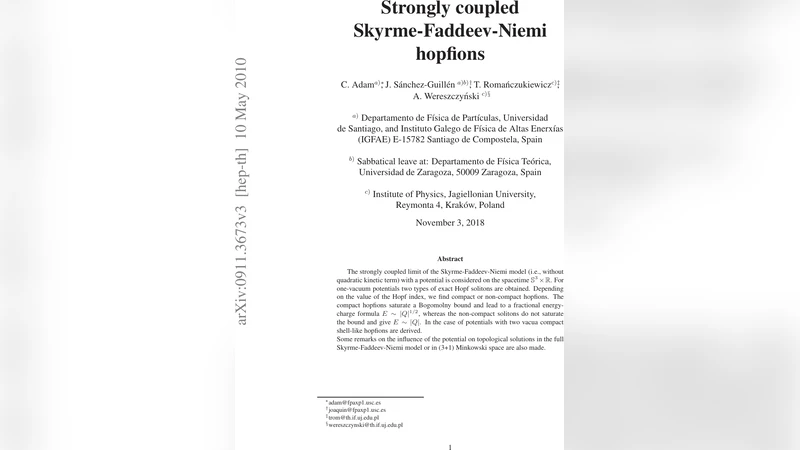
The strongly coupled limit of the Skyrme-Faddeev-Niemi model (i.e., without quadratic kinetic term) with a potential is considered on the spacetime S^3 x R. For one-vacuum potentials two types of exact Hopf solitons are obtained. Depending on the value of the Hopf index, we find compact or non-compact hopfions. The compact hopfions saturate a Bogomolny bound and lead to a fractional energy-charge formula E \sim |Q|^{1/2}, whereas the non-compact solitons do not saturate the bound and give E \sim |Q|. In the case of potentials with two vacua compact shell-like hopfions are derived. Some remarks on the influence of the potential on topological solutions in the full Skyrme-Faddeev-Niemi model or in (3+1) Minkowski space are also made.
💡 Research Summary
The paper investigates the Skyrme‑Faddeev‑Niemi (SFN) model in the extreme “strong‑coupling” limit where the conventional quadratic kinetic term is completely omitted, leaving only the quartic Skyrme term and a potential. The authors work on the compact spacetime manifold S³ × ℝ, which provides a finite volume and well‑defined boundary conditions, and they study two classes of potentials: (i) a single‑vacuum potential V₁ = μ²(1 − n₃) with a unique minimum at n₃ = 1, and (ii) a double‑vacuum potential V₂ = μ²(1 − n₃²) with minima at n₃ = ±1.
The field is a unit three‑vector n(x) (or equivalently a complex projective coordinate u∈ℂP¹) mapping S³ into S². The topological charge is the Hopf invariant Q, which can be expressed as an integral of the Chern‑Simons three‑form built from the pull‑back of the area form on S². In the strong‑coupling regime the energy functional consists solely of the Skyrme term (∂ n × ∂ n)² and the potential, and it admits a Bogomolny‑type bound of the form
E ≥ C |Q|^{1/2},
where the constant C depends on the Skyrme coupling β and the potential strength μ.
To obtain explicit solutions the authors impose a spherically symmetric ansatz on S³:
u(χ,θ,φ) = f(χ) e^{i m θ + i n φ},
with integers m, n and Hopf charge Q = mn. The field equation reduces to a nonlinear ordinary differential equation for the radial profile f(χ). The analysis reveals two qualitatively different families of solutions for the single‑vacuum potential V₁.
-
Compact hopfions appear when the Hopf charge is modest. The profile f(χ) is non‑trivial only inside a finite polar angle χ₀; beyond χ₀ the field sits exactly in the vacuum n₃ = 1. This “compacton” has a sharp but smooth edge (f′(χ₀)=0) and saturates the Bogomolny bound, giving the energy law
E = C |Q|^{1/2}.
Thus the energy grows only as the square‑root of the topological charge, a striking deviation from the linear scaling typical of many soliton models. -
Non‑compact hopfions arise for larger Q. In this regime the compact region expands to fill the whole S³, and the profile decays smoothly to the vacuum without a finite cutoff. The Bogomolny bound is no longer saturated; the energy scales linearly,
E ≈ β |Q|,
reflecting the dominance of the Skyrme term over the potential in the bulk of the configuration.
When the double‑vacuum potential V₂ is used, the model supports a third class: shell‑like compact hopfions. Here the field interpolates between the two vacua, forming a thin spherical shell where the transition occurs. The interior and exterior of the shell are each in a distinct vacuum, while the shell itself carries the Hopf charge. These configurations also saturate the Bogomolny bound and obey the same √|Q| energy law as the single‑vacuum compactons.
The authors discuss the implications of these findings for the full SFN model (i.e., with the quadratic kinetic term restored) and for realistic (3+1)‑dimensional Minkowski space. They argue that the presence of a potential can dramatically alter the balance between the quadratic and quartic terms, allowing stable Hopf solitons even when the quadratic term is absent. In the full model, however, the Bogomolny structure is typically broken, and one expects the conventional linear energy‑charge relation E ∝ |Q| to re‑emerge. Nonetheless, the compacton solutions identified here provide valuable analytic benchmarks and suggest that, in physical settings where a suitable potential is present (e.g., in condensed‑matter systems with anisotropy or in effective field theories of QCD), energetically efficient, finite‑size Hopf solitons could exist.
In summary, the paper delivers:
- Exact analytic Hopf soliton solutions in the strong‑coupling SFN model on S³ × ℝ.
- A clear classification into compact (Bogomolny‑saturating, E ∝ |Q|^{1/2}) and non‑compact (E ∝ |Q|) families for a single‑vacuum potential.
- The discovery of shell‑like compact hopfions for a double‑vacuum potential, also obeying the √|Q| law.
- Insight into how potentials influence soliton stability, energy scaling, and the possible extension of these results to the full SFN model and to flat Minkowski spacetime.
These results enrich the theoretical understanding of topological solitons in higher‑derivative field theories and open new avenues for exploring compact, low‑energy Hopf configurations in both high‑energy and condensed‑matter contexts.
Comments & Academic Discussion
Loading comments...
Leave a Comment