Suzaku broadband spectroscopy of Swift J1753.5-0127 in the Low-Hard State
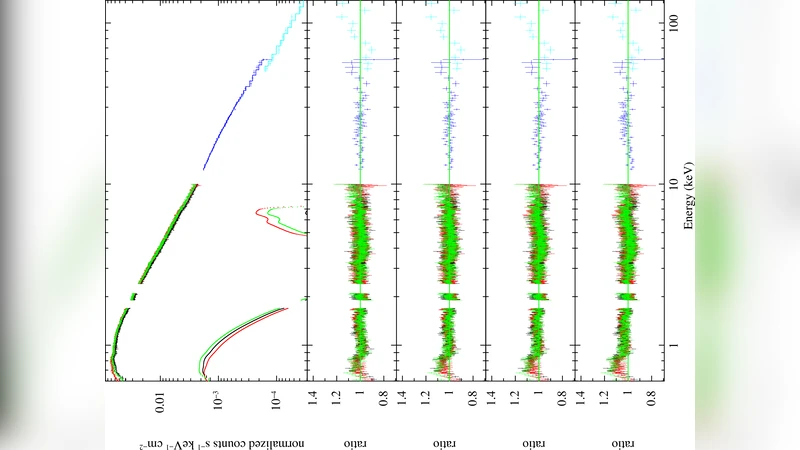
We present Suzaku observations of the Galactic black hole candidate Swift J1753.5-0127 in the low-hard state. The broadband coverage of Suzaku enables us to detect the source over the energy range 0.6 – 250 keV. The broadband spectrum (2 – 250 keV) is found to be consistent with a simple power-law (gamma \sim 1.63). In agreement with previous observations of this system, a significant excess of soft X-ray flux is detected consistent with the presence of a cool accretion disc. Estimates of the disc inner radius infer a value consistent with the ISCO (R_{in} \lesssim 6 R_g, for certain values of, e.g. N_H, i), although we cannot conclusively rule out the presence of an accretion disc truncated at larger radii (R_{in} \sim 10 - 50 R_g). A weak, relativistically-broadened iron line is also detected, in addition to disc reflection at higher energy. However, the iron-K line profile favours an inner radius larger than the ISCO (R _{in} \sim 10 - 20 R_g). The implications of these observations for models of the accretion flow in the low-hard state are discussed.
💡 Research Summary
This paper presents a comprehensive Suzaku observation of the Galactic black‑hole candidate Swift J1753.5‑0127 while it was in the low‑hard state (LHS). By exploiting the broad energy coverage of Suzaku’s XIS (0.6–10 keV), HXD‑PIN (10–70 keV) and HXD‑GSO (70–250 keV), the authors obtained a continuous spectrum from 0.6 to 250 keV with an effective exposure of roughly 100 ks. Initial fits with a simple absorbed power‑law (TBabs*powerlaw) describe the 2–250 keV band well (photon index Γ≈1.63), but leave a pronounced excess below ~2 keV. Adding a multicolour disc blackbody (DISKBB) resolves this soft excess, yielding an inner disc temperature kT_in≈0.21 keV. The inferred inner disc radius R_in depends sensitively on the assumed hydrogen column density (N_H) and inclination (i). For N_H≈2×10^21 cm⁻² and i≈30°, R_in is ≲6 R_g, essentially at the innermost stable circular orbit (ISCO). If higher N_H (≈3×10^21 cm⁻²) and larger i (≈70°) are adopted, the radius expands to 10–30 R_g. Thus the data cannot unambiguously decide whether the disc reaches the ISCO or is modestly truncated.
A weak Fe Kα emission line is detected near 6.4 keV with an equivalent width of ~30 eV and a width σ≈0.38 keV. Modelling the line with the relativistic LAOR profile indicates an emitting radius of ~12–20 R_g and an inclination of ~40°, suggesting that the line originates from a region somewhat farther out than the innermost disc. The high‑energy spectrum shows a modest Compton hump, and fitting with a self‑consistent reflection model (REFLIONX) gives a reflection fraction Ω/2π≈0.25, consistent with the low‑reflection expectations for the LHS.
The authors discuss the implications for accretion geometry. Classic advection‑dominated accretion flow (ADAF) models predict a disc truncated at hundreds of gravitational radii and negligible reflection, which conflicts with the observed cool disc component, modest reflection, and relativistically broadened iron line. Instead, a hybrid picture—where a truncated thin disc coexists with an inner hot flow or a compact “lamppost” corona—better accommodates the data. The discrepancy between the inner radius inferred from the disc continuum (potentially ISCO‑scale) and that derived from the iron line (larger) may indicate that the line is produced primarily in the outer parts of the disc or in the interface between disc and corona.
In summary, Suzaku’s broadband spectroscopy demonstrates that even in a canonical low‑hard state Swift J1753.5‑0127 retains a cool accretion disc and exhibits weak but relativistically broadened reflection features. These findings challenge models that invoke a completely recessed disc in the LHS and support scenarios where the disc remains relatively close to the black hole while a hot, possibly outflowing corona dominates the high‑energy emission. Future high‑resolution missions such as XRISM and Athena will be crucial for disentangling the disc‑corona geometry and for tracking rapid spectral variability, thereby refining our understanding of accretion physics in low‑luminosity black‑hole binaries.