Disk-outflow coupling: Energetics around spinning black holes
The mechanism by which outflows and plausible jets are driven from black hole systems, still remains observationally elusive. Notwithstanding, several observational evidences and deeper theoretical insights reveal that accretion and outflow/jet are s…
Authors: Debbijoy Bhattacharya, Shubhrangshu Ghosh, Banibrata Mukhopadhyay
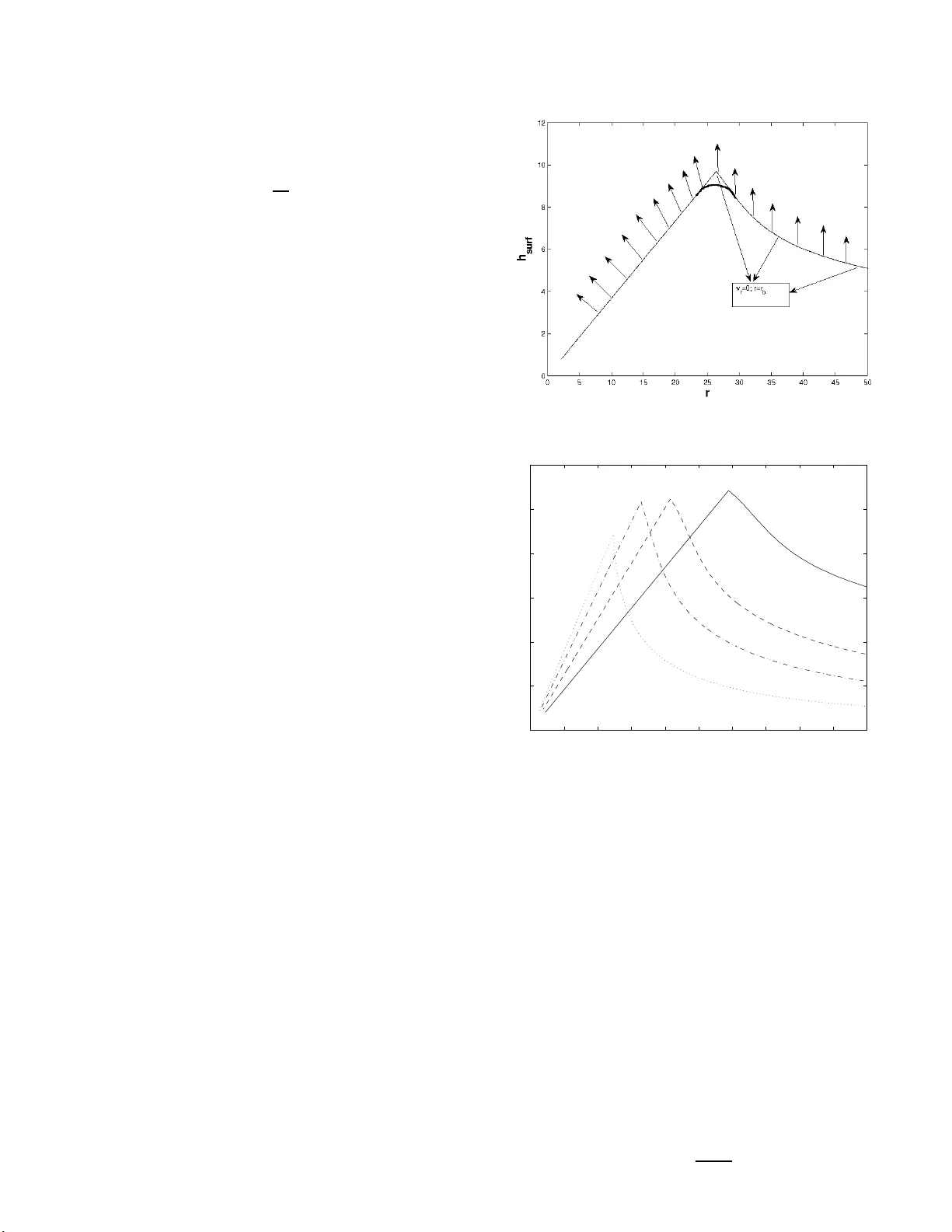
Draft version September 6, 2018 Preprint typeset using L A T E X style emulateap j v. 03/07/07 DISK-OUTFLOW COUPLING: ENERGETICS AR OUND SPINNING BLACK HOLES Debbijoy B ha t t achar y a 1 , Shubhrangshu Ghosh 2 , Bani bra t a Mukhop adhy a y 3 Astronomy and Astroph ysics Programme, De partmen t of Ph ysics, Indian Institute of Science, Bangalore-560012, In dia. Dr aft ve rsion Septemb er 6, 2018 ABSTRA CT The mechanism b y which o utflows and plausible jets are driven from black ho le systems, still re - mains observ ationally elusiv e. Notwithstanding, several observ atio nal evidences and deep er theore tica l insights r e veal that ac cretion and outflow/jet are strongly correlated. W e mo del an advectiv e disk- outflow coupled dynamics, incorp ora ting explicitly the vertical flux. Int er-connec ting dynamics of outflow and accretio n essentially upholds t he cons erv ation laws. W e investigate the prop erties of the disk-outflow surfac e and its stro ng dep endence on the r otation parameter of the black hole. The energetics of the disk-outflow strongly dep end on the mass, accretion rate and spin of the black holes. The mo del clearly shows that the outflo w p ow er extracted from the disk increases strong ly with the spin of the black hole, infer ring that the p ow er of the o bserved a strophysical jets has a propor tional corres p o ndence with the spin of the cen tral ob ject. In case of blazars (BL Lacs and Flat Sp ectrum Radio Quasars ), most of their emission are believed to be or iginated from their jets. It is observed that B L Lacs are rela tively lo w luminous than Flat Sp ectrum Radio Quasar s (FSR Qs ). The lumi- nosity migh t be link ed to the power of the jet, which in turn reflects that the n uclea r r egions of the BL Lac ob jects ha ve a r elatively lo w spinning black hole compared to that in the case of FSRQ. If the ex tr eme gra vity is th e source to pow er str ong o utflows and jets, then the spin of the black hole, per haps, might b e the fundamental parameter to account for the o bs erved astrophysical pro cess e s in an a ccretion p owered system. Subje ct he adings: accretio n, accretion disks — black hole physics — hydrodyna mics — galaxies: a ctive — galaxies: jets — X-rays: binaries 1. INTR ODUCTION High resolution observ ations show stro ng outflo ws and jets in black hole accreting systems, b oth in active galac- tic nuclei (A GNs) o r q ua sars (Beg elman et al. 1984; Mirab el 20 03) and microqua sars (SS433, GRS 1 915+1 05) [Margon 198 4; Mir ab el & Rodrig uez 1 994, 199 8]. Ex- tragala ctic r a dio source s sho w evidenc e of strong jets in the vic inity o f spinning black holes (Meier et a l. 2001 ; Meier 2002). O utflows a re also observed in neutron star low mass X-ra y binaries (LMXBs) (F ender et al. 2 004; Migliari & F ender, 2006) and a lso in young s tellar ob jects (Mundt 1985). It has b een arg ued (Ghosh & Mukhopad- hy ay 2009 ; Ghosh et al. 2010; hereinafter GM09, G10 resp ectively , and references therein) that outflows a nd jets ar e more prone to emanate from strong advective accretion flows; the s aid paradigm is more susceptible for super -Eddington a nd sub-Eddington accretio n flows. How ever, the ex a ct (globa l if any) mechanism of forma - tion o f the jet, its collimation, accelera tion, comp ositio n from the accretio n p ow er ed systems still remain incon- clusive. Extensive works have b een pursued on the or igin of outflow/jet, since the pioneering work of Blandford & Pa yne (1 982) (e.g. Pudritz & Norman 1986; Contopo u- los 1995; Ostriker 1997 ), where the author s used a self- similar a pproach to demonstrate that the p oloida l com- po nent o f the mag ne tic field can be seemingly used to launch outflowing matter from th e disk. The formation of the jet is directly related to the efficacy of extrac- 1 E-mail: deb bijoy@ph ysics.i isc.ernet.in 2 E-mail: sghosh@ph ysics. iisc.ernet.in 3 E-mail: bm@ph ysics.iisc.ernet.in tion o f angular momentum a nd energy from the accr e- tion disk. Physical understanding o f the h ydro magnetic outflows fro m disks has b een developed from magnetohy- dro dynamic (MHD) simulations (Shibata & Uchida 198 6 ; Ust yogov a et al. 1999; De Villiers et al. 2005; Haw- ley & Krolik 2006) b oth in non- relativistic as well as in relativistic r egimes, mostly in the Kepleria n pa radigm. How ever, the large Lorentz factors as well as F araday rotation measures suggest that the observed VLBI jets in qua sars and active gala xies are in the Poyn ting flux regime (Homan et a l. 20 0 1; Lyutikov 2006). On the other front, strong ra diation pr essure can serve as a dif- ferent mec ha nism to effuse o utflows/jets. This is likely to o ccur when the accr etion r ate is sup er-E ddington or sup er-critica l (F abr ik a 200 4; Beg elman et al. 2 006; GM09,G10 and references therein) a nd the accretion disk is precis ely “r adiation trapp ed” as in ultra-luminous X- ray (ULX) sour ces. It has been confirmed by r adiation hydrodynamic simulation a t sup er-cr itica l accr etion rate (Okuda et a l. 2009) as well to explain luminosity and mass o utflow rate of rela tivistic outflows from SS433. The under-luminous accr eting s ources, having high sub- critical accretion flow, were explained b y an advection dominated accr etion flow (AD AF) mo del (Narayan & Yi 1994). The promising outcome of this model lies in the large p ositive v alue of the Berno ulli para meter becaus e of the small ra diative energy lo s s. It leads to conceive that the ga s in the inflowing disk is susc e ptible to escap e, leading to str ong unbounded flows in the form of o utflows and j ets. This also signifies that even in the a bsence of magnetic field and r adiation pressur e, o utflows ar e pla u- sible from stro ngly advective accretio n flow if the system is allowed to p er turb. Nevertheless, the definitive under - 2 standing of the origin of outflows/jets is s ill unkno wn. It r emains one o f the most comp elling problems in high energy a strophysics. Whatever might b e the reaso n for the origin of o ut- flow and then jet fr o m the disk, o ne asp ect is how ever definite that strong outflows pro ducing relativis tic jets are powered b y extreme g r avit y . Although se ems para- doxical, the strength and the length scale of observed astrophysical jets v a ry directly with the strength of the central gravitating p o ten tial. Observ ationally , it is evi- dent that strong o utflows and relativistic jets ar e more powerful in observed A GNs and quasa rs, ha rb oring su- per massive blac k holes, compared to that in bla ck hole X-ray binaries (XRBs). In addition, the jets obser ved in A GNs and quas a rs ha ve greater length scale compar ed to that seen in stellar mass bla ck hole systems. One of the most imp or ta nt sig na tures of relativistic gravitation is the spin of the cen tra l o b ject. It is pr esumably believed that the spin (practically sp ecific angular momentum) of the neutro n star is less than tha t of a black ho le, and th us the obser ved jet fr o m black ho le s is muc h stronger and p ow e r ful than that of neutro n s ta r sour ces. In early , Blandford & Zna jek (197 7) demonstra ted that if there is a magnetic field asso ciated with the black hole due to threa ding of ma gnetic field lines from the dis k and the ang ular momentum of the K err black hole is la rge enough, then the energy and the ang ular momentum can be e x tracted from the underly ing black hole by a purely electromagne tic mechanism, which ca n thus b e exp ected to pow er the jet in an A GN. These imply that the spin might play a significant r ole in p ow er ing jets, b oth in micro quasa rs a nd in AGNs, rather, it can act a s a fun- damental parameter in an a ccretion powered s y stem. Most of the studies o f accretio n disk and studies of re- lated outflow/jet hav e b een evolved separately , assuming these tw o apparently to be dissimilar ob jects. How ever, several obser v ational inference s (for details see GM09, G10 and re fer ences therein) and improv ed understand- ing o f accretion flow and outflow reveal that accr etion and outflow/jet ar e strongly corr e la ted. The unifying scheme of disk and outflow is es sentially gov erned by con- serv ation laws; cons e rv ations of matter, energy and mo- men tum. Hence, in modeling the accretion a nd outflo w simult aneously in any a ccretion p owered system, follow- ing aspects should be taken int o account: (1) the effect of rela tivis tic central gravitational po tential including its spin, (2) prop er mechanism o f origin of o utflow/jet from the disk , (3 ) appropr iate hydrodyna mic equations (con- sidering that the acc reting gas b e trea ted as a contin uum fluid), capturing the infor mation ab out the intrinsic cou- pling b etw een inflow and o utflow which are gov er ned by the conserv ation laws in a strongly advectiv e paradig m. Recently , GM09, G10 made a n endeavor to explore the dynamics of the accretio n-induced o utflow aro und black holes/compa ct ob jects in a 2.5-dimensiona l par adigm. The a uthors formulated the disk-outflow co upled model in a more self-consis ten t wa y by solving a co mplete set of coupled partia l differential hydro dynamic eq ua tions in a general advectiv e regime through a self-simila r appro ach in an a xisymmetric, cy lindr ical co ordina te sy stem. They explicitly incor po rated the information of the vertical flux in their mo del. Howev er , they restricted their study to Newtonian regime, th us negating the requisite effect of general-r elativity , esp ecially the effect of spin of the cen- tral o b ject. Based on the model, the authors computed the mass outflow r ate a nd the p ow er extracted by the outflow from the disk self-consis tent ly , without prop os- ing a ny pr ior r elation betw een the inflow and o utflow. In the pr esent pap er , we prop o se a new mo del for the accretion-induced outflow by extending the work of GM09, G10, by incor po rating the general rela tivis tic ef- fect of the central p otential without limiting o urselves to a self-similar regime. As the definitiv e mec hanism of launching of outflows/jets is still ev a s ive, we do not em- brace any sp ecific mechanism of outflow like inclusion of the magnetic field in to our model e q uations. Nev erthe- less, the impo r tance o f the magnetic fie ld can not b e, in principle, disca r ded to e x plain the launching and col- limation of jets off the accretion disk. Here, owing to our inability to so lve coupled partial differential MHD equations in a 2.5-dimensional a dvective regime, w e ne- glect the influence of the magnetic field in our mo de l equations. H ow ever, the implicit coupling b etw een the inflow and outflow, dictated by the conse r v ation equa - tions, hav e been taken into a ccount appropria tely . W e arrang e o ur pap er as follows. In the next section, we present the formulation o f our mo del. The section 3 de- scrib es the co mputational pro cedure to solve the model equations o f the accretion-induced outflow. In sec tio ns 4 and 5, w e study the dy namics and the energetics of the flow resp ectively . Finally , we end up in s ection 6 with a summary a nd discussion. 2. MODELING THE COR R ELA TED DISK-OUTFLOW SYSTEM W e fo rmulate the disk- o utflow c o upled mo del by con- sidering a geometrically thick accretion disk, which is strongly advectiv e as str ong outflows/jets are more likely to eject from a thick/puffed up r egion of the a ccretion flow (GM09,G1 0). The vertical flo w is explicitly included in the sys tem. The basic feature s of the model are similar to that in GM09. W e adopt the cylindrical co o rdinate system to describ e a steady , axisymmetric accretio n flow. The dynamical flow parameters, namely , radial v elo city ( v r ), sp ecific ang ular momentum ( λ ), vertical velocity or outflow v elo city ( v z ), adia batic sound sp eed ( c s ), mass density ( ρ ) and pres sure ( P ) dep end b oth on radial and vertical co ordina tes. W e have a lready highlighted the impo rtance o f the spin o f black hole to power the o ut- flow/jet and its pr esumed r e la tive effect on the obser- v ation of v arious AGN classes. Th us we ha ve included the effect of the spin in o ur mo del. As the spin of the black hole is a signature of pure general r elativity , i.e., Einstein’s gravitation, its effect on the a ccretion flow, esp ecially in the inner region of the disk, is mimicked ap- proximately with the use of pseudo-gener al-rela tivistic or pseudo-Newtonian po ten tial (PNP). Because of the disk-outflow system to b e g eometrically thic k and the flow to b e 2.5-dimensiona l (no t co nfined to the equato- rial plane), we use the PNP of Gho sh & Mukhopadhya y (2007), which is a pseudo-Newtonian vector p otential, to capture the inner dis k prop erties of the a ccretion flow around a Ker r black hole appr oximately . A t the first instan t we neglect the effect of viscos ity in our system. O ne o f the reaso ns b ehind it is the unav ail- ability of the effective computational technique to solve coupled partial differen tial viscous h ydro dynamic conser- v ation equations for the compres s ible flow. T o make the 3 inviscid ass umption more arguable, it can also b e noted that the ang ular momentum transp or t in the accre tio n flow, for which the necessity o f turbulent v iscosity is in- vok ed, can a lternatively tak e place pure ly by outflow. At this extreme end, the outflow extracts angular momen- tum from the disk allowing the matter to get a c c reted tow ar ds the black hole a nd hence the inviscid assump- tion ca n b e a do pted. This is in essence similar to the Blandford & P ayne (1 982) mechanism to e x tract energ y and angular momen tum from the magnetized disk, whe r e the extractio n of the a ng ular momentum and energ y is essentially done b y the outflo w, and not due to the vis- cous dissipa tion. The outflow or iginates fro m just ab ov e the equatoria l plane o f the disk a nd this low er b oundary is main tained at z = 0, when v z = 0 , unlik e other w or k where the outflow is h yp othesized to effuse out from the disk sur fa ce (e.g. Xie & Y uan 2008 ). Our model is e f- fectively v alid o nly in the region where disk and outflow are co upled, i.e. the re g ion from where essentially the outflow is emanated from the accretion flow. Hence our study will re ma in confined within this predefined region. F urther, we neglect the con tribution of the magnetic field as argued in § 1 . W e c ir cumv ent the idea of vertical integration o f the flow equatio ns . The v alidit y a nd the reliability of the height integrated eq ua tions is normally gratifying in the geometrically thin limit. In that circumstances , the flow velocities are likely to b e more or les s indepe ndent of the disk sca le-height, which is not the case o f the present paradigm of interest. W e further consider that the disk to b e non- s elf-gravitating, assuming that the mass of the disk to b e m uch less than that of the bla ck hole. The radial and vertical co or dina tes are expressed in units of GM / c 2 , flow velo cities in c , time in GM /c 3 and the sp e- cific angular moment um in the unit of GM /c . Here G , M and c ar e gravitational consta nt, mass of the black hole and spee d of light resp ectively . The steady state, axisymmetric disk-o utflow coupled equations in cylindri- cal geometry in the inviscid limit a re then as follows. (a) Mass tra nsfer: 1 r ∂ ∂ r ( rρv r ) + ∂ ∂ z ( ρv z ) = 0 , (1) where the first term is the signature of accr etion and the second term a ttr ibutes to outflow. As the outflow star ts from just ab ov e z = 0 surface, within the inflow reg ion itself, we mak e a reasonable h yp othesis that within the prescrib ed disk region the v ar iation of the dynamical flow parameters with z is muc h less than that with r , allowing us to choos e ∂ A/∂ z ≈ O ( A/z ); for any parameter A . Strictly sp eaking , the weak v a riation with z e ns ures that the outflow or iginating fr om the mid-pla ne o f the disk do es not disr upt the disk structure, and thus a llowing a smo oth accretion flow tow ar ds the bla ck hole. Thus Eqn. (1) then reduces to 1 r ∂ ∂ r ( rρv r ) + ρv z z = 0 . (2) (b) Ra dial momen tum balance: v r ∂ v r ∂ r + v z ∂ v r ∂ z − λ 2 r 3 + F Gr + 1 ρ ∂ P ∂ r = 0 , (3) where F Gr is ra dia l comp onent of the g r avitational force. As discussed ear lier, her e F Gr is the radial fo r ce cor re- sp onding to the PNP in cylindrical co ordinate system given by Ghosh & Mukho padhy ay (2007 ) co nt aining the information of spin of the bla ck hole. W ith the simila r argument a s a bove the equa tio n then reduces to v r ∂ v r ∂ r + v z v r − v r 0 z − λ 2 r 3 + F Gr + 1 ρ ∂ P ∂ r = 0 , (4) where v r 0 is the radia l v e lo cit y at the mid-plane of the disk. (c) Azim uthal momentu m ba lance: 1 r 2 ∂ ∂ r r 2 ρv r v φ + ∂ ∂ z ( ρv φ v z ) = 0 , (5) where v φ is the azimuthal velo city of the flow. The fir st term o f this equatio n signifies the radial transp or t of the angular momentum, w hile the second term describ es the extraction of a ngular momentum due to mas s lo ss in the outflow. If we conside r that the net angular mo men tum extracted by the outflow b e λ j , and the r emaining a ngu- lar momentum retained b y the disk λ d , then total angu- lar momentum λ = λ j + λ d can b e assumed to re ma in constant throughout the flow within our prede fined disk - outflow regio n by the vir tue of a n inviscid flo w. There- fore, λ = co nstant . (6) (d) V e rtical moment um balance: v r ∂ v z ∂ r + v z ∂ v z ∂ z + F Gz + 1 ρ ∂ P ∂ z = 0 , (7) where F Gz is the vertical comp one nt of the gravitational force, des c rib ed b y Ghos h & Mukhopadhya y (2007). F ol- lowing pr e vious arguments this r educes to v r ∂ v z ∂ r + v 2 z z + F Gz + 1 ρ P − P 0 z = 0 , (8) where P 0 is the pressure of the flo w at the mid-plane of the disk. If there is no outflo w, then v z = 0, and Eqn. (8) reduces to the well known hydrostatic equilibrium co ndi- tion in the disk, a nd the hydrostatic disk scale-height can be o btained. Similarly , one can cus tomarily extend the vertical mo men tum equation to compute the disk scale - height when ther e is an outflow coupled with the disk. Thu s we will use Eqn. (8) to obtain the sca le-height of the disk-outflow coupled sy s tem. W e can reasonably assume that at height h (i.e. at z = h ), the pressur e of the disk is m uch le ss c ompared to that at the equa torial plane to pre vent any disruption of the disk, p er mitting a stea dy struc tur e of accretion flow. The v ariation of density along z direction is appr oximately kept co nstant ( ρ 0 ∼ ρ ) which in turn means tha t the disk-o utflow cou- pled r egion is weakly stra tified. Considering the ab ov e facts, Eqn. (8) is simplified to obtain the scale-height as v r | h ∂ v z ∂ r h + v 2 z | h h + F Gz | h − P 0 hρ = 0 , (9) where h is thu s the the ro ot of the ab ov e transcendental equation. Th us E qns. (2 ), (4), (6) & (9) will s imultane- ously hav e to be solv e d to obtain the dynamics and the energetics of the a ccretion-induced outflow. 4 3. SOLUTION PROCEDURE AND THE DISK-OUTFLOW SURF A CE W e a ssume that the accre tio n flow follo ws an adiabatic equation of state P = K ρ 1+1 /n where n = 1 / ( γ − 1), n and γ are the p oly tropic and the adia batic indices re- sp ectively . Note that constant K carries the informa- tion of entrop y (e.g. Mukhopadhya y 2003 ) of the flow. Thu s for an adia batic flow, c s = ( γ P ρ ) 1 / 2 . In an ea r- lier work (GM09), a reaso nable assumption was made that h ∼ r / 2 , which can b e approximately accepted for a geometrically thick, 2.5-dimens io nal disk structure. P re- suming that the outflow velo city is not likely to exceed the so und sp eed a t the disk-o utflow surface (the outer bo undary of the accretion flow in the z directio n), we prop ose a simplified rela tion b etw een c s and v z as v z < ∼ 2( z r ) c s . (10) Hence, at z = h ∼ r / 2 , w e obtain v z < ∼ c s . (11) This implies that the outflow ca n ideally come o ut off the disk s urface which can appropria tely b e ter med as the sonic surface in the v ertica l direction. With this notion in mind let us generalize this particular scaling betw een v z and c s , per taining to our for ma lism a s v z = ı ( z r ) µ c s , (12) where ı and µ are the constants whic h will b e deter - mined by substituting Eqn. (1 2) in our mo del co nser- v ation equations des c rib ed in § 2. The index µ meas ur es the degree of subsonic na ture of the vertical flow within the disk-outflow coupled r egion (i.e. in be tw een the mid- plane a nd the surface of the accr etion flow). Generalizing the pro cedur e adopted in earlier works for 1.5 -dimensional disks (Chakra barti 1996 ; Muk ho pad- hy ay 20 03; Mukhopadhy ay & Ghosh 2 003), we solve Eqns. (2), (4 ), (6) & (9). Using Eqn. (12) along with Eqn. (6) and co mb ining Eqns. (2) & (4), we obtain ∂ v r ∂ r = λ 2 r 3 − F Gr + c 2 s r + ı z ( z r ) µ c s ( v r 0 − v r + c 2 s v r ) v r − c 2 s v r = N D . (13) Equation (13) shows that to gua r antee a s mo o th solution at the “critical p oint”, N = D = 0 . F rom the cr itical po int condition we obtain v r c = c sc , at r = r c . Here subscript c is referr ed to critical p o int. The radius r c is also called the “so nic radius” since no disturbance cre- ated within this ra dius ca n cr oss the ra dius (also known as sound horizon) and esca p e to infin ity . Conditions at critical/so nic radius give v r c = c sc = − ı 2 z ( z r c ) µ c s 0 c r c + ı 2 z z r c µ c s 0 c r c 2 + r c F Gr c − λ 2 c r 2 c 1 / 2 , (14) where c s 0 c = v r 0 c = ( r c F Gr 0 c − λ 2 c /r 2 c ) 1 / 2 , is the sound sp eed or the radial velocity of the flow at the sonic ra - dius in the disk mid-plane ( z = 0). F Gr c is the ra dial gravitational force at the sonic radius and F Gr 0 c is the corres p o nding v a lue in the disk mid-pla ne . Now at so nic lo catio n ∂ v r ∂ r = 0 / 0. Hence by applying l’Hospital’s rule, E qn. (13) reduces to ∂ v r ∂ r c = − 2 n v r c c sc −B + √ B 2 − 4 AC 2 A + v r c r c + ı z z r c µ c sc , ( 15) where A = F 1 ( r , z ) | c , B = F 2 ( r , z ) | c and C = F 3 ( r , z ) | c , are c omplicated functions o f r and z a t s onic lo catio n; F 1 , F 2 & F 3 hav e b een explicitly g iven in the app endix. Equations (13) and (15) a re then solv ed with an appro - priate b oundary co ndition to obtain v r and c s as func- tions of r . The v alue of sp ecific angular momentum in our flow a lwa ys remains constant and is same as λ c , the v alue at sonic r adius, by virtue o f Eqn. (6). Un til now, w e ha ve e mphasized on velocity profiles of the a ccretion-induced outflow at any arbitr ary z . W e hav e, how ever, men tioned b e fore that the in tr insic cou- pling of inflow and outflow is confined within a sp eci- fied re gion, from where the outflow emana tes . The disk- outflow inter-correlated r egion is bounded vertically fro m the mid-plane ( z = 0) to a n upper surface above which any inflow o f matter ceased to exist. W e aim at pre- cisely inv estig ating the nature and dynamics o f the flow at different lay ers within this disk-outflow coupled re g ion. Therefore, we first need to calculate the scale-heig ht of the accr etion flow, based on our pr op osed mo del, and obtain the disk-outflow surface (upper b ounda ry). It is to b e noted that the transcendent al Eqn. (9) cannot b e independently used to calculate the scale- height h or its general v ar iance with r , for unknown v aria bles v r and c s . Nevertheless, w e can easily obtain the sc ale-height h at r c , say h c , fro m E qn. (9) a s ra dial velocity and sound sp eed at the so nic lo ca tion are k nown. Thus at r c , Eqn. (9) simplifies to ı h c r c µ c sc | h ı h c r c µ c sc | h h c − µ c sc | h r c + ∂ c s ∂ r c h + F Gz c | h − c 2 s 0 c γ h c = 0 , (16) where ∂ c s /∂ r | ch is ∂ c s /∂ r at the sonic lo cation in the plane with s cale-height h . Then h c obtained from E qn. (16) can b e inserted into Eqn. (15) to obtain ∂ v r /∂ r | c at s c a le-height h . The disk scale- height h witho ut a ny outflow is s e e n to be linearly incr easing with r (approximately b y dimen- sional analy sis). F or a 2.5-dimensional disk-outflow sys- tem, it seems that h and r can also b e linea rly connected, based on the order of magnitude ana ly sis (GM09). How- ever, unlike the thin disk, s trong g as pr essure g radient in the disk-outflow coupled system lea ds to a geometrica lly thic k 2.5-dimensiona l disk. Therefor e , fo r the present purp ose w e make a gener alized sca ling of h with r as h ∼ δ r , (17) where δ b e a dimensio nless a rbitrary cons ta nt or any nu merical v ariable (discussed in detail la ter). The im- pressionable choice ab o ut the factor δ would be that it should contain pr ecisely the informatio n of the nature of 5 the flo w. The o nly ph ysical informatio n w e can extract related to the scale-heig h t from our mo del e quations is h c . Thus we ratio nally demand an approximate expres- sion for dimensio nless parameter δ as δ ∼ h c r c . (18) It is found that the v alue of δ cir cum ven ts around 1 / 2, for the en tire ra nge of spin parameter of the blac k ho le, which her e a cts as a normaliza tion c o nstant. Thus e ven- tually , Eqns. (13), (15), (17) & (18) are combined to- gether to obtain v r and c s along the scale-he ig ht h for a n accretion-induced o utflow. It also app ear s that under all these circumstances, and for a ph y sically acceptable flo w , the constan t ı and the index µ of Eqn. (12) connecting v z and c s yield to b e ∼ 1 and ∼ 3 / 2 resp ectively . 3.1. Construct ion of disk-outflow surfac e After establishing the s c ale-height h , w e in princi- ple can obtain the profiles o f the dynamical parameters at different lay ers of the disk, i.e. at z = ℓh , where 0 ≤ ℓ ≤ 1, w ithin our pr escrib ed disk-outflow regio n. W e find that the radial velo c it y profile v r along all layers o f disk for an y arbitrar y s pin para meter exhibits some un- usual, yet v ery interesting b ehavior. F o r any sp ecific z and spin para meter a , v r attains a negative v alue a t a radius greater than a cer tain distance r = r b . The ma g - nitude of r b decreases with the increa se of ℓ , which indi- cates that the p ositive tr a it o f v r is greater for low e r z . The neg ative v alue of v r do es not necess a rily r e flect any unph ysical behavior. If the outflo w originates from an y particular la yer ℓh at a ra dius r ≥ r b , it then a ppea rs that the coupling b etw een the dis k a nd the outflow cea sed to exist. It infers that along the layer ℓh , b oth accr etion and outflow simultaneously o ccur up to the r adial dis- tance r b , and beyond whic h the solution (with nega tive v r ) r e flects the trunca tion of the disk (alo ng the sp ecified lay er ). Let us consider differe n t lay ers of z . As we as- cend to layers from a low er to a higher z , the truncation of the disk-outflow regio n along these lay ers o ccurs a t a radius smaller than that of the low er z . As accretion is the source o f the outflow, w e can ostensibly co nc lude that the region fr o m where the outflowing ma tter originates in the disk s hr inks as we go to higher latitudes. Note that r b corres p o nds to zer o v r . Therefore, we re s trict our study up to the boundary r b . With this insight, we simply com- pute r b along v a rious la yers of the disk a nd construct a surface in the r − z plane connecting all r b for differen t lay er s. The e nclosed region b ounded by this s ur face is defined by the po sitivity of v r , where b oth the acc r etion and outflow simultaneously per sist and are intrinsically coupled to each o ther . W e a ttribute the outer sur face of the r e g ion as disk-outflow surface ( h surf ) and ab ove this lay er no inflow takes place. The arrows in the diagra m shown in Fig. 1 reveal the dir ection of flow. The arrow exactly at r b po int s v ertically upw ar ds, which indicates that just at r b the flow pattern exclusively co rresp onds to vertical motion and any ac cretion flow ceased to ex- ist. How ever, more realistic disk-outflow surface could be v isualized with a thick-solid line s hown in Fig. 1. As in o ur system we have neglected the v is cosity and any ra diative loss , and th us the flo w is considered to be strongly advectiv e, pr esumably it is ga s pres sure dom- inated. Notwit hstanding, v arious sc a ttering pro cess es Fig. 1.— Nature and geometry of the disk-outflo w coupled region and the outflo w surf ace. Discussed in detail in § 3.1. 0 5 10 15 20 25 30 35 40 45 50 0 2 4 6 8 10 12 r h surf Fig. 2.— V ari ation of disk-outflo w surface with radial coordi nate for different spin of the black hole. Solid, dashed, dot-dashed and dotted curves are for a = 0 , 0 . 5 , 0 . 9 , 0 . 99 8 resp ectiv ely . γ = 1 . 5. will indeed pr o duce radiation in the s ystem, whose c on- tribution could be insig nificant. Hence, γ ∼ 3 / 2 is rea- sonably a n a ppropriate choice in our mo del 4 . Note that this is in essence similar to the choice of the earlier au- thors who mo deled gas dominated low mas s a dvection dominated accre tio n flows (e.g. Naray an & Yi 1994). W e would also like to clarify that γ = 5 / 3 co rresp onds only to the case of zero angular momentum. Figure 2 shows the profiles of disk- o utflow surface for v arious s pin parameters a o f the black hole. All the input parameter s corres p o nding to ea ch v a lue of a are listed in T able 1. It is seen that the disk-outflow reg ion and the p eak of the surface na mely , R j s , shifts to the vicinity of the black hole for a higher spin. The mar ginally s table o rbit in a K eplerian a ccretion flow defines the inner edge of the disk (wit h zero tor que condition). How ever the orbit is mo re or less a n arti- fact of the flow. F or a transonic advective disk (as is 4 The relationship b et wee n γ and β , the r atio of gas pressur e to the total pressure, is given by β = 6 γ − 8 3( γ − 1) (GM09). 6 T able 1 Input parameters f or v arious a a r c λ 0.0 6.15 3.3 0.3 5.7 2.9 0.5 5.5 2.6 0.7 5.3 2.3 0.9 5.0 1.9 0.95 4.4 1.6 0.97 4.3 1.5 0.99 8 4.2 1.3 the present c ase), an aprio ri definition of inner edge is somewhat fuzzy , due to which we ca n pretend to cho ose that the disk extends to the black hole horizon. In pr e s- ence of an o utflow intrinsically coupled to the disk, there is supposed to b e an inner bounda ry beyond which any outflow and then jet will ceased to exist. W e define this inner b oundary o f the disk-outflow co upled regio n in e x- plaining the e ne r getics of the flow. Also , with the in- crease of the spin of the black hole, it is seen that the disk-outflow coupled region s hrinks cons iderably , attain- ing a steeper nature. Litera lly sp eaking, the spin of the black hole directly influences the nature and region of the outflow. The tendency of the outflo w region to get con- tracted to the inner r adius sugges ts tha t the outflow is more likely to exub e rantly emana te from inner region of the disk for rapidly spinning black holes whic h hav e more gravitating power. Therefore, with the increase in spin, the disk-o utflow regio n b eco mes mor e dense and more susceptible to eject the ma tter with a gr eater p ow er . 4. DYNAMICS AND NA TURE OF THE FLOW As the system is gas pressur e dominated and str ongly advectiv e, it is mor e receptive to strong o utflows. Figures 3 and 4 desc rib e the v a r iation of flow parameters as func- tions of radial coor dina te r along the disk-outflow surfa c e for v arious spin of the blac k hole. With the increa s e o f the spin o f the black hole, v r increases at the inner r e- gion o f the disk. It is seen that along the disk-outflow surface, v r bec omes zer o b eyond a certain dis tance R j s , which is also termed as zero v r surface illustrated in § 3.1 , which is explained it detail in the next section in order to under stand the outflo w p ow er . The zero v r surface extends upto mor e inner reg ion of the disk with the in- crease o f spin o f the black hole, indicating the fact that outflows and t hen jets or ig inate fro m mor e inner region of the disk for r apidly spinning black holes. The incre a se of c s with spin (Fig. 4) indicates that the tempe r ature of the disk- induced outflow is higher for ra pidly s pinning black holes. It is found from Fig. 4 that the maximum temper ature of the accr etion-induced outflow v a ries from ∼ 10 11 to 10 12 K corres po nding to zero to m aximal spin of the black hole. The truncation o f the cur ves in the inner region symbolizes the inner b oundary of the disk- outflow region as mentioned in § 3 .1. 0 5 10 15 20 25 30 35 40 45 50 0 0.05 0.1 0.15 0.2 0.25 0.3 0.35 0.4 0.45 r v r Fig. 3 .— V ariation of radial velocity wi th radial co ordi- nate. Solid, dashed, dot-dashed and dotted curves are for a = 0 , 0 . 5 , 0 . 9 , 0 . 998 resp ectively . Other parameter γ = 1 . 5. 0 5 10 15 20 25 30 35 40 45 50 0.1 0.15 0.2 0.25 0.3 0.35 0.4 0.45 0.5 0.55 r c s Fig. 4.— Same as that of Fig. 3 but v ariation of sound sp eed. 7 5. ENERGETICS OF THE FLOW Accretion by a black hole is the primary source of en- ergy of the mass outflow from the inner disk reg ion. The energetics of the accretion-induced outflow a re mainly attributed to the ma s s outflow rate a nd the p ower ex- tracted by the outflow from the disk. The deriv ation of the mass outflo w rate had been elab orated in G10. W e follow the sa me pr o cedure her e , how ever including the spin informa tion of the black hole. The mass outflow rate is g iven by ˙ M j ( r ) = − Z 4 π r ρ ( h surf ) v z ( h surf ) dr + c j , (19 ) where the constant c j is determined b y an appropria te bo undary conditio n. F rom the adiabatic conditions, ρ can b e wr itten in ter ms of c s which is already deter - mined as a function of r . The c o rresp onding pr op ortion- ality constant is determined at a radius , outside which the contribution to the mass o utflow r ate is ne g ligible ( v z = 0). How ever, the total mass accretion r ate ˙ M (whic h is sum of the inflow r a te and the o utflow r ate) can be o btained b y int egra ting the contin uity equatio n along the radial and v ertical directions. Hence, the con- stant is co mputed eas ily by supplying the v alues of v r and c s at tha t radius in the expr ession of ˙ M . As we have discarded any p ossible small a mo un t o f the outflow at that r adius, the actual v alue of the cons tant , and hence the outflow power, co uld be s lig htly over estimated. ˙ M j ( r ) in Eqn. (19) refers to the rate at which the vertical mass flux ejects from the disk- outflow sur face. Figure 5 shows the v a riation of ˙ M j profiles with the spin of the black hole. It is seen that with the increase of spin of the black hole, ˙ M j increases. All the profile s hav e been shown considering a supermassive blac k hole of mass ∼ 10 8 M ⊙ with a mass accretion r ate at infinit y , ˙ M ∼ 1 0 − 2 ˙ M E dd , wher e ˙ M E dd is the Eddington mass ac - cretion rate ∼ 1 . 44 × 10 25 g m/s . Low ma ss accretion rate (sub E ddington accr etion flow) is in conformity with o ur gas pressur e dominated advectiv e disk para digm. It is found that ˙ M j increases with the increa se of ma ss of the black hole and mass accr e tion rate as w ell. The trunca- tion of the curves at an inner radius indicates the inner bo undary o f the disk- o utflow coupled region, explained in detail in the next par agraph. In computing the power extra cted by the outflow from the disk, we follow the same pro cedur e a s in G10. Th us the power o f the outflow is given by P j ( r ) = Z 4 π r v 2 2 + γ γ − 1 P ρ + φ G ρv z h surf dr , (20) which is the to ta l p ow er removed from the disk by the outflow alo ng the disk - outflow surface. In measuring the net p ow er o f any a strophysical jet, it app ear s that the computed power P j will then be the initial p ow e r of the jet. Fig ur e 6 depicts the v ar iation of the power P j with r for v a rious spin para meters of the bla ck hole. If we meticulously inv estig a te the nature of the power profiles, we obs e r ve that w hen the r adial distance is less than a certain v alue, P j beg ins to decrea se. The decreas ing trend o f P j infers that the c haracter istic flow is b o unded (in tegrand of Eq n. (20) carrying the information o f the vertical e nergy flux b eco mes negative). 0 10 20 30 40 50 0 1 2 3 x 10 22 r Mass outflow rate (gm s −1 ) (a) 0 10 20 30 40 50 0 2 4 6 x 10 22 r Mass outflow rate (gm s −1 ) (b) 0 10 20 30 40 50 0 2 4 6 8 x 10 22 r Mass outflow rate (gm s −1 ) (c) 0 10 20 30 40 50 0 2 4 6 8 10 x 10 22 r Mass outflow rate (gm s −1 ) (d) Fig. 5.— V ariation of m ass outflo w rate as a function of radial coordinate, when (a) a = 0, (b) a = 0.5, (c) a = 0.9, (d) a = 0.998. Other parameter γ = 1 . 5. 0 10 20 30 40 50 0 1 2 3 x 10 41 r P j (erg s −1 ) (a) 0 10 20 30 40 50 0 0.5 1 1.5 2 x 10 42 r P j (erg s −1 ) (b) 0 10 20 30 40 50 0 2 4 6 x 10 42 r P j (erg s −1 ) (c) 0 10 20 30 40 50 0 5 10 15 x 10 42 r P j (erg s −1 ) (d) Fig. 6.— V ariation of outflo w p ow er as a function of radial coordinate, when (a) a = 0, (b) a = 0.5, (c) a = 0.9, (d) a = 0.998. Other parameter γ = 1 . 5. This occur s o wing to the fact that in the extreme in- ner region of disk , due to its stro ng gravitating pow er the starved blac k hole sucks all of the matter in its sphere of influence, even if there is any outflow emana ting fr om the disk. W e ident ify this inner tr ansition ra dius as R j t , beyond which no outflow o ccurs. W e attribute R j t as the inner boundary of the disk- outflow regio n. In all of the previous profiles, the said truncation of the c ur ves is as- crib ed to R j t . W e describ e the dy na mical v aria bles in our study within the region betw een a n outer b oundar y and R j t , and within this presc r ib ed r egion strong outflo ws are most plausible to o riginate, intrinsically coupled to the disk. The power profile shows that with the incre a se in a , P j increases a s well as R j t gradually s hifts to the v icinit y of the black ho le, indica ting the fact that o utflow reg ion mov es further inw ar d. W e show the v a riation of total P j extracted from the disk-outflow region with the spin of the black hole in Fig. 7a . Considering a black hole of mass ∼ 1 0 8 M ⊙ , as seen in AGN s and quasars, accreting with ˙ M ∼ 1 0 − 2 ˙ M E dd , it is seen that P j ∼ 10 41 erg /s for a = 0 . F or a maximally spinning blac k hole ( a = 0 . 9 98) with sa me parameters , the computed P j ∼ 10 43 erg /s . 8 0 0.2 0.4 0.6 0.8 1 0.01 0.5 1 1.5 2 a P j (erg s −1 )/10 43 (a) 0 0.2 0.4 0.6 0.8 1 0 2 4 6 8 10 a R jt (b) 0 0.2 0.4 0.6 0.8 1 10 15 20 25 30 a R js (c) Fig. 7.— V ariations of (a) ne t out flow p ow er in the u nits of 10 43 erg s − 1 , (b) inner transition radius of the outflow, (c) peak of disk-outflo w surface, as functions of spin of the black hole. Thu s, ther e is an incre a se of t wo order s of magnitude of P j with the increase o f spin o f the blac k hole from 0 to 0 . 9 9 8. In an earlier w or k, Donea & Biermann ( 1996 ) show ed that the p ow er extrac ted by the outflow/jet from the disk incr eases with a . Howev er , they did no t co m- pute the power extracted from the disk explicitly . The nu merical sim ulations by De Villiers et al. (2005), in a differen t accretion paradigm including magnetic field, also concluded that the jet efficiency is po ssible to in- crease with the increa se o f spin of the black ho le from 0 to 0 . 99 8. Figur e 7b shows the v ariatio n o f R j t with a . In describing the disk-outflow surfac e in § 3 .1, we ha ve ar- ticulated the impact of spin on the disk-outflow co upled region. The geometry o f the surfa c e for a pa r ticular a is ident ified with a par ameter R j s (see Fig. 2). W e show exclusively the v ariation of R j s with the spin of the black hole in Fig. 7 c. which to o reveals that the fast r otating black hole retracts the outflow r egion towards it; a sign of a pure relativistic gravitation. 6. DISCUSSION Blandford-Zna jek process (Blandford & Zna jek 197 7 ) is still one of the most pr omising mechanisms to dr ive powerful jets in AGNs and XRBs. Although the exact mechanism of formation of the jet in the vicinity o f the black holes is still elusive, a nd whatever might b e the reason for the or igin of jet, the said work is significant mostly due to tw o underlying reasons : (1) extre me grav- it y is indispensable to effuse strong un b ounded flows in the vertical dir ection from the inner region o f the accre- tion disk, (2) the spin of the bla ck holes, which is purely a relativistic effect, is ess ent ial to p ow e r stro ng outflows and jets. In the presen t study , w e hav e neither laid imp ortance to the na ture of the outflo w nor in voked any as pec t for the origin o f outflo ws or jets. Indeed, the distinctiv e or definitive understanding of the formation of strong out- flows or jets is till unknown. Notwithstanding, the most distinguishable and obvious picture in this c ase is that outflows a nd jets observed in AGNs and XRBs can only originate in an accretion p owered sys tem, where the ac- cretion of ma tter around relativistic gravitating ob jects like blac k holes acts as a source, and outflow and then jet takes the form o f one of the p ossible sinks (the other sink is th e cen tra l nucleus). The dynamics of the outflowing matter should then b e intrinsically co upled to the accr e- tion dynamics macr o scopically thro ugh the fundamental laws of conser v a tion (of matter, momentum and ener gy). The outflow is unbounded and the total energy just a t the bas e o f the outflow should b e p o sitive. The acc retion flow should b e b ounded in the vicinity of the central ob- ject as the c e n tral po tential is attra ctive. How e ver, the strength of the unbounded flows in the form of jets is distinctly prop or tional to the attractiveness of the cen- tral gravitational p otential field. This paradox is well manifested in the o bserved universe, as rela tivistic jets are more p o pula ted around extreme g ravitating ob jects like bla ck ho les. Also noticeably , length sca le of jets in- creases fro m micr o quasar s to q ua sars, which ar e supp os- edly harb o ring stellar mas s and sup ermassive black holes resp ectively . Thu s in an y theoretical mo deling of the accretion and outflow, it can b e pre s umably argued that the mathe- matical equations gov er ning the dynamics of the inflo w and o utflow should inherently b e co rrelated and evolv ed self-consistently without an y ad hoc prop os itio n, as ac- cretion and outflow should not b e trea ted as dissimilar ob jects. Se c ond, the relativistic g ravitational e ffect o f the black hole s ho uld be incorp o r ated, as the nature of gravit y is t he cornerstone to bo th the accretion and the un b ounded outflow. T o capture this ess ent ial physics, in our pr e sent s tudy to understa nd the c o nnection be tw een disk and outflow, we have inco rp orated the gener al rela- tivistic e ffect of the s pinning bla ck hole through a pseudo- Newtonian approach. Although pseudo-Newtonian for- malism is an approximate metho d to mimic the space- time geometry of the Ker r black hole, yet it captures the impo rtant salient fea tures of the cor resp onding metric, and thu s ca n b e used to exa mine the natur e of outflows from the inner reg ion of the disk. In § 2 we hav e described the general disk-o utflow cou- pled hydrodyna mic equations in the inviscid limit fo llow- ing GM09. The necessit y to simplify our model equations for an in viscid flow is discussed in § 2. Although GM09 explored the 2.5-dimensio nal accretion-induced outflow for a fully vis c ous system, they used a self-similar ap- proach in o rder to so lve the necessary partial co upled differential equations. In addition, they neglected the most indisp ensable effect of rela tivistic gravitation or, precisely , the e ffect o f spin o f the black hole. In the present pa pe r , we hav e so lved the disk- outflow mo del equations in a more gener al 2.5-dimensio nal paradigm, while trying to limit our a ssumptions to the lea st p o ssi- ble exten t theoretically . One of the important premises we hav e made is the relatio nship betw een v z and c s , which w e hav e established empirically . W e have not used the height integrated equations which are mostly v a lid in the circumstances where the dynamica l fluid parameter s are likely to b e indep endent of z . Without presuming the fact that the o utflow originates from the surface of the disk, as mos t of the authors do, we have lo gically constructed a disk-outflow surfa c e with prop erly defined bo undary conditions. One of the most impo rtant com- putations w e ha ve done is to ev aluate the mass outflo w rate and the power of the outflow extracted from the disk self-consistently in the inviscid limit, unlike the pre- vious works (e.g . Donea & Biermann 199 6; Blandford 9 & Bege lma n 1 999; Xie & Y uan 200 8). W e hav e found that the spin o f the black hole plays a crucial r ole in de- termining the structure, dynamics and the energetics of the outflow coupled to the disk. With the increase of the spin, the outflow r egion ex tends fur ther inw ard and then the disk-o utflow region shrinks a nd co mpresses (see Fig. 2). As a result, the outflow a nd then any plaus ible jet is lik ely to eject out from an extreme inner region of the flo w around a rapidly spinning bla ck hole with a greater efficiency . Note that the higher spin r e sults in the system to get mor e compressed with a g reater out- flow p ow er. Therefore, the efficiency of outflow and jet is dir ectly r elated to the disk scale-heig ht and hence the disk-outflow surface. P reviously , in a different context, Mckinney & Ga mmie (2004), while examining the elec - tromagnetic luminosity o f a Kerr black hole, assumed the ratio of the disk heigh t to the radius ( h/r ) constant, ir - resp ective of the black hole spin. Howev er, a s seen in the present w or k, the consta nt h/r for different spin of the black hole may no t b e an obvious choice. The p ow er extr acted b y the outflow from the disk no t only dep ends directly on the mass o f the black hole and the initial mass accretion ra te of the flow, but also on the spin of the black ho le. With our mo del, keeping the black ho le mass and the accretio n rate the same, the power o f the outflow increa ses with the spin o f the black hole and the computed power differs in t wo o rders of magnitude b et ween non-rotating and maximally rotating black ho le s . W e hav e restricted our study vertically up to the r egion where the inflo w and the o utflow are least coupled, i.e. the disk- outflow surface. Above this surface accretion ceased to exist and probably the outflow gets decoupled from the disk, accelerates and ev entually forms relativistic jet. The modeling of the a strophysical jet is altogether a different issue and is b eyond the scope of the present work. Nevertheless, it can b e effectiv ely argued that in mo deling the dynamics of the jet, the computed outflow power ma y serve as an initial p ow er fed to the jet. Thus, the dynamics and the ener getics o f the jet will even tually be re lated to the bla ck ho le spin. According to the unification scena r io, it is p o ssible to devic e a single as trophysical scenario, which can broadly expla in the obser ved m ultitude of different t yp es of AGN s (see e.g. An tonucci 1993; Urry & Padov ani 1995). Flat Spectrum Radio Quasars (FSR Q s ) and BL Lac s are pr obably the tw o most active types of A GNs which are co llectively referre d to blazar . It is ob- served tha t BL Lacs ar e relatively low luminous than FS- R Qs. Although b oth of these galaxies s how high energy emissions, their s p ectr al prop erties are different (Bhat- tachary a et a l. 200 9) which indicate that they a re differ- ent so urce classes . According to the unification sch eme, for FSRQs the line-of-sight is almost para lle l to the jet and, hence, stro ng relativistic Doppler bea ming of the jet emission pr o duces highly v ar iable a nd contin uum domi- nated emission. As one mov es a wa y from the jet axis, the central co ntin uum emission falls and the n ucleus lo oks like a FR-I I g alaxy . Similarly , BL La cs ar e consider ed to be a sub clas s of FR-I galaxies whose line-of-sight is al- most parallel to the jet a xis. The present work suggests that the total mechanical p ow er of an outflow prop ortion- ately increa ses with the spin of the cen tral sup er massive black hole; higher the spin, str o nger is the o utflow. It is reasona ble to consider th at strong o utflow can lead to a strong jet, a nd hence, one can exp ect to observe higher luminosity . Therefore, the work sugg ests that BL Lac s are slow rotators than FSRQs. F or the theoretical formulation of the disk-outflow co u- pling even with approximations, o ne needs to be very thoughtful for the prop er foundation of the mo del which essentially needs to so lve hydrodynamic or magnetohy- dro dynamic conser v ation equa tions in pr esence of str o ng gravit y . The flow parameters v ar y in 2 .5-dimension and are coupled to each other. Limited observ ationa l inputs put irremediable constr aint o n the b oundary conditions as well as the fundamental scaling par ameters, gov erning the coupled dyna mics o f the accr etion and outflow. The inadequacy of an effective mathematical to ol to handle partial coupled differential hydrodyna mic equations for compressible flow motiv a tes us to inv o ke approximations and assumptions. Despite o f this fact, one needs to ex- plore the p os s ibilities to examine the accretion-induce d outflow. The questio n then ar is es: what are the v alid as- sumptions and to whic h exten t they can b e considered? In the present work, w e have addressed this question in the following way . (1) As the extreme gr avit y is the most imp ortant a sp ect to effuse jet from the disk, we ha ve incorpo rated its effect through a ps eudo-genera l-relativistic p otential. (2) The disk and outflow should not be treated as dissim- ilar ob jects, and hence their correla ted- dynamics should be essent ially gov erned by the conse r v ation laws. The energetics of the accretion- induce d outflow would then be e v a luated s elf-consistently as is shown in o ur work. (3) An y unbounded flow in the form of o utflow is more plausible to ema nate from a hot, puffed up region of the accre tion flow (ma y b e low/hard state o f the black hole). Hence w e hav e for mulated our mo del in a 2.5- dimensional, strongly advective paradigm, surpassing the simplicity o f height integration. (4) W e have approximated our system to an inviscid limit, whose reaso n has b een ar gued in § 2 . Nevertheless, in any future work, viscos it y sho uld b e incorp o r ated into the flow to make it more rea lis tic. (5) W e do not a ccount for the mechanism of for mation of strong jets, like due to magnetic field or strong r adiation pressure, a s the definitive mechanism of the forma tion of jet is still unknown. Indeed, it is beyond the scop e to solve magnetohydro dynamic e q uations in the presen t scenario. How ever, assuming that the outflow resides, and is coupled to the disk, the g ov er ning conserv a tio n equations o f matter, momentum and energy should b e treated accordingly . (6) P ow er o f the outflo w and jet is exp ected to directly depe nd on the spin of the black hole. The spin, which is the signatur e of gener al relativity , can make an impact on the nature of the observed AGN cla s ses, and thus the spin o f the black has b een inco rp orated in our study . As spin of the black hole has a direct impact on the flow pa- rameters, w e o btain different o utflow p ower for different spin. What can b e the mo s t defined parameter fo r the accretion p ow er e d system — mass ac cretion rate, mass of the cent ral star /black hole o r the spin of the central star/black hole? O ur analysis ha s shown that the p ow er extracted by the outflow from the disk prop o r tionately increases with the spin of the black hole. It infer s that if extreme gr avit y is essential to p ow er the jet, then the 10 strength and the length-scale of the obs e rved astrophys- ical jets directly dep end on the spin of the black hole. If it is b elieved that the distan t q ua sars harb or massiv e black holes of same mass scale and a ccrete matter with similar ra te, perhaps, s pin b e the g uiding parameter for the different o bserved AGN cla sses. W e ca n end with the s p ecific question: are the observed A GN class es astrophysical lab or atories to measure the spin of the sup e rmassive black holes? This work is supp orted b y a pro ject, Grant No. SR/S2HEP12 /200 7, funded by DST, India. The author s would lik e to thank the r eferee for making imp or tant comments which help ed to pr epare the final version of the pape r. APPENDIX Equation (15) consists of complicated terms, wher e A , B and C ar e g iven by following equations A = 4 n + 2 , ( A 1) B = F Gr c − λ 2 c r 3 c 1 2 n + 1 1 v r c + v r c r c 1 − 1 2 n − ı z z r c µ v r 0 c 1 n + 1 + 2 v r c r c + 2 ı z z r c µ v r c , ( A 2) and C = F Gr c − λ 2 c r 3 c 1 2 nr c + v 2 r c 2 nr 2 c − ı 2 nz z r c µ v r 0 c v r c 1 r c + ı z z r c µ + 1 2 n ∂ ∂ r F Gr c +3 λ 2 c r 4 c + v 2 r c 2 nr 2 c + µ ı 2 nz z µ r µ +1 c v r 0 c v r c + ı 2 nz z r c µ v r c 2 nv r 0 c c s 0 c −B 0 + p B 2 0 − 4 A 0 C 0 2 A 0 + v r 0 c r c , ( A 3) where, A 0 = 2 + 4 n, ( A 4) B 0 = F Gr 0 c − λ 2 c r 3 c 1 2 n + 1 1 v r 0 c + v r 0 c r c 1 − 1 2 n + 2 v r 0 c r c , ( A 5) and C 0 = F Gr 0 c − λ 2 c r 3 c 1 2 nr c + v 2 r 0 c nr 2 c + 1 2 n ∂ ∂ r F Gr 0 c + 3 λ 2 c r 4 c . ( A 6) REFERENCES Ant on ucci, R. 1993, ARA&A, 31, 473. Begelman, M. C., Blandford, R. D., & Rees, M.J. 1984, RvMP , 56, 255. Begelman, M. C., King, A.R., & Pr i ngle, J.E. 2006, MNRAS, 370, 399. Bhattac harya, D. , Sreekumar, P ., & Mukherjee, R., 2009, RAA, 9, 85. Blandford, R. D., & Begelman, M. C. 1999, MN R AS, 303, 1. Blandford, R. D., & Pa yne, D.G. 1982, MNRAS, 199, 883. Blandford R. D., & Zna j ek R. L. 1977, M N RAS, 179, 433. Chakrabarti, S. K. 1996, ApJ, 464, 664. Con topoulos, J. 1995, ApJ, 450, 616. De Vi l liers, J., Jean, P . , Hawley , J. F. , Krolik, J. H., & Hirose, S. 2005, ApJ, 620. 878. Donea, A. C., & Biermann, P . L. 1996, A&A, 316, 43. F abrik a, S. 2004, ASPRv, 12, 1. F ender, R. P ., Belloni, T. M., & Gall o, E. 2004, MNRAS, 35 5, 110. Ghosh, S., & Mukhopadh ya y , B. 2007, ApJ, 667, 367. Ghosh, S., & Mukhopadh ya y , B. 2009, RA A , 9, 157; GM09. Ghosh, S., Mukhopa dhy ay , B., Kri shan, V., & Khan, M. 2010 , New Astron, 15, 83; G10. Hawley , J. F., & Krolik, J. H. 2006, ApJ, 641, 103. Homan, D. C. 2001, ApJ, 549, 840. K¨ ording, E., F alck e, H., & Mar koff, S. 2002, A&A, 382, 13. Lyutik o v, M. 2006, M NRAS, 369, 5. Margon, B., 1984, ARA&A, 22, 507. Mck inney , J. C., & Gammie, C. F. 2004, ApJ, 611, 977. Meier, D. L. 2002, NewAR, 46, 247. Meier, D. L., Shinji, K., & Uchida, Y. 2001, Sci, 291, 84. Migliari, S., & F ender, R. P . 2006, MNRAS, 366, 79. Mirab el, I. F. 2003, New Ast. Rev., 47, 471. Mirab el, I. F., Rodr i guez, L. F. 1994, Nature, 371, 46. Mirab el, I. F., Rodr i guez, L. F. 1998, Nature, 392, 673. Mukhopadh ya y , B. 2003, ApJ, 586, 1268. Mukhopadh ya y , B., & Ghosh, S. 2003, M NRAS, 342, 274. Mundt, R. 1985, Obs, 105, 224. Naray an, R., & Yi , I. 1994, ApJ, 428, 13. Okuda, T., Lipuno v a, G. V., & Molteni, D. 2009, MNRAS, 398, 1668. Ostriker E. C. 1997, ApJ, 486, 291. Shibata, K., & Uchida, Y. 1986, P ASJ, 38, 631. Urry , P ., & Pa dov ani, P . 1995, P ASP , 107, 803. Usty ugo v a G. V., K ol doba A. V., Romano v a M. M., Chechet kin V. M., & Lov elace R. V. E. 1999, ApJ, 516, 221. Xie, F-G., & Y uan, F. 2008, ApJ, 681, 499.
Original Paper
Loading high-quality paper...
Comments & Academic Discussion
Loading comments...
Leave a Comment