An axisymmetric generalized harmonic evolution code
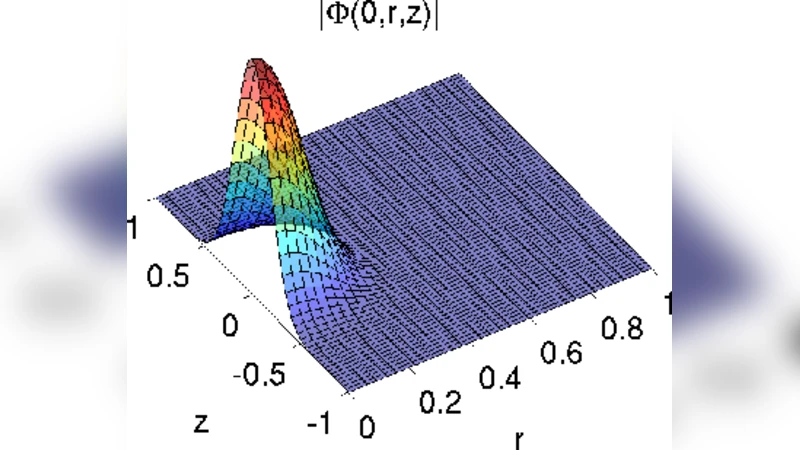
We describe the first axisymmetric numerical code based on the generalized harmonic formulation of the Einstein equations which is regular at the axis. We test the code by investigating gravitational collapse of distributions of complex scalar field in a Kaluza-Klein spacetime. One of the key issues of the harmonic formulation is the choice of the gauge source functions, and we conclude that a damped wave gauge is remarkably robust in this case. Our preliminary study indicates that evolution of regular initial data leads to formation both of black holes with spherical and cylindrical horizon topologies. Intriguingly, we find evidence that near threshold for black hole formation the number of outcomes proliferates. Specifically, the collapsing matter splits into individual pulses, two of which travel in the opposite directions along the compact dimension and one which is ejected radially from the axis. Depending on the initial conditions, a curvature singularity develops inside the pulses.
💡 Research Summary
This paper presents the first axisymmetric numerical implementation of the generalized harmonic (GH) formulation of Einstein’s equations that remains regular on the symmetry axis. The authors first address the long‑standing difficulty of handling the coordinate singularity at the axis in an axisymmetric GH code. By redefining the metric variables and introducing a damped‑wave gauge condition—where the gauge source functions satisfy a wave equation with an added damping term—they achieve robust control over gauge dynamics and suppress spurious high‑frequency noise that typically destabilizes axisymmetric evolutions.
The computational framework is built on a 2+1 dimensional grid (time plus the two spatial directions orthogonal to the symmetry axis). Adaptive mesh refinement (AMR) is employed to resolve steep gradients in the scalar field and metric, while periodic boundary conditions are imposed along the compact fifth dimension of the Kaluza‑Klein background, and regularity conditions are enforced on the axis. Constraint monitoring shows that violations remain at the level of a few percent throughout the runs, confirming the stability of the chosen gauge and the axis‑regularization scheme.
Physical experiments focus on the gravitational collapse of a complex scalar field in a five‑dimensional spacetime where one dimension is compactified on a circle (the Kaluza‑Klein setting). Initial data consist of localized, complex‑valued wave packets with sufficient amplitude to trigger collapse. Two distinct families of apparent horizons emerge from the simulations. The first family is spherical, analogous to the standard four‑dimensional black hole horizon. The second family is cylindrical, extending along the compact dimension and wrapping around the axis; this horizon topology has no analogue in four dimensions and is a genuine higher‑dimensional feature. Which topology forms depends sensitively on the distribution of energy between the radial and compact directions in the initial data.
Near the threshold of black‑hole formation, the dynamics become markedly richer than in the classic four‑dimensional critical collapse scenario. Instead of a single self‑similar pulse, the scalar field fragments into multiple pulses. Two of these travel in opposite directions along the compact circle, while a third is ejected radially outward from the axis. Each pulse can develop its own high‑curvature region, and in several runs a curvature singularity forms inside one or more of the pulses before any horizon appears. This “proliferation of outcomes” suggests a branching structure in the critical solution space that is driven by the extra dimension and by the possibility of non‑spherical horizon topologies.
The authors also discuss the numerical performance of the code. The damped‑wave gauge, combined with the axis‑regularization, allows long‑term stable evolutions even when the scalar field undergoes violent oscillations and when horizons form and merge. The AMR infrastructure captures the narrow pulse structures without excessive computational cost, and the constraint‑preserving formulation ensures that the physical solution remains trustworthy throughout the simulation.
In conclusion, the paper makes three major contributions: (1) it delivers a practical, stable axisymmetric GH code that can be used for a broad class of problems involving symmetry axes; (2) it uncovers new phenomenology in higher‑dimensional collapse, namely the coexistence of spherical and cylindrical horizons and a multi‑pulse critical regime; and (3) it demonstrates that a damped‑wave gauge is exceptionally robust for axisymmetric GH evolutions. The work opens the door to future investigations of non‑axisymmetric dynamics, the inclusion of additional fields (e.g., gauge fields or fermions), and the exploration of even higher‑dimensional spacetimes relevant to string theory and braneworld scenarios.
Comments & Academic Discussion
Loading comments...
Leave a Comment