Parquet theory for correlated thermodynamic Greens functions
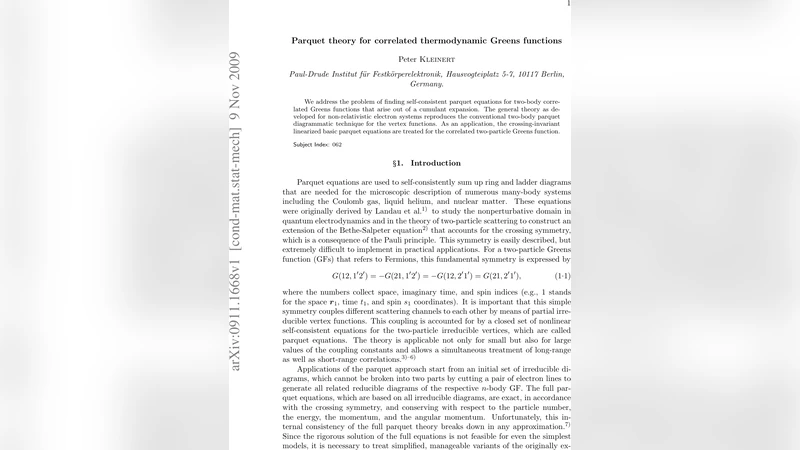
We address the problem of finding self-consistent parquet equations for two-body correlated Greens functions that arise out of a cumulant expansion. The general theory as developed for non-relativistic electron systems reproduces the conventional two-body parquet diagrammatic technique for the vertex functions. As an application, the crossing-invariant linearized basic parquet equations are treated for the correlated two-particle Greens function.
💡 Research Summary
The paper presents a self‑consistent parquet framework for two‑particle correlated thermodynamic Green’s functions derived from a cumulant expansion. Traditional many‑body perturbation theory often works with bare Green’s functions and vertex functions that contain both correlated and uncorrelated contributions, making it difficult to preserve crossing symmetry and conservation laws when strong correlations are present. By employing a cumulant expansion, the authors isolate the purely correlated part of the Green’s function, denoted (G_c), and construct parquet equations that use (G_c) as the propagator and the corresponding correlated vertex as the kernel.
The authors first review the cumulant formalism, showing how the two‑particle correlated Green’s function (\chi_c(1,2;1’,2’)) can be expressed in terms of the bare two‑particle propagator (\chi_0) plus three channel contributions: particle‑particle ((\Phi_{pp})), particle‑hole ((\Phi_{ph})), and exchange ((\Phi_{ex})). Each channel satisfies a Bethe‑Salpeter‑type integral equation where the irreducible kernel is built from the cumulant‑expanded two‑body interaction. Crucially, the crossing relations (\Phi_{pp}(1,2;1’,2’) = \Phi_{ph}(1,2’;1’,2) = \Phi_{ex}(1,2;2’,1’)) emerge automatically because the cumulant expansion removes uncorrelated background terms.
To make the scheme tractable, the authors introduce the “basic parquet equations” and linearize them. Linearization consists of retaining only the first‑order terms in the channel couplings while imposing the crossing constraints as explicit symmetrization conditions. This yields a set of coupled linear integral equations that can be solved iteratively with modest computational effort. The linearized parquet equations are then applied to compute the correlated two‑particle Green’s function for a generic non‑relativistic electron gas. The resulting spectral functions and response functions respect both crossing symmetry and the Ward identities associated with particle number and spin conservation, and they converge more rapidly than conventional parquet calculations that rely on bare propagators.
The paper demonstrates that the cumulant‑based parquet approach reproduces the conventional parquet diagrammatics when the cumulant expansion is truncated at the lowest order, thereby establishing consistency with established many‑body theory. Moreover, because the formalism works directly with thermodynamic Green’s functions, it provides a natural link to observable quantities such as free energy, specific heat, and susceptibilities, which are otherwise obtained only after additional analytic continuation steps.
In the discussion, the authors argue that the method is particularly advantageous for strongly correlated systems—high‑(T_c) superconductors, low‑dimensional Luttinger liquids, and transition‑metal oxides—where the interplay of multiple scattering channels is essential. They outline future extensions, including full nonlinear parquet implementations, multi‑band generalizations, and applications to non‑equilibrium Green’s functions.
Overall, the work offers a rigorous, symmetry‑preserving parquet scheme built on correlated Green’s functions, bridging the gap between diagrammatic parquet theory and cumulant‑based many‑body expansions, and opening new avenues for accurate, conserving calculations in strongly correlated electron physics.
Comments & Academic Discussion
Loading comments...
Leave a Comment