The X-ray Energy Dependence of the Relation between Optical and X-ray Emission in Quasars
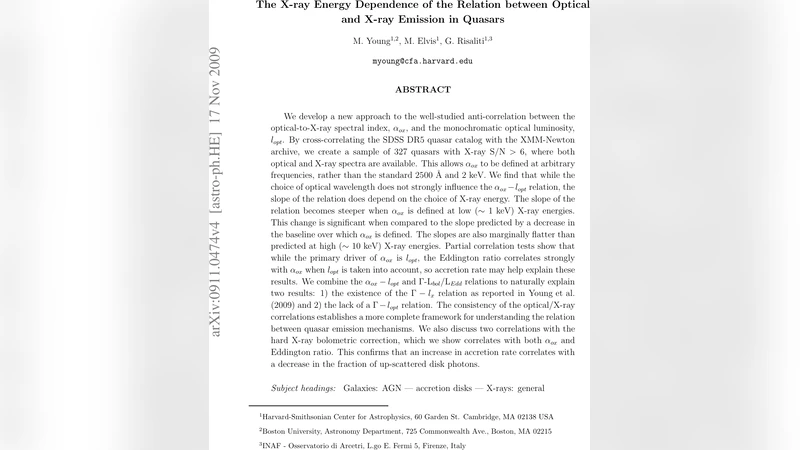
We develop a new approach to the well-studied anti-correlation between the optical-to-X-ray spectral index, alpha_ox, and the monochromatic optical luminosity, l_opt. By cross-correlating the SDSS DR5 quasar catalog with the XMM-Newton archive, we create a sample of 327 quasars with X-ray S/N > 6, where both optical and X-ray spectra are available. This allows alpha_ox to be defined at arbitrary frequencies, rather than the standard 2500 Angstroms and 2 keV. We find that while the choice of optical wavelength does not strongly influence the alpha_ox-l_opt relation, the slope of the relation does depend on the choice of X-ray energy. The slope of the relation becomes steeper when alpha_ox is defined at low (~ 1 keV) X-ray energies. This change is significant when compared to the slope predicted by a decrease in the baseline over which alpha_ox is defined. The slopes are also marginally flatter than predicted at high (~ 10 keV) X-ray energies. Partial correlation tests show that while the primary driver of alpha_ox is l_opt, the Eddington ratio correlates strongly with alpha_ox when l_opt is taken into account, so accretion rate may help explain these results. We combine the alpha_ox-l_opt and Gamma -L_bol/L_Edd relations to naturally explain two results: 1) the existence of the Gamma-l_x relation as reported in Young et al. (2009) and 2) the lack of a Gamma-l_opt relation. The consistency of the optical/X-ray correlations establishes a more complete framework for understanding the relation between quasar emission mechanisms. We also discuss two correlations with the hard X-ray bolometric correction, which we show correlates with both alpha_ox and Eddington ratio. This confirms that an increase in accretion rate correlates with a decrease in the fraction of up-scattered disk photons.
💡 Research Summary
The authors present a novel investigation of the well‑known anti‑correlation between the optical‑to‑X‑ray spectral index (αₒₓ) and the monochromatic optical luminosity (Lₒₚₜ) by allowing αₒₓ to be defined at arbitrary optical wavelengths and X‑ray energies. Using a cross‑match of the Sloan Digital Sky Survey Data Release 5 quasar catalog with the XMM‑Newton archive, they assemble a high‑quality sample of 327 quasars with X‑ray signal‑to‑noise ratios greater than six and with both optical and X‑ray spectra available. This dataset enables the authors to compute αₒₓ not only at the traditional 2500 Å–2 keV reference points but across a broad range of optical (≈1500–5000 Å) and X‑ray (0.5–10 keV) frequencies.
Their analysis shows that varying the optical wavelength has only a minor effect on the αₒₓ–Lₒₚₜ relation, whereas the choice of X‑ray energy significantly changes the slope of the correlation. When αₒₓ is defined at low X‑ray energies (~1 keV) the relation becomes markedly steeper, while at higher energies (~10 keV) the slope is modestly flatter than would be expected merely from the change in the baseline over which αₒₓ is measured. This indicates that the physical coupling between the accretion‑disk UV/optical emission and the coronal X‑ray output is energy‑dependent, rather than a simple scaling.
Partial‑correlation tests reveal that, after controlling for Lₒₚₜ, the Eddington ratio (L_bol/L_Edd) correlates strongly with αₒₓ. In other words, quasars with higher accretion rates exhibit smaller αₒₓ values, implying that a larger fraction of the disk photons remain in the UV/optical band and fewer are up‑scattered to X‑rays. By combining the αₒₓ–Lₒₚₜ relationship with the known Γ–L_bol/L_Edd correlation (where Γ is the X‑ray photon index), the authors naturally reproduce two previously reported findings: (1) the existence of a Γ–L_X correlation (as found by Young et al. 2009) and (2) the absence of a significant Γ–Lₒₚₜ correlation. This synthesis suggests that the X‑ray spectral slope is primarily driven by the accretion rate rather than directly by the optical luminosity.
The study also examines the hard‑X‑ray bolometric correction (k_bol for 2–10 keV) and finds that it correlates positively with both αₒₓ and the Eddington ratio. This reinforces the picture that higher accretion rates lead to a reduced contribution of the X‑ray corona to the total bolometric output, consistent with a less efficient up‑scattering process.
Overall, the paper establishes a more comprehensive, multi‑parameter framework for interpreting quasar emission. By demonstrating that the αₒₓ–Lₒₚₜ relation is not a fixed, one‑dimensional correlation but varies with X‑ray energy and is modulated by the Eddington ratio, the authors provide crucial empirical constraints for theoretical models of disk‑corona coupling, radiative efficiency, and the energy budget of active galactic nuclei. This work paves the way for future large‑scale surveys to incorporate energy‑dependent αₒₓ definitions, thereby achieving a deeper physical understanding of quasar spectral energy distributions.