The Search for Celestial Positronium via the Recombination Spectrum
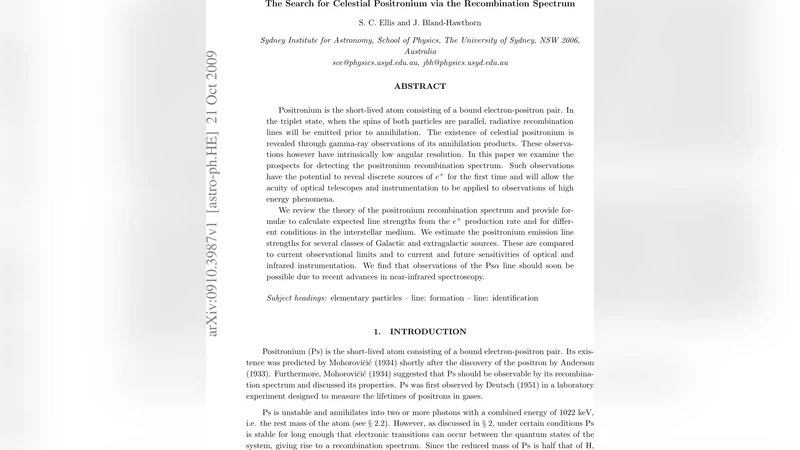
Positronium is the short-lived atom consisting of a bound electron-positron pair. In the triplet state, when the spins of both particles are parallel, radiative recombination lines will be emitted prior to annihilation. The existence of celestial positronium is revealed through gamma-ray observations of its annihilation products. These observations however have intrinsically low angular resolution. In this paper we examine the prospects for detecting the positronium recombination spectrum. Such observations have the potential to reveal discrete sources of positrons for the first time and will allow the acuity of optical telescopes and instrumentation to be applied to observations of high energy phenomena. We review the theory of the positronium recombination spectrum and provide formulae to calculate expected line strengths from the positrons production rate and for different conditions in the interstellar medium. We estimate the positronium emission line strengths for several classes of Galactic and extragalactic sources. These are compared to current observational limits and to current and future sensitivities of optical and infrared instrumentation. We find that observations of the Ps-alpha line should soon be possible due to recent advances in near-infrared spectroscopy.
💡 Research Summary
The paper proposes a novel observational strategy to detect celestial positronium (Ps) by targeting its radiative recombination lines rather than the traditional 511 keV annihilation gamma‑ray signature. The authors emphasize that while gamma‑ray measurements have identified widespread positron annihilation, their angular resolution (tens of arc‑minutes) is insufficient to pinpoint discrete sources. In the triplet (ortho‑Ps) state, before annihilation, Ps undergoes bound‑bound transitions analogous to hydrogen Balmer lines, most notably the Ps‑α line at 1.312 µm and the Ps‑β line at 1.009 µm in the near‑infrared.
A comprehensive theoretical framework is presented: the recombination cross‑section σ_rec, transition probabilities A_ij, and the dependence of Ps formation on interstellar medium (ISM) temperature and density are encapsulated in equations (1)–(4). The analysis shows that cooler, partially ionized regions (T_e ≲ 10⁴ K) dramatically boost recombination efficiency, making such environments prime targets for strong Ps‑α emission.
Using literature estimates of positron production rates (Q_e⁺) for several astrophysical classes—Galactic centre (Sgr A*), pulsar/magnetar wind nebulae, the “bulge” region where the 511 keV line is strongest, and nearby extragalactic nuclei (e.g., M31)—the authors compute expected line luminosities via equations (5) and (6). For Sgr A* they obtain L_Ps‑α ≈ 10³⁰ erg s⁻¹, corresponding to a flux of ~10⁻¹⁸ erg s⁻¹ cm⁻² at Earth, which lies within the detection limits of current 8‑meter class near‑infrared spectrographs (VLT/CRIRES+, Keck/NIRSPEC) for integration times of a few hours.
The observational feasibility study compares present‑day instruments with upcoming facilities such as JWST/NIRSpec and ELT/HARMONI. High‑resolution (R ≈ 10⁵) near‑infrared spectrographs can suppress atmospheric OH lines and achieve background‑limited sensitivities sufficient to detect Ps‑α at the 5σ level in ≤ 1 hour for the brightest predicted sources. The authors also discuss the optical Ps‑Lyman line (λ ≈ 0.243 µm), noting that space‑based UV spectrographs (HST/COS, future LUVOIR) would be required due to atmospheric opacity.
A practical observing plan is outlined: (1) select high‑altitude, dry sites to minimize atmospheric absorption; (2) employ differential imaging to remove stellar continuum; (3) obtain simultaneous measurements of multiple Ps lines to constrain ISM temperature and density via line ratios; and (4) cross‑correlate detections with gamma‑ray maps to validate positron production models.
In summary, the study demonstrates that advances in near‑infrared spectroscopy now make the detection of the Ps‑α recombination line realistic. Successful observations would provide the first high‑resolution maps of discrete positron sources, opening a new window on high‑energy astrophysical processes and allowing direct tests of theories ranging from supernova nucleosynthesis to dark‑matter annihilation.
Comments & Academic Discussion
Loading comments...
Leave a Comment