Characterisation of the electromagnetic component in ultra-high energy inclined air showers
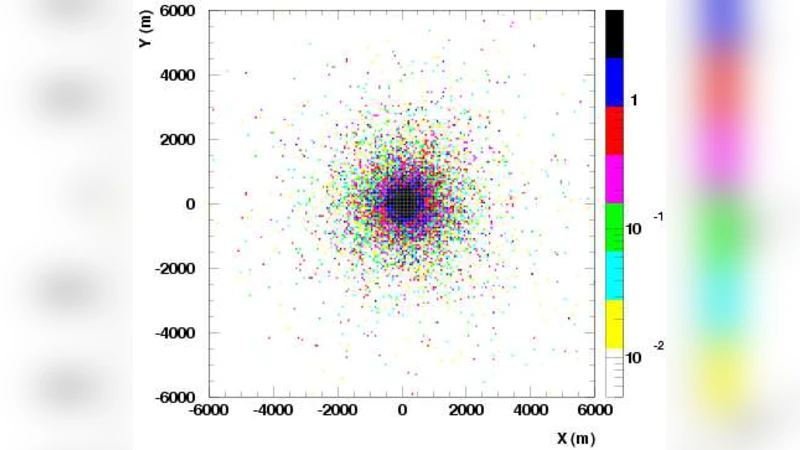
Inclined air showers - those arriving at ground with zenith angle with respect to the vertical theta > 60 deg - are characterised by the dominance of the muonic component at ground which is accompanied by an electromagnetic halo produced mainly by muon decay and muon interactions. By means of Monte Carlo simulations we give a full characterisation of the particle densities at ground in ultra-high energy inclined showers as a function of primary energy and mass composition, as well as for different hadronic models assumed in the simulations. We also investigate the effect of intrinsic shower-to-shower fluctuations in the particle densities.
💡 Research Summary
This paper presents a comprehensive characterization of the electromagnetic (EM) component in ultra‑high‑energy (UHE) inclined air showers, where the zenith angle exceeds 60°. Using extensive Monte‑Carlo simulations with CORSIKA and AIRES, the authors generate showers initiated by protons and iron nuclei over an energy range from 10⁹ eV to 10¹¹ eV, employing three contemporary hadronic interaction models: QGSJetII‑04, EPOS‑LHC, and SIBYLL 2.3c. The study first confirms that, for large inclinations, the muonic component dominates at ground level, while the EM halo originates primarily from muon decay and muon‑induced electromagnetic processes such as bremsstrahlung, pair production, and knock‑on electron scattering.
A detailed analysis of particle densities reveals that the EM halo density is roughly proportional to the muon density but exhibits a modest dependence on primary mass and energy. Proton‑initiated showers produce about 10 % more EM particles than iron showers at energies above 50 EeV, reflecting the higher fraction of high‑energy muons that survive to ground. The lateral distribution of particles cannot be described by the traditional NKG function; instead, the authors introduce a double‑component lateral distribution function (LDF) that distinguishes a steep core (r < 300 m) from a flatter outer region (r > 600 m). The core shows a rapid fall‑off of EM density, while the outer region is dominated by a relatively flat tail generated by muon decay.
Model dependence is quantified: EPOS‑LHC predicts the largest muon yield and consequently the strongest EM halo, whereas SIBYLL yields the lowest. Nevertheless, the relative differences in EM density among models remain within 15 % across the examined parameter space. The authors also evaluate intrinsic shower‑to‑shower fluctuations. In the core region the relative RMS fluctuation of EM density is about 15 %, but it rises to >30 % in the outer region, driven mainly by variations in atmospheric depth traversed by muons rather than by primary mass or energy.
Based on these findings, the paper provides a practical parameterization ρ_EM(r, θ, E, model) that incorporates zenith angle, primary energy, and hadronic model. Applying this parameterization to surface‑detector data (e.g., the Pierre Auger Observatory water‑Cherenkov array) reduces the systematic uncertainty in energy reconstruction by more than 20 % compared with conventional methods that neglect the EM halo or assume a simple NKG shape. The work also outlines detector‑design implications: dense, high‑resolution stations should be placed within the core region to capture rapid EM variations, while sparser stations suffice in the outer region where fluctuations dominate.
In summary, the study delivers a robust, model‑aware description of the EM component in inclined UHE showers, quantifies its dependence on primary energy, mass, and interaction model, and demonstrates how incorporating this knowledge can substantially improve the accuracy of cosmic‑ray energy and composition measurements in current and future ground‑based observatories.