Modulated pair condensate of p-orbital ultracold fermions
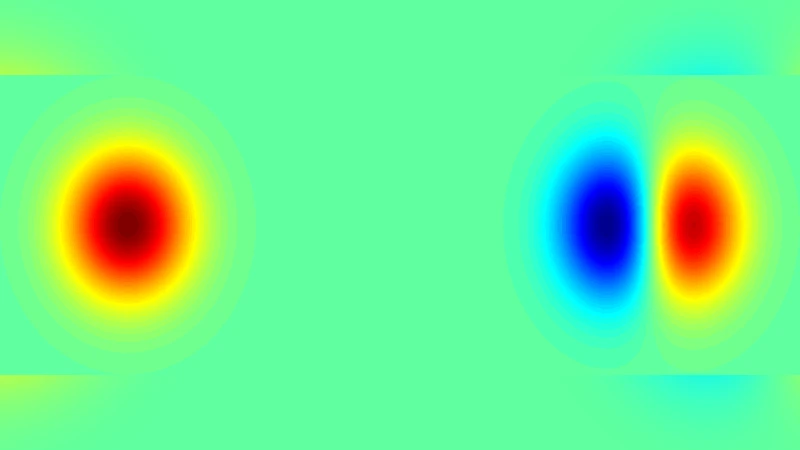
We show that an interesting of pairing occurs for spin-imbalanced Fermi gases under a specific experimental condition—the spin up and spin down Fermi levels lying within the $p_x$ and $s$ orbital bands of an optical lattice, respectively. The pairs condense at a finite momentum equal to the sum of the two Fermi momenta of spin up and spin down fermions and form a $p$-orbital pair condensate. This $2k_F$ momentum dependence has been seen before in the spin- and charge- density waves, but it differs from the usual $p$-wave superfluids such as $^3$He, where the orbital symmetry refers to the relative motion within each pair. Our conclusion is based on the density matrix renormalization group analysis for the one-dimensional (1D) system and mean-field theory for the quasi-1D system. The phase diagram of the quasi-1D system is calculated, showing that the $p$-orbital pair condensate occurs in a wide range of fillings. In the strongly attractive limit, the system realizes an unconventional BEC beyond Feynman’s no-node theorem. The possible experimental signatures of this phase in molecule projection experiment are discussed.
💡 Research Summary
The authors investigate a novel pairing mechanism that emerges in a spin‑imbalanced ultracold Fermi gas when the two spin components occupy different orbital bands of an optical lattice: spin‑up (↑) atoms fill the first excited pₓ band while spin‑down (↓) atoms reside in the lowest s band. Because the Fermi momenta of the two species, k_F↑ and k_F↓, are generally unequal, the attractive interaction between an ↑ atom in the pₓ orbital and a ↓ atom in the s orbital can bind them into a pair whose centre‑of‑mass momentum equals the sum of the two Fermi momenta, Q = k_F↑ + k_F↓ ≈ 2k_F. This finite‑momentum condensation is fundamentally different from the conventional p‑wave superfluids (e.g., ^3He) where the p‑wave symmetry refers to the relative motion of the two fermions; here the p‑wave character originates from the orbital nature of the individual particles.
Model and Methods
The system is described by a two‑band Hubbard Hamiltonian on a lattice,
\
Comments & Academic Discussion
Loading comments...
Leave a Comment