Exact Solution for 1D Spin-Polarized Fermions with Resonant Interactions
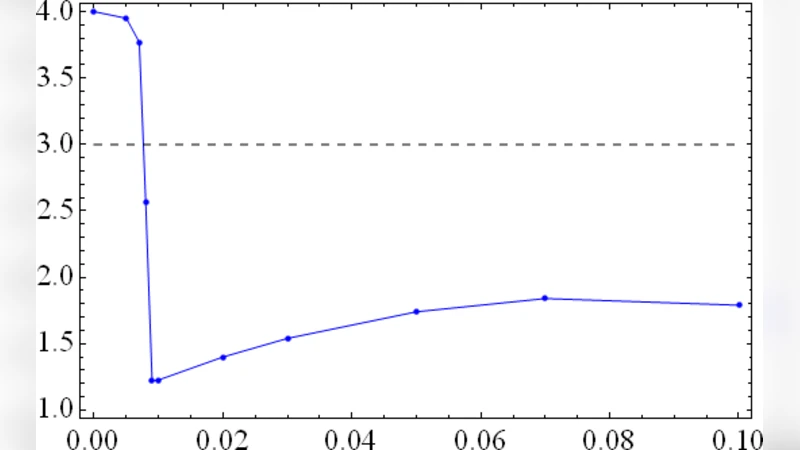
Using the asymptotic Bethe Ansatz, we obtain an exact solution of the many-body problem for 1D spin-polarized fermions with resonant p-wave interactions, taking into account the effects of both scattering volume and effective range. Under typical experimental conditions, accounting for the effective range, the properties of the system are significantly modified due to the existence of “shape” resonances. The excitation spectrum of the considered model has unexpected features, such as the inverted position of the particle- and hole-like branches at small momenta, and roton-like minima. We find that the frequency of the “breathing” mode in the harmonic trap provides an unambiguous signature of the effective range.
💡 Research Summary
This paper presents an exact solution for a one‑dimensional gas of spin‑polarized fermions interacting via resonant p‑wave scattering. Using the asymptotic Bethe Ansatz, the authors construct many‑body wavefunctions that incorporate both the scattering volume (V) and the effective range (R) of the interaction. While earlier works typically retained only V, the inclusion of R captures “shape‑resonance” effects that become prominent under realistic experimental conditions.
The Bethe‑Ansatz equations are generalized to contain an additional k³ term arising from the finite effective range. This term modifies the dispersion relation ε(k) in a non‑trivial way: at small momenta the particle‑like and hole‑like excitation branches are inverted, a phenomenon absent in the pure contact‑interaction (δ‑function) limit. Moreover, for certain values of V and sufficiently large R, the spectrum develops roton‑like minima at finite k, indicating the emergence of low‑energy collective excitations reminiscent of those in superfluid helium.
To connect theory with experiment, the authors analyze a harmonically trapped gas. In the pure contact model the breathing‑mode frequency ω_B equals 2ω₀ (ω₀ being the trap frequency). With a finite effective range, ω_B deviates markedly from 2ω₀, either increasing or decreasing depending on the sign and magnitude of R. Consequently, precise measurement of the breathing mode provides a clear, model‑independent signature of the effective‑range contribution.
Overall, the work extends the exactly solvable Lieb‑Liniger‑type framework to p‑wave resonant fermions, revealing rich spectral features—branch inversion, roton‑like dips, and trap‑mode shifts—that were previously inaccessible. These results offer a robust theoretical foundation for ongoing cold‑atom experiments with ⁶Li, ⁴⁰K, and other p‑wave fermionic species, and open avenues for exploring novel quantum phases and non‑linear dynamics in one‑dimensional systems.
Comments & Academic Discussion
Loading comments...
Leave a Comment