Mass Accretion Rate of Rotating Viscous Accretion Flow
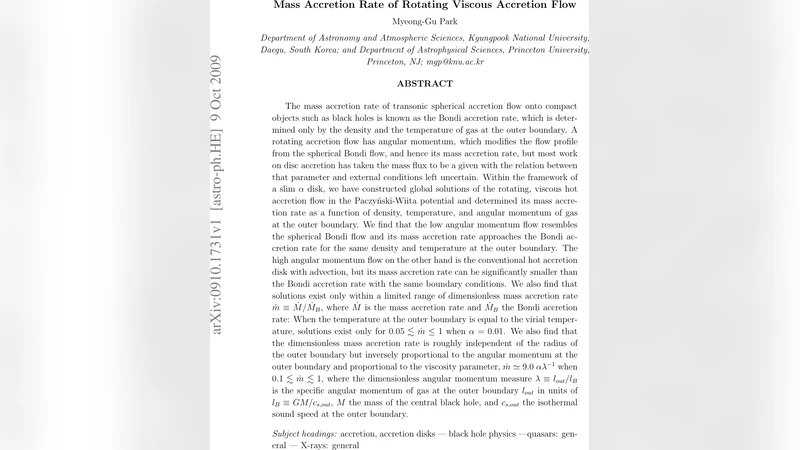
The mass accretion rate of transonic spherical accretion flow onto compact objects such as black holes is known as the Bondi accretion rate(Mdot_B), which is determined only by the density and the temperature of gas at the outer boundary. But most work on disc accretion has taken the mass flux to be a given with the relation between that parameter and external conditions left uncertain. Within the framework of a slim alpha disk, we have constructed global solutions of the rotating, viscous hot accretion flow and determined its mass accretion rate as a function of density, temperature, and angular momentum of gas at the outer boundary. We find that the low angular momentum flow resembles the spherical Bondi flow and its mass accretion rate approaches the Bondi accretion rate for the same density and temperature at the outer boundary. The high angular momentum flow on the other hand is the conventional hot accretion disk with advection, but its mass accretion rate can be significantly smaller than the Bondi accretion rate with the same boundary conditions. We also find that when the temperature at the outer boundary is equal to the virial temperature, solutions exist only for 0.05 ~< mdot ~< 1 when alpha=0.01 where mdot==Mdot/Mdot_B. We also find that the dimensionless mass accretion rate is roughly independent of the radius of the outer boundary but inversely proportional to the angular momentum at the outer boundary and proportional to the viscosity parameter, mdot ~= 9.0 alpha/lambda when 0.1 ~< mdot ~< 1, where the dimensionless angular momentum measure lambda == l_out/l_B is the specific angular momentum of gas at the outer boundary l_out in units of l_B == GM/c_{s,out}, and $c_{s,out}$ the isothermal sound speed at the outer boundary.
💡 Research Summary
The paper investigates how rotation and viscosity modify the mass accretion rate onto compact objects compared with the classic Bondi solution, which depends only on the ambient density and temperature. Using the slim‑disk formalism with an α‑prescription for viscosity, the authors solve the full set of radial continuity, momentum, and energy equations to obtain global, trans‑sonic solutions for a hot, rotating flow. The outer boundary is characterized by three quantities: density ρ_out, temperature T_out (or sound speed c_s,out), and specific angular momentum l_out. By normalizing l_out to the Bondi characteristic angular momentum l_B = GM / c_s,out, they define a dimensionless angular momentum λ = l_out / l_B, and by normalizing the accretion rate to the Bondi value they define ṁ = Ṁ / Ṁ_B.
Two limiting regimes emerge. When λ ≪ 1 the flow is essentially spherical; the centrifugal term is negligible, the solution reduces to the Bondi case, and ṁ → 1. When λ is of order unity or larger, centrifugal support forces the flow to form a hot, advection‑dominated disc. In this regime the accretion rate can be far below the Bondi value because most of the inflowing mass is halted by angular momentum barriers and must lose angular momentum through viscous stresses before it can fall inward.
A key result is that, for outer‑boundary temperatures equal to the virial temperature (T_out = T_vir) and a modest viscosity parameter α = 0.01, physically admissible solutions exist only for 0.05 ≲ ṁ ≲ 1. Within the range 0.1 ≲ ṁ ≲ 1 the authors find a simple scaling law
ṁ ≈ 9 α / λ,
demonstrating that the dimensionless accretion rate is directly proportional to the viscosity parameter and inversely proportional to the normalized angular momentum. This relation is remarkably insensitive to the actual radius of the outer boundary, indicating that the governing balance is set locally by the competition between centrifugal forces and viscous angular‑momentum transport.
The paper also explores the dependence on the outer radius r_out and confirms that, provided r_out is sufficiently large that the gravitational potential is essentially Newtonian, the accretion rate does not vary significantly with r_out. The authors discuss the astrophysical implications: low‑angular‑momentum gas (e.g., hot halo gas with little rotation) will accrete at nearly the Bondi rate, while gas with substantial rotation (as expected in galactic nuclei or binary systems) can experience a strong suppression of Ṁ, potentially explaining the low radiative efficiencies observed in many low‑luminosity AGN and quiescent X‑ray binaries. By inserting typical values (α ≈ 0.01–0.1, λ ≈ 0.1–1) the scaling predicts ṁ of order 0.1–1, consistent with observed sub‑Eddington accretion rates.
In summary, the study provides a quantitative bridge between spherical Bondi accretion and viscous, rotating disc accretion. It shows that the mass accretion rate is not a free parameter but is set by the outer‑boundary density, temperature, angular momentum, and the viscosity parameter. The derived ṁ ≈ 9 α / λ scaling offers a practical tool for estimating realistic accretion rates in a wide variety of astrophysical contexts, from supermassive black holes in galactic centers to stellar‑mass black holes in X‑ray binaries.
Comments & Academic Discussion
Loading comments...
Leave a Comment