Coulomb crystals in the magnetic field
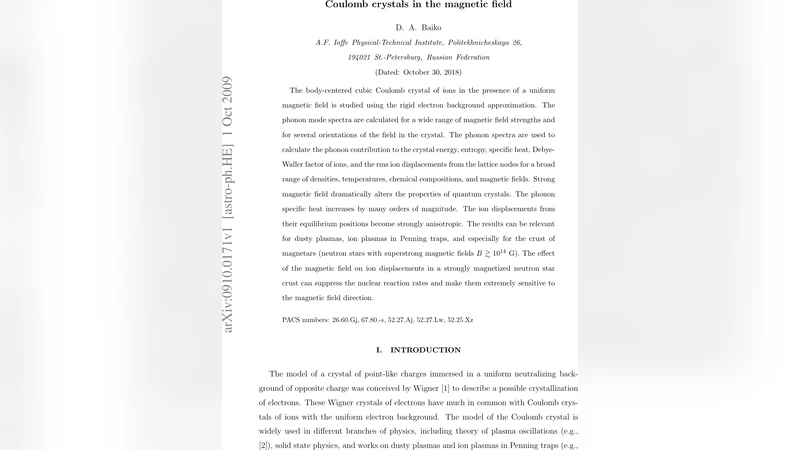
The body-centered cubic Coulomb crystal of ions in the presence of a uniform magnetic field is studied using the rigid electron background approximation. The phonon mode spectra are calculated for a wide range of magnetic field strengths and for several orientations of the field in the crystal. The phonon spectra are used to calculate the phonon contribution to the crystal energy, entropy, specific heat, Debye-Waller factor of ions, and the rms ion displacements from the lattice nodes for a broad range of densities, temperatures, chemical compositions, and magnetic fields. Strong magnetic field dramatically alters the properties of quantum crystals. The phonon specific heat increases by many orders of magnitude. The ion displacements from their equilibrium positions become strongly anisotropic. The results can be relevant for dusty plasmas, ion plasmas in Penning traps, and especially for the crust of magnetars (neutron stars with superstrong magnetic fields $B \gtrsim 10^{14}$ G). The effect of the magnetic field on ion displacements in a strongly magnetized neutron star crust can suppress the nuclear reaction rates and make them extremely sensitive to the magnetic field direction.
💡 Research Summary
This paper investigates the lattice dynamics of a body‑centered‑cubic (BCC) Coulomb crystal of ions immersed in a uniform magnetic field, using the rigid‑electron‑background approximation. The authors treat the electrons as a static, uniform charge background, which is justified when the electron response time is much shorter than ion motions and the magnetic field does not significantly distort the electron distribution. Within this framework the ion equations of motion acquire a Lorentz term, leading to a modified dynamical matrix that depends on the dimensionless magnetic parameter β = ωc/ωp (the ratio of the ion cyclotron frequency to the ion plasma frequency) and on the orientation of the field relative to the crystal axes.
A comprehensive numerical solution of the eigenvalue problem is performed for β ranging from 10⁻³ to 10³ and for several field directions. In the weak‑field limit (β ≪ 1) the phonon spectrum reproduces the familiar three acoustic‑optic branches of an unmagnetized BCC lattice. As β approaches and exceeds unity, the spectrum reorganises into two high‑frequency, magnetically‑coupled modes and one low‑frequency, essentially non‑magnetic mode. The degeneracy of the transverse branches is lifted when the field is not aligned with a high‑symmetry direction, producing pronounced anisotropy in the dispersion relations.
Using the calculated phonon frequencies the authors evaluate the phonon contribution to the Helmholtz free energy, entropy, specific heat, Debye‑Waller factor, and mean‑square ion displacement. The specific heat exhibits a dramatic enhancement: at temperatures well below the ion plasma temperature, the usual T³ Debye law is replaced by a much weaker temperature dependence (≈ T or T²) and the magnitude can be tens to hundreds of times larger than in the zero‑field case for β ≈ 10²–10³. Entropy follows a similar trend, reflecting the increased density of low‑energy states introduced by the magnetic field.
The Debye‑Waller factor and ion rms displacements become strongly anisotropic. Displacements parallel to the magnetic field are suppressed, while those perpendicular are amplified. This anisotropy directly influences nuclear reaction rates that depend on tunnelling probabilities, such as ¹²C+¹²C or ¹⁶O+¹⁶O fusion in dense matter. In a strongly magnetized neutron‑star crust the reaction rates can vary by many orders of magnitude with the field direction, potentially altering the thermal evolution and crustal heating of magnetars.
The paper discusses three classes of physical systems where these results are relevant. In dusty plasma experiments, micron‑sized charged grains can form BCC lattices, and laboratory magnetic fields of a few tesla can achieve β ≈ 1, allowing direct observation of the predicted phonon modifications. In Penning traps, ions are routinely confined in strong magnetic fields and can be arranged in crystalline structures; the calculated spectra provide a benchmark for precision spectroscopy and quantum‑simulation studies. The most compelling astrophysical application is the outer crust of magnetars (B ≳ 10¹⁴ G). There, densities of 10¹¹–10¹⁴ g cm⁻³ and ultra‑strong fields place the system deep in the β ≫ 1 regime, so the enhanced specific heat, anisotropic ion motion, and suppressed nuclear reactions could have measurable consequences for magnetar cooling curves, burst energetics, and the development of crustal fractures.
In conclusion, the authors present the first systematic, quantitative analysis of how a uniform magnetic field reshapes the phonon spectrum and thermodynamic properties of a Coulomb crystal in the BCC configuration. Their work bridges condensed‑matter physics, plasma physics, and neutron‑star astrophysics, highlighting the need to incorporate magnetic‑field‑induced lattice anisotropies in models of strongly magnetized dense matter. Future extensions could relax the rigid‑electron approximation, include anharmonic effects, and explore other lattice symmetries, but the present study already establishes a robust baseline for interpreting experiments and observations involving magnetized Coulomb crystals.
Comments & Academic Discussion
Loading comments...
Leave a Comment