Radiative Models of Sgr A* from GRMHD Simulations
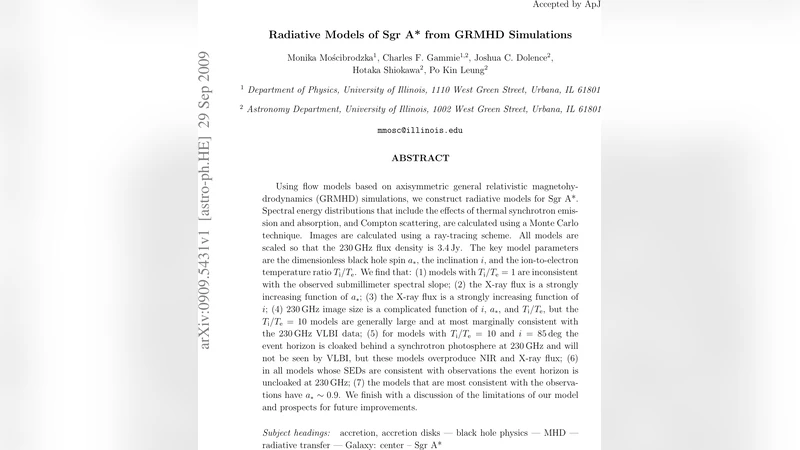
Using flow models based on axisymmetric general relativistic magnetohydrodynamics (GRMHD) simulations, we construct radiative models for sgr A*. Spectral energy distributions that include the effects of thermal synchrotron emission and absorption, and Compton scattering, are calculated using a Monte Carlo technique. Images are calculated using a ray-tracing scheme. All models are scaled so that the 230 GHz flux density is 3.4 Jy. The key model parameters are the dimensionless black hole spin a*, the inclination i, and the ion-to-electron temperature ratio Ti/Te. We find that: (1) models with Ti/Te=1 are inconsistent with the observed submillimeter spectral slope; (2) the X-ray flux is a strongly increasing function of a*; (3) the X-ray flux is a strongly increasing function of i; (4) 230 GHz image size is a complicated function of i, a*, and Ti/Te, but the Ti/Te = 10 models are generally large and at most marginally consistent with the 230 GHz VLBI data; (5) for models with Ti/Te=10 and i=85 deg the event horizon is cloaked behind a synchrotron photosphere at 230 GHz and will not be seen by VLBI, but these models overproduce NIR and X-ray flux; (6) in all models whose SEDs are consistent with observations the event horizon is uncloaked at 230 GHz; (7) the models that are most consistent with the observations have a* \sim 0.9. We finish with a discussion of the limitations of our model and prospects for future improvements.
💡 Research Summary
This paper presents a comprehensive effort to model the radiative properties of the supermassive black hole at the Galactic Center, Sgr A*, by coupling axisymmetric general‑relativistic magnetohydrodynamic (GRMHD) simulations with detailed radiative transfer calculations. The authors first run a suite of GRMHD simulations covering a range of dimensionless spin parameters (a* ≈ 0–0.998) and adopt a standard torus initial condition with a weak poloidal magnetic field. The simulated fluid variables (density, temperature, magnetic field strength) are then rescaled so that the synthetic 230 GHz flux matches the observed value of 3.4 Jy. This scaling introduces three key free parameters: the black‑hole spin a*, the observer inclination i (the angle between the disc angular momentum vector and the line of sight), and the ion‑to‑electron temperature ratio Ti/Te, which controls the electron temperature relative to the ion temperature in the simulation.
Radiative transfer is performed in two stages. In the first stage a Monte‑Carlo code computes the broadband spectral energy distribution (SED) including thermal synchrotron emission and self‑absorption, as well as inverse‑Compton scattering of synchrotron photons by the same thermal electrons. The electron distribution is assumed to be purely thermal (Maxwell‑Jüttner). In the second stage a general‑relativistic ray‑tracing algorithm produces synthetic images at 230 GHz, fully accounting for gravitational lensing, Doppler boosting, and gravitational redshift.
The main findings can be summarized as follows:
-
Ti/Te = 1 is ruled out – when electrons share the ion temperature, the resulting synchrotron spectrum is too flat in the sub‑millimeter band and fails to reproduce the observed spectral slope.
-
X‑ray flux rises sharply with spin – higher a* values increase the depth of the potential well and the frame‑dragging rate, leading to stronger electron heating and more efficient Compton up‑scattering. Models with a* ≈ 0.9 produce X‑ray luminosities that are compatible with Chandra measurements, whereas low‑spin models under‑predict the flux by orders of magnitude.
-
X‑ray flux also depends strongly on inclination – edge‑on views (large i) enhance Doppler boosting of the inner flow, boosting the high‑energy tail. Consequently, for a given spin, the X‑ray flux can vary by a factor of several as i changes from 30° to 85°.
-
230 GHz image size is a non‑trivial function of (a, i, Ti/Te)* – models with Ti/Te = 10 generally produce a larger synchrotron photosphere because the cooler electrons increase the optical depth. In many high‑inclination cases the photosphere lies outside the photon ring, making the event horizon “cloaked” at 230 GHz.
-
Cloaking occurs for Ti/Te = 10 and i ≈ 85° – in these configurations the synchrotron photosphere completely covers the shadow, so VLBI would not see the classic black‑hole silhouette. However, such models over‑produce near‑infrared (NIR) and X‑ray emission, violating observational constraints.
-
All SED‑consistent models have an uncloaked horizon – whenever the broadband SED matches the observed radio, NIR, and X‑ray fluxes, the 230 GHz photosphere is compact enough that the photon ring and shadow remain visible.
-
Best‑fit parameters – the combination a* ≈ 0.9, Ti/Te ≈ 10, and a moderate inclination (i ≈ 45°–60°) simultaneously reproduces the sub‑mm spectral slope, the measured NIR flux, the Chandra X‑ray luminosity, and the VLBI‑measured size of Sgr A* at 230 GHz.
The authors discuss several limitations of their approach. The electron heating prescription is highly simplified; a realistic plasma would involve kinetic processes such as magnetic reconnection, turbulent cascade, and anisotropic heating, which cannot be captured by a single temperature ratio. The simulations are axisymmetric (2‑D), thus missing non‑axisymmetric turbulence, variability, and possible jet‑like structures that could affect the high‑energy emission. Moreover, the assumption of a purely thermal electron distribution neglects possible non‑thermal tails that are often invoked to explain the observed NIR flares.
Future work is outlined: (i) implementing two‑temperature GRMHD with self‑consistent electron heating based on sub‑grid plasma physics, (ii) extending to fully three‑dimensional simulations to capture variability and asymmetric structures, and (iii) exploring hybrid electron distributions (thermal + power‑law) to better model NIR flares and the high‑energy tail. Such improvements will tighten the connection between GRMHD dynamics and observable signatures, allowing more definitive tests of General Relativity and accretion physics with upcoming Event Horizon Telescope observations and next‑generation X‑ray facilities.
Comments & Academic Discussion
Loading comments...
Leave a Comment