On cosmic ray acceleration in supernova remnants and the FERMI/PAMELA data
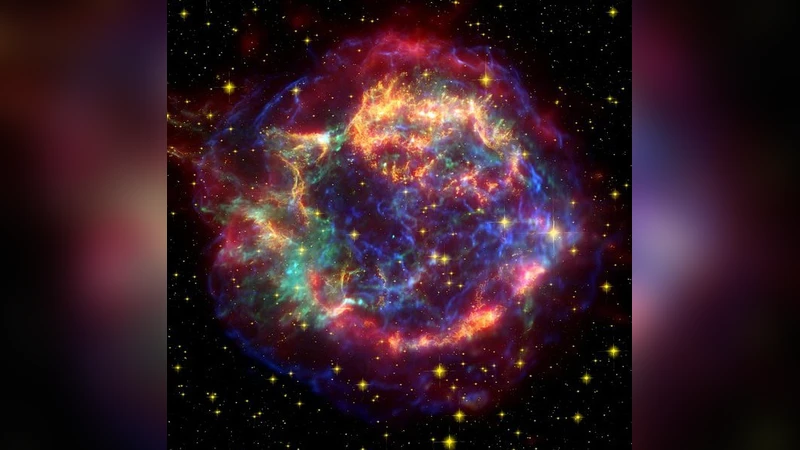
We discuss recent observations of high energy cosmic ray positrons and electrons in the context of hadronic interactions in supernova remnants, the suspected accelerators of galactic cosmic rays. Diffusive shock acceleration can harden the energy spectrum of secondary positrons relative to that of the primary protons (and electrons) and thus explain the rise in the positron fraction observed by PAMELA above 10 GeV. We normalize the hadronic interaction rate by holding pion decay to be responsible for the gamma-rays detected by HESS from some SNRs. By simulating the spatial and temporal distribution of SNRs in the Galaxy according to their known statistics, we are able to then fit the electron (plus positron) energy spectrum measured by Fermi. It appears that IceCube has good prospects for detecting the hadronic neutrino fluxes expected from nearby SNRs.
💡 Research Summary
The paper addresses the puzzling rise in the cosmic‑ray positron fraction reported by the PAMELA satellite above ~10 GeV, and the overall electron‑plus‑positron spectrum measured by Fermi‑LAT up to the TeV range, by invoking hadronic interactions and subsequent particle acceleration within supernova remnants (SNRs). The authors start from the well‑established paradigm that SNR shock fronts accelerate primary cosmic‑ray protons and electrons through diffusive shock acceleration (DSA), producing a power‑law spectrum roughly ∝ E⁻²·⁷. In addition to this primary component, they consider secondary particles generated when the accelerated protons collide with ambient gas nuclei, producing neutral and charged pions. While neutral pions decay into gamma rays, the charged pions decay into muons and then into electrons and positrons. Crucially, the authors argue that these secondary e± are still located within the shock region when they are created and can themselves be re‑accelerated by DSA. Because the acceleration time scales for secondaries are shorter than their energy‑loss times at the relevant energies, the resulting secondary spectrum is “hardened” relative to the primary one, taking on an approximate ∝ E⁻²·⁴ shape. This hardened secondary component naturally yields a rising positron fraction without invoking exotic sources such as dark‑matter annihilation or pulsar wind nebulae.
To fix the overall normalization of the hadronic interaction rate, the authors use gamma‑ray observations of several SNRs by the HESS telescope (e.g., RX J1713‑3946, Vela Jr, RCW 86). They assume that the observed TeV gamma‑ray fluxes are dominated by π⁰ decay, which directly ties the gamma‑ray luminosity to the underlying proton‑proton collision rate. By matching the model‑predicted π⁰‑decay gamma flux to the HESS data, they obtain a calibrated production rate for secondary e± and for the accompanying neutrinos (from π± decay).
Next, the paper builds a Monte‑Carlo model of the Galactic SNR population. The supernova rate is taken to be ~3 × 10⁻² yr⁻¹, with remnants distributed in a thin disk (scale height ≈ 100 pc, radial extent ≈ 15 kpc). For each simulated SNR, the authors assign an age (10³–10⁵ yr), distance (up to a few kpc), and ambient gas density (0.1–10 cm⁻³). They then compute the primary and secondary particle spectra injected by each remnant, apply DSA hardening to the secondaries, and propagate the particles through the interstellar medium using a diffusion coefficient D(E) ∝ E^δ with δ≈0.33, together with synchrotron and inverse‑Compton energy losses. The summed contribution of all simulated SNRs reproduces the smooth, slightly curved electron‑plus‑positron spectrum measured by Fermi‑LAT, while the subset of nearby, relatively young SNRs dominates the positron fraction at energies above 10 GeV. The model therefore simultaneously fits both the PAMELA positron fraction and the Fermi total lepton spectrum.
Because the same hadronic collisions that generate secondary e± also produce charged pions, the authors calculate the expected high‑energy neutrino flux from each SNR. They compare these fluxes with the current sensitivity of the IceCube neutrino observatory. For the brightest and closest remnants (notably Vela Jr), the predicted neutrino flux lies within a factor of a few of IceCube’s discovery potential after several years of exposure. Consequently, a detection (or a stringent upper limit) would provide an independent test of the hadronic acceleration scenario and could confirm SNRs as genuine cosmic‑ray “nuclear” accelerators.
In summary, the paper makes three interconnected claims: (1) Diffusive shock acceleration of secondary positrons hardens their spectrum enough to explain the PAMELA positron excess without exotic physics. (2) Normalizing the hadronic interaction rate to HESS γ‑ray observations allows the model to reproduce the Fermi‑LAT electron‑plus‑positron spectrum across the 10 GeV–1 TeV range. (3) The associated neutrino fluxes are within reach of IceCube, offering a concrete observational test. By integrating gamma‑ray, cosmic‑ray, and neutrino data within a single, physically motivated framework, the work advances our understanding of Galactic cosmic‑ray origins and highlights the importance of multi‑messenger astronomy in probing particle acceleration in supernova remnants.
Comments & Academic Discussion
Loading comments...
Leave a Comment