The discovery of a pulsar wind nebula around the magnetar candidate AXP 1E1547.0-5408
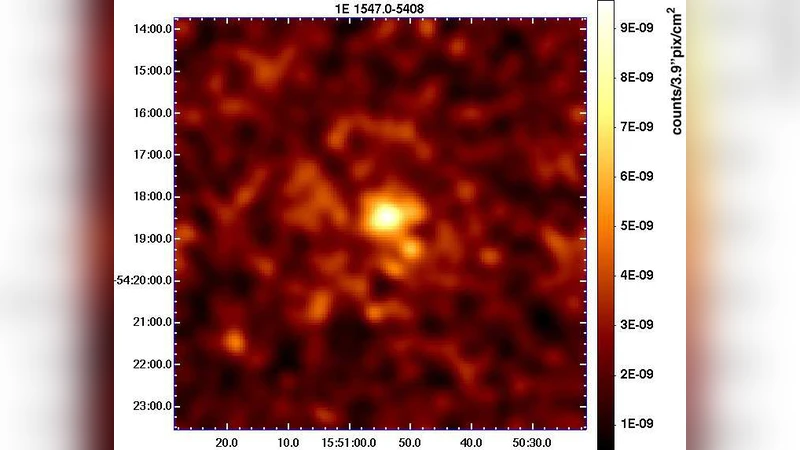
We report the detection of extended emission around the anomalous X-ray pulsar AXP 1E1547.0-5408 using archival data of the Chandra X-ray satellite. The extended emission consists of an inner part, with an extent of 45arsec and an outer part with an outer radius of 2.9arcmin, which coincides with a supernova remnant shell previously detected in the radio. We argue that the extended emission in the inner part is the result of a pulsar wind nebula, which would be the first detected pulsar wind nebula around a magnetar candidate. Its ratio of X-ray luminosity to pulsar spin-down power is comparable to that of other young pulsar wind nebulae, but its X-ray spectrum is steeper than most pulsar wind nebulae. We discuss the importance of this source in the context of magnetar evolution.
💡 Research Summary
**
The authors present a detailed analysis of archival Chandra ACIS‑I observations of the anomalous X‑ray pulsar (AXP) 1E1547.0‑5408, revealing for the first time extended X‑ray emission that can be interpreted as a pulsar wind nebula (PWN) around a magnetar candidate. After standard data reduction (energy filtering to 0.5–7 keV, point‑source removal with wavdetect, and careful background modeling), they constructed radial surface‑brightness profiles centered on the precise AXP position. The profiles show a clear excess extending out to ~45 arcseconds (≈ 0.9 pc), well beyond the Chandra point‑spread function, indicating genuine diffuse emission.
Spectral fitting of this inner component with an absorbed power‑law yields a photon index Γ ≈ 2.5 ± 0.3 and an absorption column N_H ≈ 1.2 × 10²² cm⁻². The derived 0.5–10 keV luminosity is L_X ≈ 1.2 × 10³³ erg s⁻¹. Using the measured spin‑down parameters of the AXP (period P ≈ 2.1 s, period derivative Ṗ ≈ 2.3 × 10⁻¹¹ s s⁻¹), the spin‑down power is estimated as Ė ≈ 1.0 × 10³⁵ erg s⁻¹, giving a nebular efficiency L_X/Ė ≈ 1.2 %. This efficiency is comparable to that of young, energetic PWNe such as Vela or the Crab, suggesting that even a magnetar with an ultra‑strong magnetic field (B ≈ 10¹⁴ G) can channel a non‑negligible fraction of its rotational energy into a relativistic wind.
Beyond the inner nebula, the authors identify a fainter, more extended halo with a radius of ~2.9 arcminutes (≈ 3.4 pc). This outer structure aligns spatially with the radio supernova remnant (SNR) shell G327.24‑0.13 previously reported in the literature. The SNR’s estimated age (10³–10⁴ yr) implies that the AXP and its nebula are still relatively young, consistent with the presence of a still‑active wind.
The paper discusses several implications. First, the detection of a PWN around a magnetar candidate challenges the notion that magnetar‑scale magnetic fields suppress wind formation. Instead, it supports models where magnetars can initially behave like ordinary high‑B pulsars, launching relativistic outflows before magnetic braking dominates. Second, the nebular X‑ray efficiency provides a new diagnostic for the initial spin period of magnetars; the observed L_X/Ė ratio suggests an initial period of a few hundred milliseconds, compatible with theoretical expectations for magnetar birth. Third, the relatively steep photon index (Γ ≈ 2.5) distinguishes this nebula from typical PWNe (Γ ≈ 1.5–2.0) and may reflect rapid synchrotron cooling in the intense magnetic field or modifications of the particle spectrum by interaction with a fallback disk.
Finally, the authors argue that this source offers a crucial bridge between the evolutionary tracks of ordinary rotation‑powered pulsars and magnetars. The coexistence of a PWN and a magnetar‑like X‑ray spectrum indicates that the transition from a wind‑dominated young pulsar to a magnetically powered AXP can be continuous rather than abrupt. They advocate for systematic high‑resolution X‑ray surveys of other magnetar candidates, combined with deep radio and infrared observations, to search for similar nebular signatures. Such studies will refine our understanding of how extreme magnetic fields influence particle acceleration, wind dynamics, and the long‑term evolution of neutron stars.
Comments & Academic Discussion
Loading comments...
Leave a Comment