Cooling of Hybrid Stars with Spin Down Compression
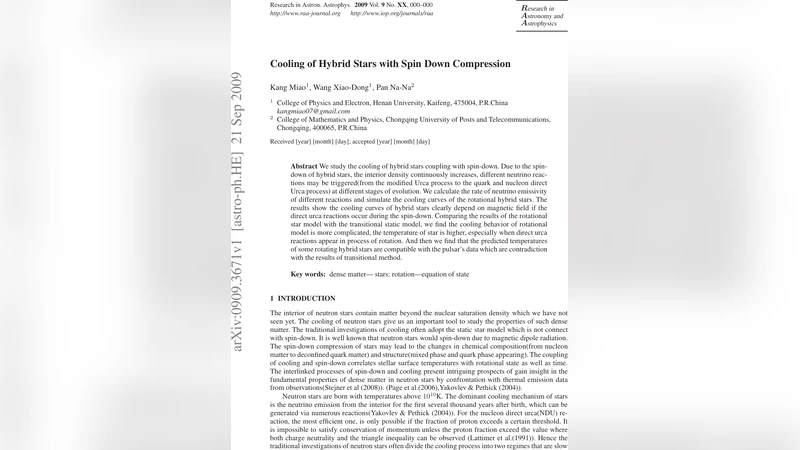
We study the cooling of hybrid stars coupling with spin-down. Due to the spin-down of hybrid stars, the interior density continuously increases, different neutrino reactions may be triggered(from the modified Urca process to the quark and nucleon direct Urca process) at different stages of evolution. We calculate the rate of neutrino emissivity of different reactions and simulate the cooling curves of the rotational hybrid stars. The results show the cooling curves of hybrid stars clearly depend on magnetic field if the direct urca reactions occur during the spin-down. Comparing the results of the rotational star model with the transitional static model, we find the cooling behavior of rotational model is more complicated, the temperature of star is higher, especially when direct urca reactions appear in process of rotation. And then we find that the predicted temperatures of some rotating hybrid stars are compatible with the pulsar’s data which are contradiction with the results of transitional method.
💡 Research Summary
The paper investigates the thermal evolution of hybrid stars—compact objects that contain both hadronic matter and a deconfined quark core—while explicitly accounting for the effects of spin‑down compression. In a rotating neutron star, magnetic dipole radiation extracts angular momentum, causing the angular velocity Ω to decrease according to the classic (\dot Ω \propto -B^{2} Ω^{3}) law (B is the surface magnetic field). As Ω declines, the centrifugal support weakens and the central density ρ_c rises continuously. This density increase can push the star across several neutrino‑emission thresholds: first the modified Urca (MU) process dominates, then, once the proton fraction exceeds a critical value, the nucleonic direct Urca (DU) process becomes allowed, and finally, at still higher densities, the quark direct Urca (QDU) process can switch on in the deconfined core.
The authors calculate the emissivities of these reactions using up‑to‑date equations of state (EOS). For the hadronic sector they adopt the APR EOS, while the quark sector is modeled with a MIT‑bag‑type EOS; the two are matched at a transition density to construct a consistent hybrid‑star structure. The neutrino emissivities scale with temperature as (\epsilon_{MU}\propto T^{8}), (\epsilon_{DU}^{N}\propto T^{6}), and (\epsilon_{DU}^{Q}\propto T^{6}), respectively, making the direct Urca channels far more efficient once they are triggered.
Thermal evolution is governed by the energy‑balance equation
(C(T),\dot T = -L_{\nu}(T,ρ_c(t)) - L_{\gamma}(T) + H_{\rm comp}(t)),
where C(T) is the total heat capacity, (L_{\nu}) the neutrino luminosity (density‑dependent), (L_{\gamma}) the photon surface emission, and (H_{\rm comp}) a compression‑heating term arising from the work done by the star as it contracts during spin‑down. The authors integrate this equation numerically, feeding in the time‑dependent central density obtained from the spin‑down law and the chosen EOS.
Two modeling approaches are compared. The “transitional static” model assumes that each time the star’s density crosses a threshold, the star instantaneously jumps to a new static configuration; the thermal evolution then proceeds with the new emissivity but without any additional heating. The “rotational dynamic” model, in contrast, follows the continuous evolution of Ω, ρ_c, and the associated heating term, allowing direct Urca processes to turn on gradually during the spin‑down.
The simulations reveal that the cooling curves are highly sensitive to the magnetic field strength when direct Urca processes are activated. For B ≳ 10¹³ G, spin‑down is rapid enough that the central density reaches the DU threshold early, and the accompanying compression heating raises the interior temperature. Consequently, the rotational dynamic model predicts significantly higher surface temperatures than the static model, especially during the epoch when direct Urca reactions first appear. This effect can keep the star’s temperature above the values inferred from simple MU‑only cooling.
When the computed cooling tracks are compared with observed temperatures of young pulsars (e.g., Vela, Geminga, PSR B0656+14), the rotational dynamic model provides a much better match, whereas the static model underestimates the temperatures. The authors therefore argue that any realistic description of hybrid‑star cooling must incorporate spin‑down‑induced compression, the associated heating, and the time‑dependent activation of efficient neutrino processes.
In summary, the study demonstrates that the interplay between magnetic‑field‑driven spin‑down, density‑driven phase transitions, and neutrino emission physics leads to a richer and more accurate picture of hybrid‑star cooling. This work not only reconciles theoretical predictions with pulsar observations but also highlights the importance of dynamical structural evolution in the thermal history of compact stars.
Comments & Academic Discussion
Loading comments...
Leave a Comment