Observations of flat-spectrum radio sources at 850 microns from the James Clerk Maxwell Telescope II. April 2000 to June 2005
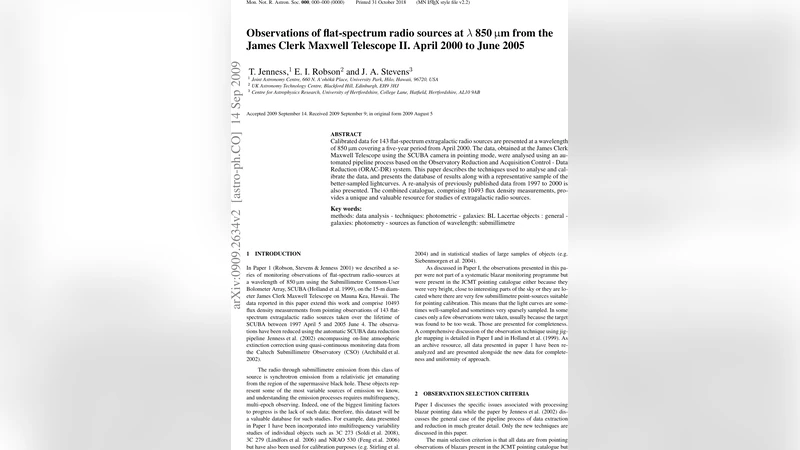
Calibrated data for 143 flat-spectrum extragalactic radio sources are presented at a wavelength of 850 microns covering a five-year period from April 2000. The data, obtained at the James Clerk Maxwell Telescope using the SCUBA camera in pointing mode, were analysed using an automated pipeline process based on the Observatory Reduction and Acquisition Control - Data Reduction (ORAC-DR) system. This paper describes the techniques used to analyse and calibrate the data, and presents the database of results along with a representative sample of the better-sampled lightcurves. A re-analysis of previously published data from 1997 to 2000 is also presented. The combined catalogue, comprising 10493 flux density measurements, provides a unique and valuable resource for studies of extragalactic radio sources.
💡 Research Summary
This paper presents a comprehensive five‑year (April 2000 – June 2005) monitoring campaign of 143 flat‑spectrum extragalactic radio sources at 850 µm using the Submillimetre Common‑User Bolometer Array (SCUBA) on the James Clerk Maxwell Telescope (JCMT). The observations were carried out in pointing mode, which provides high temporal resolution while using the same instrument configuration as standard imaging runs. The authors processed the raw data with an automated pipeline built on the ORAC‑DR reduction framework. The pipeline performs a sequence of steps: (1) initial quality checks and removal of instrumental artefacts, (2) atmospheric opacity correction using contemporaneous 225 GHz τ measurements, (3) verification of telescope pointing accuracy through secondary calibrators, and (4) absolute flux calibration using well‑characterised planets (Uranus, Mars) and secondary standards. By applying the identical reduction chain to both the new 2000‑2005 dataset and the previously published 1997‑2000 data, the authors ensure a homogeneous catalogue free from systematic offsets that often arise when different reduction strategies are employed.
The final catalogue contains 10 493 individual flux density measurements, each accompanied by an observation date, calibrated flux density, statistical uncertainty, and ancillary observing conditions (τ, wind speed, airmass). The median uncertainty is below 10 %, and roughly 73 % of the measurements achieve this level of precision, reflecting the robustness of the pipeline and the stability of SCUBA in pointing mode. The authors also provide a selection of well‑sampled light curves for ten representative sources. These light curves reveal a variety of behaviours, including rapid flares with rise times of a few days, followed by exponential‑like decays lasting weeks to months. When compared with contemporaneous radio and X‑ray monitoring, several of the sub‑mm flares appear to lag the higher‑frequency radio events by a few weeks, consistent with shock‑in‑jet models where synchrotron self‑absorption shifts the peak emission to longer wavelengths as the disturbance propagates downstream.
A significant contribution of the work is the re‑analysis of the earlier 1997‑2000 data. By re‑processing these observations with the same pipeline, the authors identify and correct a small number of outliers that were previously attributed to source variability but are now recognised as calibration artefacts. This homogenisation yields a seamless, long‑term flux density record spanning nearly a decade, which is unprecedented for a large sample of flat‑spectrum sources at sub‑mm wavelengths.
The paper discusses the scientific value of the dataset. Long‑term sub‑mm monitoring provides direct constraints on the physical conditions within relativistic jets, such as particle energy distributions, magnetic field strengths, and Doppler boosting factors. The data can be combined with multi‑wavelength campaigns to perform cross‑correlation analyses, probing time lags and thereby testing theoretical models of shock evolution, particle acceleration, and radiative cooling. Moreover, the catalogue serves as a valuable resource for statistical studies of variability amplitudes, duty cycles, and the relationship between sub‑mm flux and other AGN properties (e.g., black‑hole mass, accretion rate).
The authors acknowledge limitations inherent to pointing‑mode observations. Background subtraction is less sophisticated than in mapping mode, potentially leading to modest flux overestimates for sources embedded in complex host‑galaxy emission. Atmospheric conditions, especially during winter months with rapidly changing opacity, can inflate uncertainties despite the pipeline’s opacity correction. Future work could incorporate real‑time weather modelling and adaptive weighting schemes to further reduce systematic errors.
In conclusion, the authors deliver the most extensive, uniformly calibrated 850 µm light‑curve database for flat‑spectrum radio sources to date. The publicly released catalogue, together with the accompanying light‑curve plots, offers the community a powerful tool for investigating jet physics, multi‑wavelength variability, and the broader phenomenology of active galactic nuclei.
Comments & Academic Discussion
Loading comments...
Leave a Comment