Seeing the Collision of a Supernova with its Companion Star
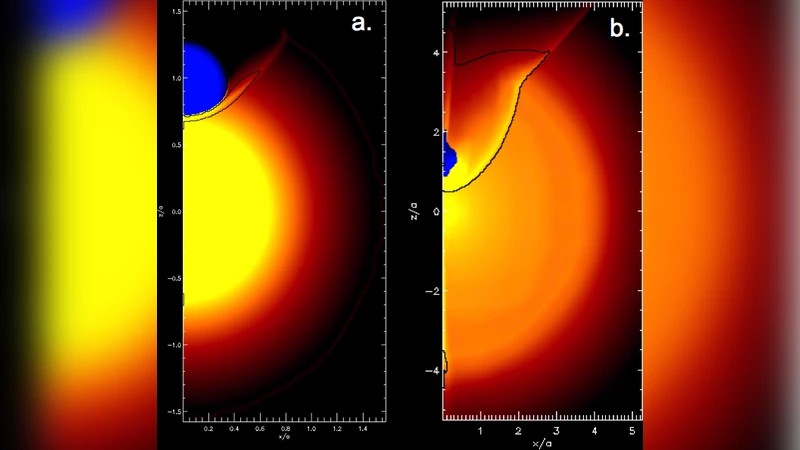
The progenitors of Type Ia and some core collapse supernovae are thought to be stars in binary systems, but little observational evidence exists to confirm the hypothesis. We suggest that the collision of the supernova ejecta with its companion star should produce detectable emission in the hours and days following the explosion. The interaction occurs at distances ~10^11-10^13 cm and shocks the impacting supernova debris, dissipating kinetic energy and re-heating the gas. Initially, some radiation may escape promptly through the evacuated region of the shadowcone, producing a bright X-ray (0.1-2 keV) burst lasting minutes to hours with luminosity L ~ 10^44 ergs/s. Continuing radiative diffusion from deeper layers of shock heated ejecta produces a longer lasting optical/UV emission which exceeds the radioactively powered luminosity of the supernova for the first few days after the explosion. These signatures are prominent for viewing angles looking down upon the shocked region, or about 10% of the time. The properties of the emission provide a straightforward measure of the separation distance between the stars and hence (assuming Roche lobe overflow) the companion’s radius. Current optical and UV data sets likely already constrain red giant companions. By systematically acquiring early time data for many supernovae, it should eventually be possible to empirically determine how the parameters of the progenitor system influence the outcome of the explosion.
💡 Research Summary
The paper proposes a direct observational test for the long‑standing hypothesis that many Type Ia and some core‑collapse supernovae arise from binary systems. When the supernova ejecta expand and strike the companion star, a strong shock forms at a distance of roughly 10¹¹–10¹³ cm from the explosion centre. This interaction creates two temporally distinct electromagnetic signatures that are potentially observable with current facilities.
First, the impact generates a brief, soft X‑ray flash (0.1–2 keV) as the shocked gas in the low‑density “shadow cone” behind the companion becomes optically thin. Assuming that about ten percent of the kinetic energy of the impacting ejecta is converted into radiation, the authors estimate a luminosity of order 10⁴⁴ erg s⁻¹ lasting from a few minutes up to several hours. Such a flash would be detectable by rapid‑response X‑ray telescopes (e.g., Swift/XRT, NICER) if observations can be triggered within the first hour after explosion.
Second, the shocked material beneath the surface of the companion is heated to temperatures of a few ×10⁶ K. Radiative diffusion from this hot layer proceeds on a timescale of days (τ ≈ κ ρ ΔR²/c, with κ≈0.2 cm² g⁻¹, ρ≈10⁻⁸ g cm⁻³, ΔR≈10⁹ cm). During this diffusion phase the supernova exhibits an excess of ultraviolet/optical emission that can reach L≈10⁴²–10⁴³ erg s⁻¹, outshining the radioactive decay power of ⁵⁶Ni for the first few days. This UV/optical excess should be observable with wide‑field UV imagers (e.g., Swift/UVOT, GALEX) and with ground‑based optical surveys that obtain data within 24 h of explosion.
The visibility of both signatures depends strongly on viewing angle. Only observers looking down the shocked region—roughly 10 % of all possible lines of sight, as given by the solid angle Ω≈π(R₂/a)²—will see the full brightness. Consequently, the measured flash luminosity and duration directly encode the binary separation a and the companion radius R₂. Under the assumption of Roche‑lobe overflow, a and R₂ are linked, allowing a straightforward inference of the companion’s evolutionary state (main‑sequence, subgiant, red giant, or white dwarf).
The authors argue that existing early‑time UV datasets already place stringent limits on red‑giant companions for many well‑observed Type Ia events, because a red giant would produce a much brighter and longer‑lasting UV excess than is seen. By systematically acquiring ultra‑early X‑ray and UV observations for a large sample of supernovae, one could statistically map the distribution of binary separations and companion types, thereby testing progenitor models and improving the calibration of Type Ia supernovae as cosmological distance indicators.
In summary, the paper identifies a clear, time‑critical electromagnetic signature of the supernova–companion collision, quantifies its expected luminosity, duration, and angular dependence, and outlines a practical observational strategy to detect it. Successful detection would provide the first direct measurement of binary parameters in supernova progenitors, while non‑detections would tighten constraints on the prevalence of certain companion types, especially extended red giants. This work thus bridges theoretical binary‑evolution predictions with concrete, testable observations.
Comments & Academic Discussion
Loading comments...
Leave a Comment