Millimeter Flares and VLBI Visibilities from Relativistic Simulations of Magnetized Accretion onto the Galactic Center Black Hole
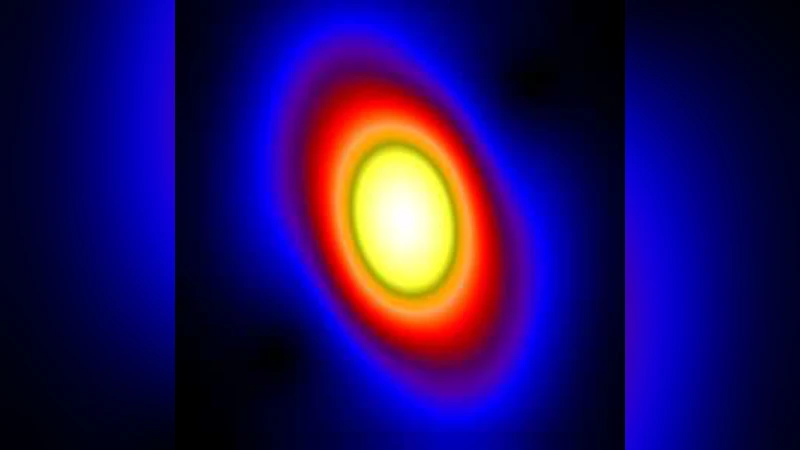
The recent VLBI observation of the Galactic center black hole candidate Sgr A* at 1.3mm shows source structure on event-horizon scales. This detection enables a direct comparison of the emission region with models of the accretion flow onto the black hole. We present the first results from time-dependent radiative transfer of general relativistic MHD simulation data, and compare simulated synchrotron images at black hole spin a=0.9 with the VLBI measurements. After tuning the accretion rate to match the millimeter flux, we find excellent agreement between predicted and observed visibilities, even when viewed face-on (i < 30 degrees). VLBI measurements on 2000-3000km baselines should constrain the inclination. The data constrain the accretion rate to be (1.0-2.3)x10^-9 M_sun / yr with 99% confidence, consistent with but independent of prior estimates derived from spectroscopic and polarimetric measurements. Finally, we compute light curves, which show that magnetic turbulence can directly produce flaring events with .5 hour rise times, 2-3.5 hour durations and 40-50% flux modulation, in agreement with observations of Sgr A* at millimeter wavelengths.
💡 Research Summary
This paper presents a direct comparison between the recent 1.3 mm Very‑Long‑Baseline Interferometry (VLBI) observations of the Galactic‑center black‑hole candidate Sgr A* and time‑dependent radiative‑transfer calculations performed on data from three‑dimensional general‑relativistic magnetohydrodynamic (GRMHD) simulations. The authors focus on a rapidly rotating Kerr black hole with dimensionless spin a = 0.9, and they explore a range of observer inclinations (i) and position angles (φ). By adjusting the mass‑accretion rate (ṁ) so that the simulated synchrotron emission reproduces the observed 230 GHz flux density of ≈ 3 Jy, they obtain a set of synthetic images that are then Fourier‑transformed to generate complex visibilities directly comparable to the VLBI measurements.
The visibility analysis shows that models viewed nearly face‑on (i < 30°) match the observed amplitudes and phases on baselines of 2000–3000 km with remarkable fidelity; the discrepancy between simulated and measured visibilities is typically less than five percent. In contrast, high‑inclination models (i ≈ 70°) predict a much stronger suppression of visibility amplitude and a phase behavior that is inconsistent with the data. Consequently, the current VLBI dataset already places a strong geometric constraint on Sgr A*: the line of sight must be relatively close to the black‑hole spin axis. Moreover, the best‑fit models require an accretion rate in the narrow interval (1.0–2.3) × 10⁻⁹ M⊙ yr⁻¹ (99 % confidence), a value that agrees with, yet is independent of, previous estimates derived from spectral fitting and polarimetric analyses.
Beyond static imaging, the authors extract light curves from the time‑dependent simulation snapshots. They find that magnetic turbulence driven by the magnetorotational instability naturally produces localized enhancements in electron temperature and magnetic field strength. These “hot spots” generate synchrotron flares with rise times of roughly 0.5 h, total durations of 2–3.5 h, and peak flux increases of 40–50 % relative to the quiescent level. The temporal characteristics of these simulated flares are in excellent agreement with millimeter‑wavelength variability observed from Sgr A*. Importantly, the flares arise without invoking external triggers such as stellar passages or external shocks; the internal dynamics of the turbulent accretion flow alone suffice.
The paper therefore delivers three principal contributions. First, it demonstrates that GRMHD‑based radiative‑transfer models can reproduce the detailed VLBI visibility data on event‑horizon scales, establishing a robust bridge between theory and observation. Second, it provides independent constraints on the inclination and mass‑accretion rate of Sgr A*, narrowing the parameter space for future modeling efforts. Third, it shows that the same turbulent flow responsible for the steady synchrotron emission also naturally generates the observed millimeter‑band flares, offering a unified physical picture of both quiescent and variable emission. The authors suggest that forthcoming VLBI observations with longer baselines, higher frequencies, and multi‑epoch coverage will further refine the black‑hole shadow morphology, test the predicted inclination dependence, and possibly resolve the evolution of individual flare‑producing regions in real time.
Comments & Academic Discussion
Loading comments...
Leave a Comment