Explorations Beyond the Snow Line: Spitzer/IRS Spectra of Debris Disks Around Solar-Type Stars
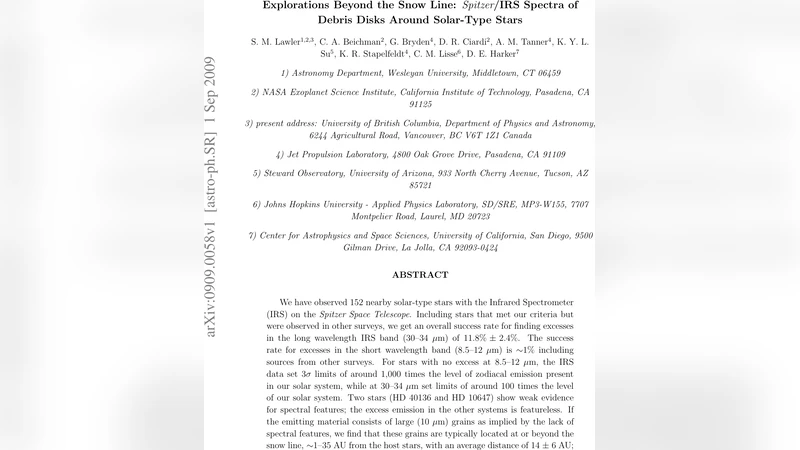
We have observed 152 nearby solar-type stars with the Infrared Spectrometer (IRS) on the Spitzer Space Telescope. Including stars that met our criteria but were observed in other surveys, we get an overall success rate for finding excesses in the long wavelength IRS band (30-34 micron) of 11.8% +/- 2.4%. The success rate for excesses in the short wavelength band (8.5-12 micron) is ~1% including sources from other surveys. For stars with no excess at 8.5-12 microns, the IRS data set 3 sigma limits of around 1,000 times the level of zodiacal emission present in our solar system, while at 30-34 microns set limits of around 100 times the level of our solar system. Two stars (HD 40136 and HD 10647) show weak evidence for spectral features; the excess emission in the other systems is featureless. If the emitting material consists of large (10 micron) grains as implied by the lack of spectral features, we find that these grains are typically located at or beyond the snow line, ~1-35 AU from the host stars, with an average distance of 14 +/- 6 AU; however smaller grains could be located at significantly greater distances from the host stars. These distances correspond to dust temperatures in the range ~50-450 K. Several of the disks are well modeled by a single dust temperature, possibly indicative of a ring-like structure. However, a single dust temperature does not match the data for other disks in the sample, implying a distribution of temperatures within these disks. For most stars with excesses, we detect an excess at both IRS and MIPS wavelengths. Only three stars in this sample show a MIPS 70 micron excess with no IRS excess, implying that very cold dust is rare around solar-type stars.
💡 Research Summary
This paper presents a systematic mid‑infrared spectroscopic survey of 152 nearby solar‑type (F, G, K) stars using the Infrared Spectrograph (IRS) on the Spitzer Space Telescope. The authors divided the IRS wavelength coverage into a short‑wavelength band (8.5–12 µm) and a long‑wavelength band (30–34 µm) and searched for excess emission above the stellar photosphere in each band. By also incorporating stars that met the selection criteria but were observed in other Spitzer programs, they derived an overall detection rate of 11.8 % ± 2.4 % for excesses in the long‑wavelength band, while the detection rate in the short‑wavelength band is only about 1 %. This stark contrast indicates that warm dust (≈300 K and hotter) is rare around solar‑type stars, whereas colder dust (≈50–150 K) is present in roughly one‑tenth of the sample.
For stars without detectable excesses, the authors set 3σ upper limits of roughly 1 000 times the zodiacal dust level of the Solar System in the short band and about 100 times in the long band. Thus, the majority of surveyed stars do not host debris disks that are substantially brighter than our own zodiacal cloud, especially at the colder temperatures probed by the long‑wavelength IRS data.
Spectral analysis shows that only two objects (HD 40136 and HD 10647) display weak solid‑state features (likely silicate or carbonaceous emission), whereas the excesses in the remaining systems are essentially featureless. The lack of spectral features points to grain sizes of order 10 µm or larger, because particles of this size suppress the characteristic vibrational resonances that produce emission bands. Assuming such large grains, the authors model the excesses as blackbody emission and infer typical radial locations of the dust between 1 and 35 AU, with an average distance of 14 ± 6 AU from the host stars. These radii correspond to dust temperatures ranging from about 50 K up to 450 K, i.e., the material generally resides at or beyond the snow line of the system.
Some disks are well described by a single blackbody temperature, suggesting a narrow, ring‑like dust distribution. Other systems require multiple temperature components, implying a broader radial spread or a mixture of grain sizes and compositions that produce a temperature gradient. The authors note that most stars with IRS excesses also show excesses at MIPS 24 µm and/or 70 µm, reinforcing the view that the detected dust spans the temperature range to which both instruments are sensitive. Only three stars exhibit a 70 µm excess without an accompanying IRS excess, indicating that truly cold (≲30 K) dust reservoirs are uncommon around solar‑type stars.
Statistically, the presence of detectable cold debris disks around solar‑type stars is about 10 %, consistent with the idea that a modest fraction of such stars retain planetesimal belts after the epoch of planet formation. The scarcity of warm excesses suggests either low levels of ongoing collisional grinding in the inner planetary system or rapid removal of small grains by radiation pressure and Poynting‑Robertson drag.
The paper concludes that Spitzer/IRS provides valuable constraints on grain size, temperature, and radial location of debris material, and that the predominance of large, cold grains points to an evolutionary stage where only the outer, more massive planetesimal belts survive. The authors advocate for follow‑up observations with higher‑resolution and higher‑sensitivity facilities such as JWST, the Extremely Large Telescope (ELT), and future far‑infrared missions. These instruments will be able to probe smaller grains, resolve disk structures, and test whether the featureless spectra truly reflect a lack of small particles or are simply limited by Spitzer’s spectral resolution and sensitivity. Such studies will deepen our understanding of debris‑disk evolution and its connection to planetary system architecture.
Comments & Academic Discussion
Loading comments...
Leave a Comment