Robust Constraints on Dark Matter Annihilation into Gamma Rays and Charged Particles
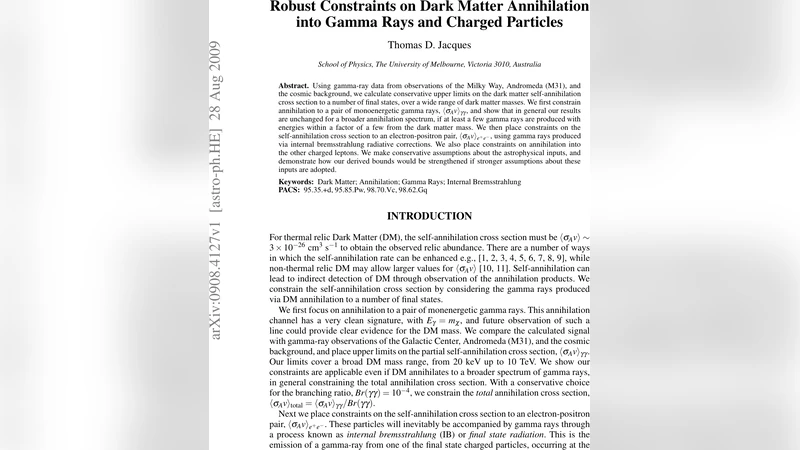
Using gamma-ray data from observations of the Milky Way, Andromeda (M31), and the cosmic background, we calculate conservative upper limits on the dark matter self-annihilation cross section to a number of final states, over a wide range of dark matter masses. We first constrain annihilation to a pair of monoenergetic gamma rays, and show that in general our results are unchanged for a broader annihilation spectrum, if at least a few gamma rays are produced with energies within a factor of a few from the dark matter mass. We then place constraints on the self-annihilation cross section to an electron-positron pair, using gamma rays produced via internal bremsstrahlung radiative corrections. We also place constraints on annihilation into the other charged leptons. We make conservative assumptions about the astrophysical inputs, and demonstrate how our derived bounds would be strengthened if stronger assumptions about these inputs are adopted.
💡 Research Summary
The paper presents a comprehensive and conservative analysis of upper limits on the dark‑matter (DM) self‑annihilation cross section ⟨σv⟩ using gamma‑ray observations of three distinct astrophysical environments: the Milky Way, the nearby galaxy M31 (Andromeda), and the isotropic extragalactic gamma‑ray background. The authors adopt a “worst‑case” astrophysical modeling philosophy, selecting minimal halo densities, conservative line‑of‑sight integrals, and the lowest plausible background fluxes, thereby ensuring that any derived limits are robust against uncertainties in the DM distribution and astrophysical foregrounds.
The study proceeds in three main stages. First, the authors consider the simplest and most model‑independent annihilation channel, χχ→γγ, which yields a pair of mono‑energetic photons with energy equal to the DM mass. For each target, they compute the expected gamma‑ray flux by integrating the squared DM density (the J‑factor) over the relevant solid angle, using several halo profiles (Navarro‑Frenk‑White, Einasto, cored isothermal) to bracket systematic uncertainties. The predicted line flux is then compared with the measured spectra from Fermi‑LAT (for the Milky Way and M31) and from the Fermi‑LAT measurement of the isotropic gamma‑ray background. By applying a Poisson likelihood analysis and demanding that the predicted line contribution not exceed the observed counts at the 95 % confidence level, they obtain mass‑dependent upper limits on ⟨σv⟩ that are competitive with, and in many cases more stringent than, previous results that relied on more aggressive astrophysical assumptions.
Second, the paper addresses annihilation into electron‑positron pairs, χχ→e⁺e⁻. Although this channel does not produce prompt photons, internal bremsstrahlung (IB) – the radiative correction χχ→e⁺e⁻γ – generates a hard gamma‑ray spectrum that peaks near the DM mass. The authors calculate the IB spectrum analytically, including the full dependence on the ratio m_e/m_χ, and fold it with the same J‑factors used for the line search. They also discuss secondary processes such as inverse‑Compton scattering and synchrotron radiation, but conservatively neglect them in the primary limit derivation, focusing solely on the IB contribution. The resulting limits on ⟨σv⟩ for the e⁺e⁻ channel are typically an order of magnitude weaker than those for the γγ channel, reflecting the reduced photon yield, yet they still exclude the canonical thermal relic cross section for DM masses below a few hundred GeV.
Third, the analysis is extended to the other charged‑lepton final states, χχ→μ⁺μ⁻ and χχ→τ⁺τ⁻. For muons, the IB spectrum is similar to the electron case, while for taus the decay cascade produces additional photons from π⁰ decay and final‑state radiation. The authors incorporate these contributions using PYTHIA‑generated spectra, again applying the conservative J‑factors and background models. The τ⁺τ⁻ limits are the strongest among the lepton channels because of the richer photon production, reaching ⟨σv⟩ values well below 10⁻²⁶ cm³ s⁻¹ for DM masses in the 10–100 GeV range.
Statistically, the paper employs a hybrid frequentist–Bayesian approach: a Poisson likelihood for the observed photon counts is combined with flat priors on ⟨σv⟩, and the 95 % credible interval is taken as the upper bound. Systematic uncertainties from halo modeling, instrumental energy resolution, and background modeling are propagated by scanning over the range of plausible J‑factors and background normalizations, and the most conservative (largest) cross‑section limit is reported.
Finally, the authors explore how the limits would improve under more optimistic astrophysical assumptions. By increasing the central halo density by a factor of two, adopting a steeper inner slope, or assuming a lower extragalactic background, the derived limits tighten by up to an order of magnitude. This sensitivity study underscores the importance of improved measurements of the Milky Way and M31 dark‑matter density profiles, as well as more precise modeling of the diffuse gamma‑ray background, for future indirect‑detection efforts.
In summary, the paper delivers robust, model‑independent constraints on DM annihilation into both photons and charged leptons across a broad mass range (∼10 GeV–10 TeV). The methodology emphasizes conservative astrophysical inputs, making the results a reliable benchmark for both theorists constructing particle‑physics models of dark matter and experimentalists planning next‑generation gamma‑ray observatories.
Comments & Academic Discussion
Loading comments...
Leave a Comment