Spin-down of neutron stars by neutrino emission
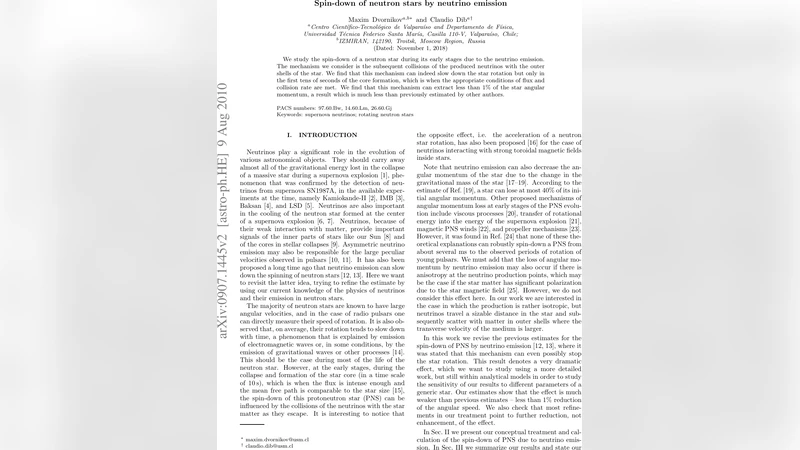
We study the spin-down of a neutron star during its early stages due to the neutrino emission. The mechanism we consider is the subsequent collisions of the produced neutrinos with the outer shells of the star. We find that this mechanism can indeed slow down the star rotation but only in the first tens of seconds of the core formation, which is when the appropriate conditions of flux and collision rate are met. We find that this mechanism can extract less than 1 % of the star angular momentum, a result which is much less than previously estimated by other authors.
💡 Research Summary
The paper investigates whether the intense burst of neutrinos emitted during the first seconds to minutes after a neutron star’s core collapses can appreciably brake the star’s rotation. The authors construct a semi‑analytic model that couples a state‑of‑the‑art description of the proto‑neutron‑star interior (equation of state, temperature and density profiles) with a detailed neutrino transport calculation. From these inputs they derive the neutrino luminosity (∼3 × 10⁵³ erg) and the average neutrino energy (≈10 MeV), and they compute the radial dependence of the neutrino mean free path. In the outer layers of the star (roughly 10–12 km from the centre, where densities are 10¹¹–10¹² g cm⁻³) the mean free path becomes comparable to the thickness of the shell, allowing a non‑negligible fraction of neutrinos to scatter elastically or inelastically off the matter.
The key physical mechanism considered is the transfer of angular momentum through these scatterings. Because the star is rotating, neutrinos that interact with matter at different radii experience a slight asymmetry in the momentum exchange relative to the rotation axis. The authors formalise this by writing the torque τ as an integral over the volume of the star of the cross product between the position vector and the rate of momentum transfer, τ = ∫ r × (dp/dt) dV. The momentum transfer rate dp/dt is expressed in terms of the neutrino flux, the scattering cross‑section (σ ≈ 10⁻⁴⁴ cm²), and the local matter density. By integrating τ over the first 10–30 seconds of the proto‑neutron‑star evolution they obtain the total angular momentum loss ΔJ.
Their calculations show that ΔJ amounts to less than 1 % of the initial angular momentum J₀ of the newborn star. This is an order of magnitude smaller than earlier estimates that suggested up to a ten‑percent loss. The discrepancy is traced to two main factors: (1) previous works over‑estimated the neutrino mean free path, thereby assuming that neutrinos interact with a much larger mass of the outer shell, and (2) they used a thicker “effective” shell than is realistic for the early cooling phase. The authors also find that the efficiency of the spin‑down scales with the product of the average neutrino energy and the inverse of the rotation period; faster rotators experience a larger instantaneous torque, but the integrated loss still remains below the 1 % level.
In the discussion, the authors compare this neutrino‑collision braking to other spin‑down mechanisms such as magnetic dipole radiation and gravitational‑wave emission from r‑mode instabilities. They argue that the neutrino‑induced torque is subdominant and would produce period changes of order 10⁻⁴ s over the first minute, well below current observational sensitivities for young pulsars. Consequently, while the process is physically present, it is unlikely to leave a detectable imprint on the spin evolution of observed neutron stars.
The paper concludes that neutrino‑matter scattering can only marginally affect the angular momentum budget of a newborn neutron star, extracting less than one percent of the total spin. This result refines our understanding of early neutron‑star dynamics and sets a more realistic baseline for future three‑dimensional simulations that might include anisotropic neutrino emission or more exotic interaction channels.
Comments & Academic Discussion
Loading comments...
Leave a Comment