Shapiro effect for for relativistic particles - testing General Relativity in a new window
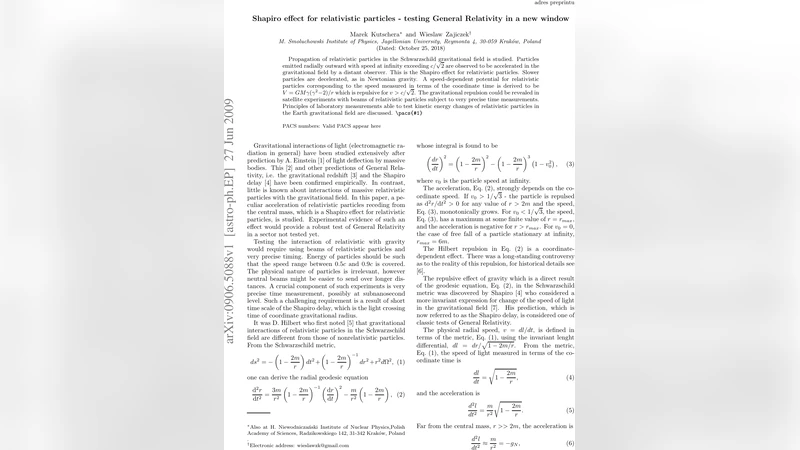
Propagation of relativistic particles in the Schwarzschild gravitational field is studied. Particles emitted radially outward with speed at infinity exceeding c/2^0.5 are observed to be accelerated in the gravitational field by a distant observer. This is the Shapiro effect for relativistic particles. Slower particles are decelerated, as in Newtonian gravity. A speed-dependent potential for relativistic particles corresponding to the speed measured in terms of the coordinate time is derived to be $V=GM gamma(gamma^2 -2)/r which is repulsive for v>c/2^0.5. The gravitational repulsion could be revealed in satellite experiments with beams of relativistic particles subject to very precise time measurements. Principles of laboratory measurements able to test kinetic energy changes of relativistic particles in the Earth gravitational field are discussed.
💡 Research Summary
The paper investigates the motion of relativistic particles in the static, spherically symmetric Schwarzschild gravitational field, extending the well‑known Shapiro time‑delay effect—originally formulated for photons—to massive particles. Starting from the Schwarzschild line element, the authors write the particle Lagrangian in terms of the coordinate time (t) and derive the conserved energy \
Comments & Academic Discussion
Loading comments...
Leave a Comment