Two Rapidly Variable Galactic X-ray Transients Observed with Chandra, XMM and Suzaku
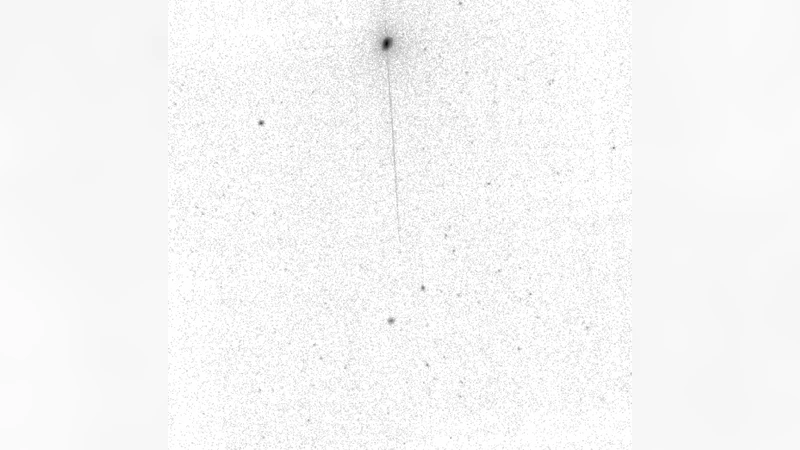
We have identified two moderately bright, rapidly variable transients in new and archival X-ray data near the Galactic center. Both objects show strong, flaring variability on timescales of tens to thousands of seconds, evidence of N_H variability, and hard spectra. XMMU J174445.5-295044 is seen at 2-10 keV fluxes of 310^{-11} to <10^{-12} ergs/cm^2/s, with N_H at or above 510^22 cm^{-2}, by XMM, Chandra, and Suzaku. A likely 2MASS counterpart with K_S=10.2 shows colors indicative of a late-type star. CXOU J174042.0-280724 is a likely counterpart to the fast hard transient IGR J17407-2808. Chandra observations find F_X(2-10 keV)~10^{-12} ergs/cm^{-2}/s, with large N_H variations (from 210^22 to >210^23 cm^{-2}). No 2MASS counterpart is visible, to K_S>13. XMMU J174445.5-295044 seems likely to be a new symbiotic star or symbiotic X-ray binary, while CXOU J174042.0-280724 is more mysterious, likely an unusual low-mass X-ray binary.
💡 Research Summary
The authors report the discovery and multi‑epoch analysis of two rapidly variable X‑ray transients located within a few degrees of the Galactic Center, using data from Chandra, XMM‑Newton, and Suzaku. The first source, XMMU J174445.5‑295044, exhibits 2–10 keV fluxes ranging from ~3 × 10⁻¹¹ erg cm⁻² s⁻¹ down to below 10⁻¹² erg cm⁻² s⁻¹, with column densities N_H at or above 5 × 10²² cm⁻². A likely infrared counterpart is found in the 2MASS catalog (K_S ≈ 10.2 mag) whose colors are consistent with a late‑type giant. The combination of hard X‑ray emission, strong and variable absorption, and a red‑giant companion points to a symbiotic star or symbiotic X‑ray binary, where a compact object accretes from the wind of a giant.
The second source, CXOU J174042.0‑280724, is identified as the soft X‑ray counterpart of the fast hard transient IGR J17407‑2808. Chandra observations reveal a 2–10 keV flux of ~10⁻¹² erg cm⁻² s⁻¹, but the measured N_H varies dramatically from ~2 × 10²² cm⁻² up to >2 × 10²³ cm⁻² on timescales of minutes to hours. No 2MASS object is detected at the position (K_S > 13 mag), indicating either a very faint donor or a large distance. The rapid flaring, hard spectrum, and extreme absorption variability suggest an unusual low‑mass X‑ray binary, possibly involving a neutron star with a strong magnetic field or a compact object embedded in a dense, clumpy wind.
Both transients share key characteristics: hard X‑ray spectra, strong and variable intrinsic absorption, and variability on timescales from tens to thousands of seconds. The first source is likely a new member of the symbiotic class, while the second remains enigmatic but may represent a rare type of low‑mass system with extreme circumstellar material. These findings expand the known population of Galactic Center X‑ray transients and underscore the importance of coordinated, multi‑instrument monitoring to uncover the nature of rapidly varying, heavily absorbed X‑ray sources.
Comments & Academic Discussion
Loading comments...
Leave a Comment