Phases of a bilayer Fermi gas
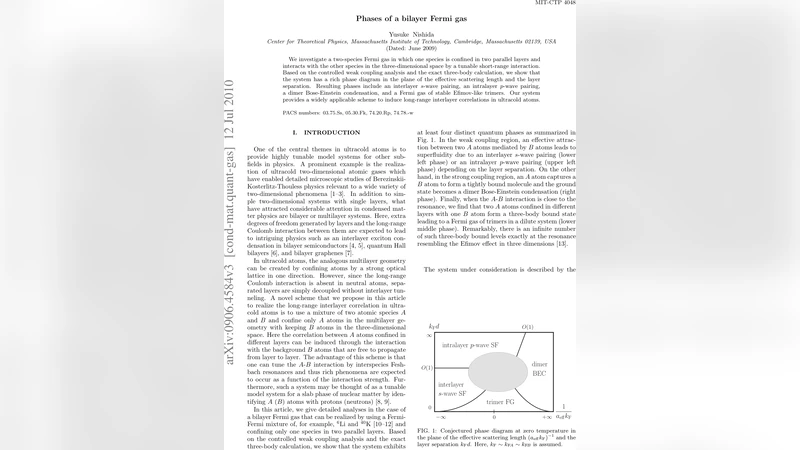
We investigate a two-species Fermi gas in which one species is confined in two parallel layers and interacts with the other species in the three-dimensional space by a tunable short-range interaction. Based on the controlled weak coupling analysis and the exact three-body calculation, we show that the system has a rich phase diagram in the plane of the effective scattering length and the layer separation. Resulting phases include an interlayer s-wave pairing, an intralayer p-wave pairing, a dimer Bose-Einstein condensation, and a Fermi gas of stable Efimov-like trimers. Our system provides a widely applicable scheme to induce long-range interlayer correlations in ultracold atoms.
💡 Research Summary
The paper presents a theoretical study of a mixed‑dimensional two‑species Fermi gas in which one species (denoted A) is confined to two parallel two‑dimensional (2D) layers while the other species (denoted B) moves freely in three dimensions (3D). The two species interact via a short‑range contact interaction that can be tuned by a Feshbach resonance, giving an effective 2D‑3D scattering length (a_{\mathrm{eff}}). The second controllable parameter is the inter‑layer separation (d). By varying ((a_{\mathrm{eff}},d)) the authors map out a rich phase diagram that contains four distinct many‑body phases: inter‑layer s‑wave pairing, intra‑layer p‑wave pairing, a dimer Bose‑Einstein condensate (BEC), and a gas of stable Efimov‑like trimers.
Model and Methods
The Hamiltonian consists of two 2D fermionic fields (\psi_{A}^{(1,2)}) (one per layer) and a 3D field (\psi_{B}) coupled by a contact term (g,\psi_{A}^{\dagger}\psi_{B}^{\dagger}\psi_{B}\psi_{A}). The bare coupling (g) is related to the experimentally tunable scattering length (a_{\mathrm{eff}}) through the usual renormalization relation (g\propto 4\pi a_{\mathrm{eff}}/\mu) where (\mu) is the reduced mass. In the weak‑coupling regime the authors employ perturbation theory and the random‑phase approximation (RPA) to derive an induced interaction between the two layers,
\
Comments & Academic Discussion
Loading comments...
Leave a Comment