A GRB Follow-up System at the Xinglong Observatory and Detection of the High-Redshift GRB 060927
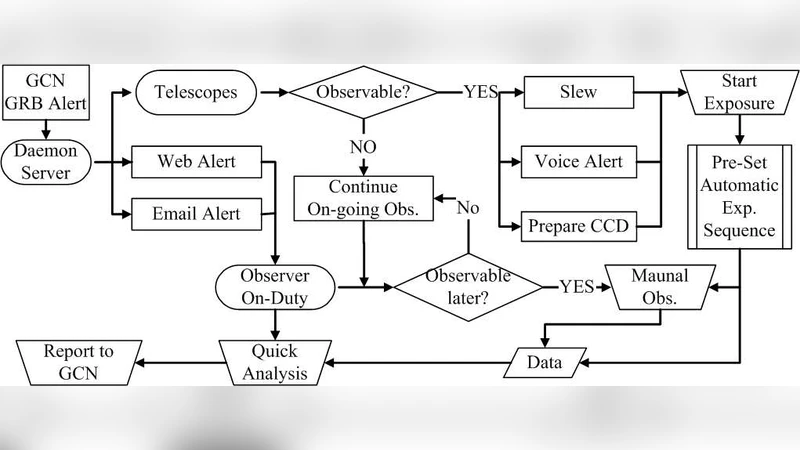
A gamma-ray burst (GRB) optical photometric follow-up system at the Xinglong Observatory of National Astronomical Observatories of China (NAOC) has been constructed. It uses the 0.8-m Tsinghua-NAOC Telescope (TNT) and the 1-m EST telescope, and can automatically respond to GRB Coordinates Network (GCN)alerts. Both telescopes slew relatively fast, being able to point to a new target field within about 1 min upon a request. Whenever available, the 2.16-m NAOC telescope is also used. In 2006, the system responded to 15 GRBs and detected seven early afterglows. In 2007, six GRBs have been detected among 18 follow-up observations. TNT observations of the second most distant GRB 060927 (z=5.5) are shown, which started as early as 91s after the GRB trigger. The afterglow was detected in the combined image of first 19x20s unfiltered exposures. This GRB follow-up system has joined the East-Asia GRB Follow-up Observation Network (EAFON).
💡 Research Summary
The paper presents the design, implementation, and performance of a rapid optical follow‑up system for gamma‑ray bursts (GRBs) operating at the Xinglong Observatory of the National Astronomical Observatories of China (NAOC). The system is built around two medium‑size telescopes: the 0.8‑m Tsinghua‑NAOC Telescope (TNT) and the 1‑m EST (Equatorial Schmidt Telescope). When a GRB Coordinates Network (GCN) alert is received, an automated software suite parses the coordinates, generates an observing script, and commands the telescopes to slew to the target. Both telescopes are equipped with fast, motorized mounts capable of completing the slew in roughly 60 seconds, a substantial improvement over traditional manual response times.
The observing strategy emphasizes speed and sensitivity. The telescopes operate primarily in an unfiltered (white‑light) mode to maximize photon collection. For each trigger the system acquires a series of short exposures (typically 20 s each); during the 2006–2007 campaign a standard sequence of 19 consecutive frames was used, yielding a total integration time of 380 s after co‑addition. This approach balances the need for rapid early‑time coverage with sufficient signal‑to‑noise to detect faint afterglows that fade quickly.
Operational statistics are reported for two years. In 2006 the system responded to 15 GCN alerts, detecting early afterglows in 7 cases (≈47 % success). In 2007 it handled 18 alerts, with 6 detections (≈33 %). The detection rate is limited primarily by weather, night‑time availability, and target elevation, but the overall performance demonstrates that a sub‑minute response combined with a modest total exposure can reliably capture the early optical emission of a substantial fraction of GRBs.
A highlight of the program is the observation of GRB 060927, the second most distant GRB known at the time (spectroscopic redshift z = 5.5). The first exposure began 91 seconds after the BAT trigger. The afterglow was not visible in any single 20‑second frame but emerged clearly in the stacked image of the first 19 exposures, reaching an approximate magnitude of R ≈ 20 mag with a >5σ detection. This early detection at such a high redshift illustrates the system’s capability to probe the Universe when it was less than a billion years old, providing valuable constraints on star formation, metal enrichment, and the intergalactic medium at that epoch.
The Xinglong system is a member of the East‑Asia GRB Follow‑up Observation Network (EAFON), contributing rapid, medium‑aperture coverage that complements larger telescopes which often require longer setup times. The paper discusses future upgrades: implementation of an automated filter wheel to obtain multi‑band color information (R, I, z), real‑time data transmission and automated photometry pipelines for immediate dissemination to the global community, and the development of a dedicated automatic mode for the 2.16‑m NAOC telescope to provide deeper, higher‑resolution follow‑up when conditions permit.
In conclusion, the Xinglong GRB follow‑up system demonstrates that a well‑integrated, fast‑slewing, automated network of 0.8‑m and 1‑m telescopes can achieve sub‑minute response times, secure early afterglow detections, and contribute significantly to high‑redshift GRB science. Its performance validates the strategy of combining rapid response with modest exposure depth, and its integration into EAFON enhances the overall temporal and geographic coverage of GRB afterglow observations worldwide.
Comments & Academic Discussion
Loading comments...
Leave a Comment