A faint type of supernova from a white dwarf with a helium-rich companion
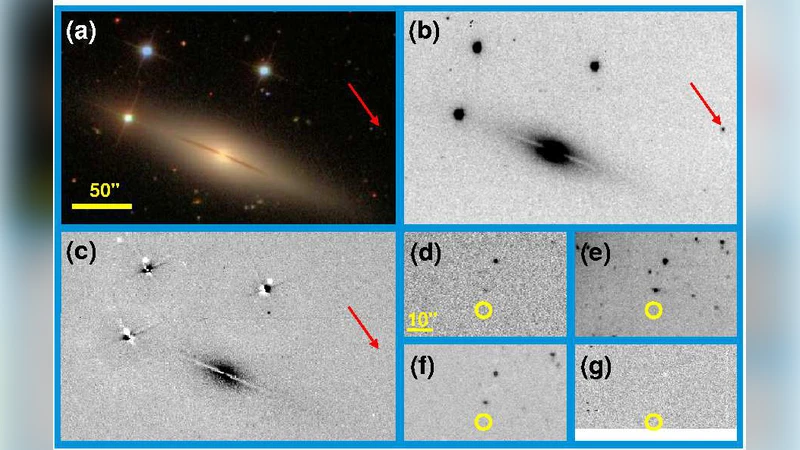
Supernovae (SNe) are thought to arise from two different physical processes. The cores of massive, short-lived stars undergo gravitational core collapse and typically eject a few solar masses during their explosion. These are thought to appear as as type Ib/c and II SNe, and are associated with young stellar populations. A type Ia SN is thought to arise from the thermonuclear detonation of a white dwarf star composed mainly of carbon and oxygen, whose mass approaches the Chandrasekhar limit. Such SNe are observed in both young and old stellar environments. Here we report our discovery of the faint type Ib SN 2005E in the halo of the nearby isolated galaxy, NGC 1032. The lack of any trace of recent star formation near the SN location (Fig. 1), and the very low derived ejected mass (~0.3 M_sun), argue strongly against a core-collapse origin for this event. Spectroscopic observations and the derived nucleosynthetic output show that the SN ejecta have high velocities and are dominated by helium-burning products, indicating that SN 2005E was neither a subluminous nor a regular SN Ia (Fig. 2). We have therefore found a new type of stellar explosion, arising from a low-mass, old stellar system, likely involving a binary with a primary white dwarf and a helium-rich secondary. The SN ejecta contain more calcium than observed in any known type of SN and likely additional large amounts of radioactive 44Ti. Such SNe may thus help resolve fundamental physical puzzles, extending from the composition of the primitive solar system and that of the oldest stars, to the Galactic production of positrons.
💡 Research Summary
The paper reports the discovery and detailed study of SN 2005E, a faint type Ib supernova located in the halo of the isolated galaxy NGC 1032. Unlike typical core‑collapse supernovae (type Ib/c or II), which arise from massive, short‑lived stars and are found in regions of recent star formation, SN 2005E shows no evidence of any young stellar population at its site. Deep imaging in H α and the ultraviolet reveals a completely quiescent environment, indicating that the progenitor belongs to an old stellar population. Photometric analysis yields a peak absolute magnitude of about –15 mag, roughly four magnitudes fainter than a normal type Ia event, and a rapid decline that implies an ejected mass of only ~0.3 M☉. This is far smaller than the ~1 M☉ typically expelled by thermonuclear Ia explosions or the several solar masses released in core‑collapse events.
Spectroscopy obtained near maximum light displays high expansion velocities (~8000 km s⁻¹) and a composition dominated by helium‑burning products. Strong He I 5876 Å, O I 7774 Å, Mg I b, and especially Ca II near‑infrared triplet lines are present, with the calcium features being unusually intense—more so than in any previously observed supernova. Iron‑peak elements and the signatures of ⁵⁶Ni are essentially absent, while the nucleosynthetic pattern suggests a large yield of radioactive ⁴⁴Ti. The abundance pattern points to a detonation of a helium‑rich layer rather than a carbon‑oxygen core explosion.
The authors propose that SN 2005E originates from a low‑mass, old binary system consisting of a carbon‑oxygen white dwarf (≈0.6 M☉) and a helium‑rich companion (either a helium‑rich subgiant or a helium white dwarf). Mass transfer from the companion builds up a thin helium shell on the white dwarf surface. When the shell reaches a critical mass, a helium detonation ignites, ejecting a small amount of material at high velocity without disrupting the underlying white dwarf. Numerical models of such helium‑shell detonations reproduce the observed low ejecta mass, high velocities, calcium‑rich spectra, and the occurrence in old stellar environments.
These events constitute a new class of “calcium‑rich gap transients.” Their rarity in the local universe, combined with their distinctive nucleosynthetic yields, has several broader implications. First, the large calcium output may help explain the calcium enrichment observed in the oldest, metal‑poor stars. Second, the copious production of ⁴⁴Ti, which decays via positron emission, could contribute significantly to the Galactic positron budget and to the 511 keV annihilation line observed from the Milky Way’s center. Third, the presence of short‑lived radioisotopes like ⁴⁴Ti in early solar system material could be accounted for by nearby calcium‑rich transients.
In summary, SN 2005E provides compelling evidence for a novel explosion mechanism distinct from both core‑collapse and classic thermonuclear supernovae. It highlights the importance of helium‑detonation scenarios in old binary systems and opens new avenues for understanding chemical evolution, radioactive isotope production, and positron sources in galaxies.
Comments & Academic Discussion
Loading comments...
Leave a Comment