Gravitomagnetic time-varying effects on the motion of a test particle
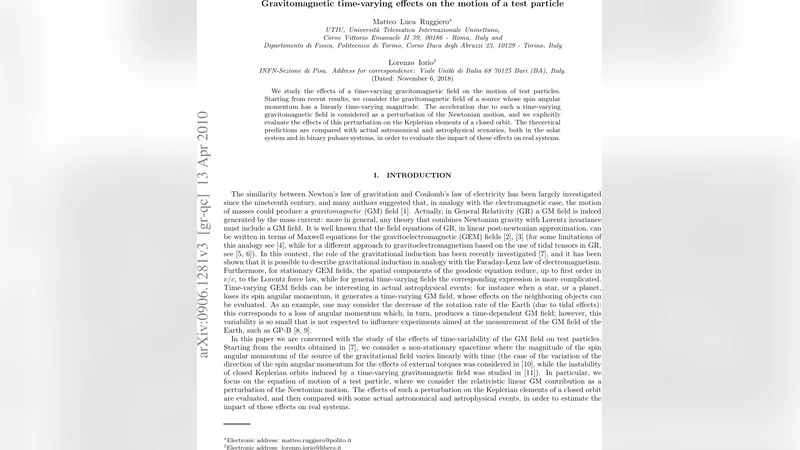
We study the effects of a time-varying gravitomagnetic field on the motion of test particles. Starting from recent results, we consider the gravitomagnetic field of a source whose spin angular momentum has a linearly time-varying magnitude. The acceleration due to such a time-varying gravitomagnetic field is considered as a perturbation of the Newtonian motion, and we explicitly evaluate the effects of this perturbation on the Keplerian elements of a closed orbit. The theoretical predictions are compared with actual astronomical and astrophysical scenarios, both in the solar system and in binary pulsars systems, in order to evaluate the impact of these effects on real systems.
💡 Research Summary
The paper investigates how a time‑varying gravitomagnetic (GM) field—generated by a rotating mass whose spin angular momentum changes linearly with time—affects the orbital motion of a test particle. Starting from the weak‑field, slow‑motion approximation of General Relativity, the authors write the metric in terms of the Newtonian potential Φ and the gravitomagnetic vector potential A. For a body with spin S(t)=S₀+Ṡ t, the GM potential becomes A = (G/c²)(S(t)×r)/r³, and its time derivative produces an additional acceleration term
a_Ṡ = (2G/c²)(Ṡ×r)/r³.
This term is treated as a perturbation to the Newtonian two‑body problem. Using the Gauss planetary equations (or the equivalent Lagrange planetary equations) the authors derive the secular and periodic variations of the six Keplerian elements (a, e, i, Ω, ω, M) caused by a_Ṡ. The main analytical results are:
- The semimajor axis a and eccentricity e acquire only oscillatory variations proportional to Ṡ; their long‑term averages remain unchanged.
- The inclination i and the longitude of the ascending node Ω experience a linear drift proportional to the component of Ṡ perpendicular to the orbital plane. In particular, Ω precesses steadily in the direction set by the sign of Ṡ.
- The argument of pericenter ω and the mean anomaly M acquire second‑order tiny oscillations that are negligible for practical purposes.
To assess the physical relevance, the authors apply the formalism to two classes of astrophysical systems.
-
Solar‑system bodies – Using measured Earth‑day lengthening (≈1.7 ms per century) as a proxy for Earth’s spin‑down, they estimate Ṡ ≈10²⁴ kg m² s⁻². The resulting nodal drift is of order 10⁻¹² rad yr⁻¹, far below the sensitivity of Lunar Laser Ranging, planetary radar, or spacecraft tracking. Similar conclusions hold for the Moon, Mars, and the Galilean satellites. Hence, for present‑day solar‑system dynamics the time‑varying GM effect is completely negligible.
-
Binary pulsars – In systems where a neutron star’s spin changes rapidly (e.g., due to magnetic braking or accretion torques), Ṡ can reach 10³⁰ kg m² s⁻² or higher. In such extreme cases the predicted nodal drift can be a few micro‑arcseconds per year. While still small, this magnitude approaches the precision of long‑baseline interferometry (VLBI) and could manifest as a systematic term in pulsar‑timing residuals or in the phase evolution of gravitational‑wave signals from compact binaries.
The authors conclude that the time‑varying gravitomagnetic acceleration is a well‑defined, first‑order relativistic correction, but its magnitude is generally far below current observational thresholds. Nevertheless, in astrophysical environments with very large spin‑down/up rates and over timescales of thousands to millions of years, the cumulative effect could become measurable. They suggest future work to explore non‑linear spin evolution, multi‑body interactions, and possible detection strategies using next‑generation timing arrays or space‑based interferometers. This study thus bridges a subtle relativistic effect with concrete orbital dynamics, highlighting both its theoretical interest and its practical insignificance for most known systems.
Comments & Academic Discussion
Loading comments...
Leave a Comment