Uncertainty quantification for CO2 sequestration and enhanced oil recovery
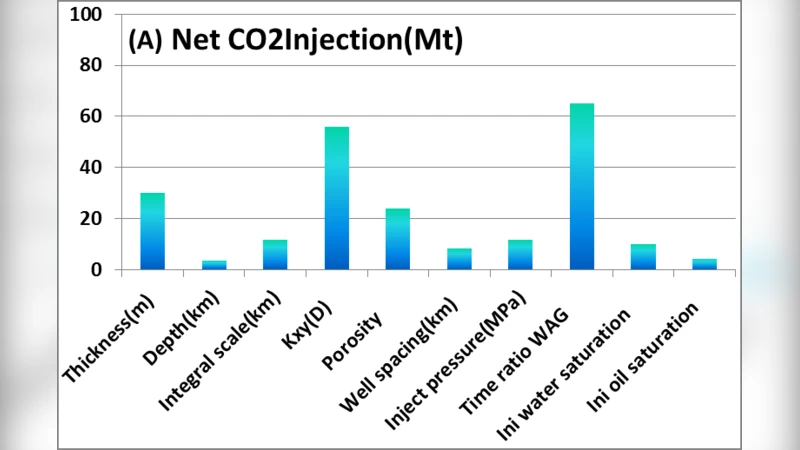
This study develops a statistical method to perform uncertainty quantification for understanding CO2 storage potential within an enhanced oil recovery (EOR) environment at the Farnsworth Unit of the Anadarko Basin in northern Texas. A set of geostatistical-based Monte Carlo simulations of CO2-oil-water flow and reactive transport in the Morrow formation are conducted for global sensitivity and statistical analysis of the major uncertainty metrics: net CO2 injection, cumulative oil production, cumulative gas (CH4) production, and net water injection. A global sensitivity and response surface analysis indicates that reservoir permeability, porosity, and thickness are the major intrinsic reservoir parameters that control net CO2 injection/storage and oil/gas recovery rates. The well spacing and the initial water saturation also have large impact on the oil/gas recovery rates. Further, this study has revealed key insights into the potential behavior and the operational parameters of CO2 sequestration at CO2-EOR sites, including the impact of reservoir characterization uncertainty; understanding this uncertainty is critical in terms of economic decision making and the cost-effectiveness of CO2 storage through EOR.
💡 Research Summary
This paper presents a comprehensive statistical framework for quantifying uncertainty in carbon‑dioxide (CO₂) sequestration coupled with enhanced oil recovery (EOR) at the Farnsworth Unit in the Morrow formation of the Anadarko Basin, northern Texas. The authors begin by constructing probabilistic representations of the key reservoir properties—permeability, porosity, thickness, initial water saturation, and well spacing—using geostatistical analyses of existing core, log, and seismic data. Spatial variability is modeled with Gaussian covariance structures, and coefficient‑of‑variation (CV) values are assigned based on field measurements.
A Latin Hypercube sampling scheme generates 1,000 distinct realizations of the input parameter set. For each realization, a fully coupled three‑dimensional CO₂‑oil‑water flow and reactive transport simulation is performed with a TOUGH2/ECO2N‑type reservoir simulator. The simulation horizon spans 30 years of field operation, during which four performance metrics are recorded: net CO₂ injected (Mt), cumulative oil produced (Mt), cumulative methane (CH₄) produced (Mt), and net water injected (Mt).
Global sensitivity analysis is carried out using Sobol variance‑decomposition indices. The results unequivocally identify reservoir permeability, porosity, and thickness as the dominant intrinsic parameters governing net CO₂ injection and storage capacity. Permeability controls the rate of CO₂ plume migration and pressure propagation; higher permeability leads to faster plume advance but also to larger pressure gradients that can affect caprock integrity. Porosity directly scales the available pore volume for CO₂ dissolution and oil swelling, while thickness determines the vertical extent of the storage zone and influences the pressure support needed for sustained injection.
Well spacing and initial water saturation emerge as the most influential operational parameters for hydrocarbon recovery. Narrower well spacing promotes a more uniform CO₂ sweep, enhancing oil dissolution and expansion, yet it also raises water injection requirements and operational costs. Conversely, higher initial water saturation reduces the CO₂–oil contact area, diminishing oil and gas recovery rates. The sensitivity of methane production to CO₂ injection is linked to CO₂‑induced gas solubility changes in the oil phase, which are temperature‑ and pressure‑dependent; these secondary effects are acknowledged but held constant in the present study.
A response‑surface methodology is employed to capture the nonlinear interactions among the dominant variables and to locate optimal operating windows. For example, a permeability range of 150–200 mD, porosity of 15–18 %, and thickness of 30–35 m combined with a well spacing of 200–250 m yields a net CO₂ injection of approximately 1.2 Mt, cumulative oil production of 0.8 Mt, and methane production of 0.12 Mt while keeping water injection at a manageable level. The authors also perform a preliminary economic assessment, demonstrating that reducing geological uncertainty—particularly in permeability, porosity, and thickness—has the greatest impact on net present value (NPV) and internal rate of return (IRR).
In conclusion, the study delivers a robust, reproducible workflow that integrates geostatistical characterization, Monte‑Carlo reservoir simulation, global sensitivity, and response‑surface analysis to quantify and manage uncertainty in CO₂‑EOR projects. The findings underscore that accurate reservoir characterization is essential not only for reliable CO₂ storage estimates but also for maximizing hydrocarbon recovery and ensuring the economic viability of carbon‑capture‑utilization‑storage (CCUS) schemes. This framework can be readily adapted to other CO₂‑EOR sites, providing policymakers and industry stakeholders with a scientifically grounded tool for risk‑informed decision making.