An interface phase transition induced by a driven line in 2D
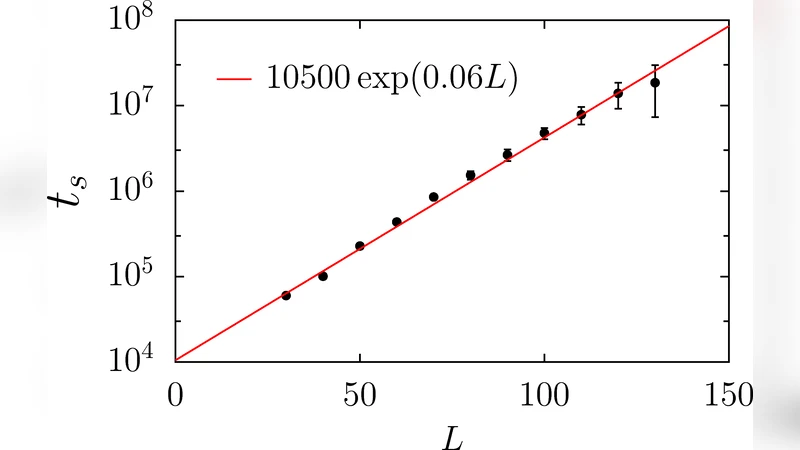
The effect of a localized drive on the steady state of an interface separating two phases in coexistence is studied. This is done using a spin conserving kinetic Ising model on a two dimensional lattice with cylindrical boundary conditions, where a drive is applied along a single ring on which the interface separating the two phases is centered. The drive is found to induce an interface spontaneous symmetry breaking whereby the magnetization of the driven ring becomes non-zero. The width of the interface becomes finite and its fluctuations around the driven ring are non-symmetric. The dynamical origin of these properties is analyzed in an adiabatic limit which allows the evaluation of the large deviation function of the driven-ring magnetization.
💡 Research Summary
The paper investigates how a highly localized non‑equilibrium drive affects the steady state of an interface separating two coexisting phases in a two‑dimensional kinetic Ising model with spin‑conserving Kawasaki dynamics. The system is a rectangular lattice with periodic boundary conditions along the horizontal (y) direction and fixed up/down spins at the top and bottom edges, creating a cylindrical geometry. In the absence of any drive the interface fluctuates freely around the central row, its width growing as the square‑root of the system size in accordance with capillary‑wave theory, and the average magnetization of the central row remains zero because of the up/down symmetry.
A drive is introduced only on a single horizontal ring (the “driven line”) that coincides with the average position of the interface. The drive biases the exchange of neighboring spins along this line, thereby breaking detailed balance locally while the bulk dynamics remains symmetric. Monte‑Carlo simulations are performed for various temperatures, system sizes, and drive strengths ε. The main observables are (i) the magnetization m₀ of the driven line, (ii) the interface width w, and (iii) the probability distribution of the interface height.
The numerical results reveal two striking phenomena. First, beyond a critical drive strength the magnetization of the driven line becomes spontaneously non‑zero. The distribution of m₀ develops two symmetric peaks at ±m*; the system selects one of them, thereby breaking the up/down symmetry that is present in equilibrium. This constitutes a genuine non‑equilibrium phase transition induced by a strictly one‑dimensional perturbation. Second, the interface width no longer diverges with system size; instead it saturates to a finite value that is essentially independent of the lateral dimension L. The interface is thus “locked” to the driven line, and its fluctuations become markedly asymmetric: the probability of finding the interface above the driven line differs from that of finding it below, reflecting the directionality of the imposed current.
To explain these observations the authors invoke an adiabatic limit in which the drive is taken to be infinitely strong (ε→∞) while the bulk evolves much more slowly. In this limit the driven line can be treated as an effectively one‑dimensional driven subsystem coupled at its ends to two equilibrium reservoirs (the upper and lower bulk phases) characterized by fixed chemical potentials μ₊ and μ₋. The dynamics on the line reduces to an asymmetric simple exclusion process (ASEP) with known exact stationary current‑density relation. By integrating out the fast degrees of freedom on the line, the authors derive an effective master equation for the slow bulk variables and compute the large‑deviation function ϕ(m₀) governing the probability P(m₀)∝exp