IRS Characterization of a Debris Disk around an M-type star in NGC2547
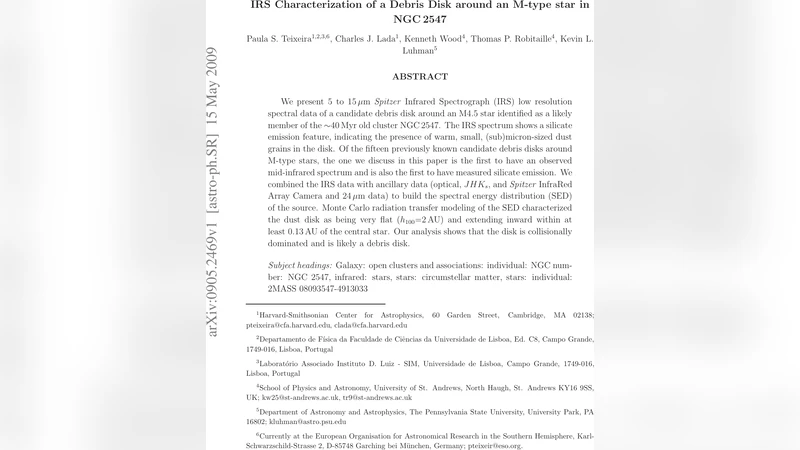
We present 5 to 15 micron Spitzer Infrared Spectrograph (IRS) low resolution spectral data of a candidate debris disk around an M4.5 star identified as a likely member of the ~40 Myr old cluster NGC2547. The IRS spectrum shows a silicate emission feature, indicating the presence of warm, small, (sub)micron-sized dust grains in the disk. Of the fifteen previously known candidate debris disks around M-type stars, the one we discuss in this paper is the first to have an observed mid-infrared spectrum and is also the first to have measured silicate emission. We combined the IRS data with ancillary data (optical, JHKs, and Spitzer InfraRed Array Camera and 24 micron data) to build the spectral energy distribution (SED) of the source. Monte Carlo radiation transfer modeling of the SED characterized the dust disk as being very flat (h100=2AU) and extending inward within at least 0.13AU of the central star. Our analysis shows that the disk is collisionally dominated and is likely a debris disk.
💡 Research Summary
This paper presents the first mid‑infrared spectroscopic study of a debris‑disk candidate around an M‑type star in the ∼40 Myr old open cluster NGC 2547. The target, an M4.5 star identified as a likely cluster member, was observed with the Spitzer Infrared Spectrograph (IRS) in low‑resolution mode covering 5–15 µm. The IRS spectrum reveals a clear 10 µm silicate emission feature, indicating the presence of warm (≈200–300 K), sub‑micron to micron‑sized silicate grains. Such a feature has never been reported for an M‑type debris‑disk candidate, making this detection a unique diagnostic of dust composition in low‑mass stellar environments.
The authors combined the IRS data with ancillary photometry (optical, 2MASS JHKₛ, Spitzer IRAC, and MIPS 24 µm) to construct a comprehensive spectral energy distribution (SED). Monte‑Carlo radiative‑transfer modeling was employed to fit the SED and the silicate feature simultaneously. The best‑fit model describes a geometrically thin disk (scale height at 100 AU, h₁₀₀ ≈ 2 AU, corresponding to h/r ≈ 0.07) extending from an inner radius of ≤ 0.13 AU out to ∼30 AU. The dust mass is estimated at (1–5) × 10⁻⁵ M⊕, and the grain‑size distribution follows a power law n(a) ∝ a⁻³·⁵ with a minimum size of ∼0.1 µm and a maximum of ∼10 µm. These parameters reproduce both the continuum excess and the strength of the silicate emission.
From the derived geometry and grain properties, the authors argue that the disk is collisionally dominated. The thinness and the presence of warm small grains imply that gas has largely dissipated, and that ongoing collisional grinding of larger bodies replenishes the observed dust. The collisional timescale (10⁴–10⁵ yr) is much shorter than the cluster age, confirming that the system is in a steady‑state debris phase rather than a primordial protoplanetary disk.
The study places this object in context with the fifteen previously identified M‑type debris‑disk candidates. It is the first among them to have a mid‑IR spectrum and the first to show silicate emission, highlighting the importance of spectroscopic follow‑up for low‑mass stars. The inner disk radius of 0.13 AU overlaps the region where terrestrial planets could form, suggesting that future high‑resolution observations (e.g., JWST/MIRI or ALMA) could probe potential planet‑disk interactions.
The authors conclude by outlining future work: expanding the spectroscopic sample of M‑type cluster members, obtaining high‑resolution imaging to resolve disk structure, and performing dynamical simulations to model collisional evolution. Such efforts will refine the occurrence rate and evolutionary pathways of debris disks around low‑mass stars and will inform theories of planet formation in these ubiquitous stellar systems.
Comments & Academic Discussion
Loading comments...
Leave a Comment