A Chandra Study of the Rosette Star-Forming Complex. II. Clusters in the Rosette Molecular Cloud
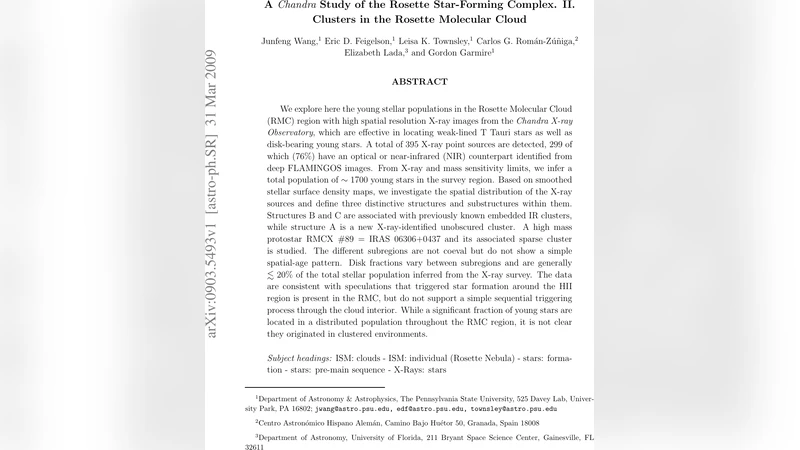
We explore here the young stellar populations in the Rosette Molecular Cloud (RMC) region with high spatial resolution X-ray images from the Chandra X-ray Observatory, which are effective in locating weak-lined T Tauri stars as well as disk-bearing young stars. A total of 395 X-ray point sources are detected, 299 of which (76%) have an optical or near-infrared (NIR) counterpart identified from deep FLAMINGOS images. From X-ray and mass sensitivity limits, we infer a total population of about 1700 young stars in the survey region. Based on smoothed stellar surface density maps, we investigate the spatial distribution of the X-ray sources and define three distinctive structures and substructures within them. Structures B and C are associated with previously known embedded IR clusters, while structure A is a new X-ray-identified unobscured cluster. A high mass protostar RMCX #89 = IRAS 06306+0437 and its associated sparse cluster is studied. The different subregions are not coeval but do not show a simple spatial-age pattern. Disk fractions vary between subregions and are generally 20% of the total stellar population inferred from the X-ray survey. The data are consistent with speculations that triggered star formation around the HII region is present in the RMC, but do not support a simple sequential triggering process through the cloud interior. While a significant fraction of young stars are located in a distributed population throughout the RMC region, it is not clear they originated in clustered environments.
💡 Research Summary
This study presents a comprehensive Chandra X‑ray survey of the Rosette Molecular Cloud (RMC), focusing on the spatial distribution, demographics, and evolutionary status of its young stellar population. Using 17 ACIS‑I pointings, the authors detected 395 X‑ray point sources, of which 299 (76 %) have counterparts in deep FLAMINGOS near‑infrared images or optical catalogs. The X‑ray sensitivity (L_X ≈ 10³⁰ erg s⁻¹) corresponds to a mass limit of roughly 0.3 M_⊙, allowing the detection of both weak‑lined T Tauri stars and disk‑bearing pre‑main‑sequence objects that are often missed in infrared surveys. By correcting for incompleteness, the authors estimate a total young stellar population of about 1,700 members within the surveyed area, roughly twice the number inferred from previous infrared work.
Kernel‑density surface‑density maps reveal three principal stellar structures, designated A, B, and C. Structures B and C coincide with previously identified embedded infrared clusters, while Structure A is a newly identified, largely unobscured cluster centered on the high‑mass protostar RMCX #89 (IRAS 06306+0437). The latter object has a bolometric luminosity of ∼10⁴ L_⊙ and is surrounded by a sparse, relatively evolved stellar grouping. Within each structure, sub‑clusters and density peaks are evident, indicating a hierarchical organization.
The authors assess relative ages using X‑ray activity (L_X/L_bol) and infrared disk fractions. Structure A shows a low disk fraction (~20 %) and modest X‑ray activity, suggesting an age of 2–3 Myr. Structures B and C exhibit higher disk fractions (30–40 %) and stronger X‑ray emission, consistent with ages ≤1 Myr. Importantly, the age distribution does not follow a simple gradient outward from the H II region (NGC 2244), contradicting a straightforward sequential triggering scenario. Instead, star formation appears to have proceeded in a non‑coeval, patchy fashion across the cloud.
A significant dispersed population—about 30 % of the total—lies outside the identified clusters. These stars show little extinction and are evenly spread, raising the question of their origin. They could be former cluster members ejected by dynamical interactions, or they could have formed in situ in low‑density environments. The current data cannot decisively distinguish between these possibilities.
The paper discusses triggered star formation in the context of the expanding H II region. While some evidence (e.g., high extinction and elevated disk fractions in B and C) supports localized compression‑driven star formation, the lack of a coherent age sequence undermines a model of a single, outward‑propagating trigger. The authors favor a picture in which local conditions—such as pressure enhancements, magnetic fields, or small‑scale shocks—induce star formation sporadically throughout the cloud.
In summary, the Chandra observations provide a more complete census of the RMC’s young stellar content, revealing ~1,700 members organized into three main clusters (A, B, C) and a widespread distributed component. The clusters differ in age and disk fraction, but do not display a simple spatial‑age ordering, suggesting that star formation in the Rosette complex is governed by complex, locally varying processes rather than a single, sequential triggering front. Future high‑resolution infrared and radio studies, combined with dynamical modeling, will be essential to unravel the detailed mechanisms shaping star formation in this iconic region.
Comments & Academic Discussion
Loading comments...
Leave a Comment