Neutrino Coherent Scattering Rates at Direct Dark Matter Detectors
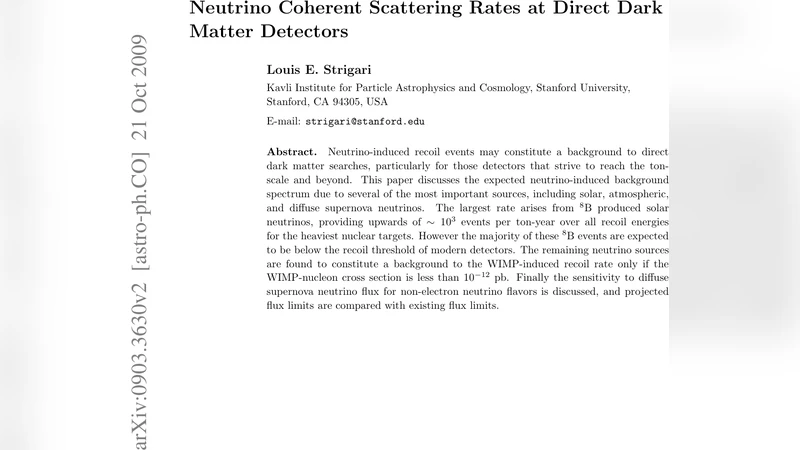
Neutrino-induced recoil events may constitute a background to direct dark matter searches, particularly for those detectors that strive to reach the ton-scale and beyond. This paper discusses the expected neutrino-induced background spectrum due to several of the most important sources, including solar, atmospheric, and diffuse supernova neutrinos. The largest rate arises from $^8$B produced solar neutrinos, providing upwards of $\sim 10^3$ events per ton-year over all recoil energies for the heaviest nuclear targets. However the majority of these $^8$B events are expected to be below the recoil threshold of modern detectors. The remaining neutrino sources are found to constitute a background to the WIMP-induced recoil rate only if the WIMP-nucleon cross section is less than $10^{-12}$ pb. Finally the sensitivity to diffuse supernova neutrino flux for non-electron neutrino flavors is discussed, and projected flux limits are compared with existing flux limits.
💡 Research Summary
The paper provides a comprehensive quantitative assessment of coherent elastic neutrino‑nucleus scattering (CEνNS) as an irreducible background for next‑generation direct dark‑matter detectors. Starting from the theoretical description of CEνNS, the authors emphasize that the cross‑section scales roughly as the square of the nuclear mass number (∝ A²) while the recoil energy scales inversely with the nuclear mass (E_R ≈ 2E_ν²/M_N). Consequently, heavy target nuclei (Xe, Ge, W) enjoy large scattering rates but produce very low‑energy recoils that often fall below the detection thresholds of current experiments.
The analysis includes the three dominant neutrino sources: (i) solar ⁸B neutrinos, (ii) atmospheric neutrinos, and (iii) the diffuse supernova neutrino background (DSNB). Using up‑to‑date solar models, atmospheric flux calculations, and DSNB predictions, the authors compute event rates for a variety of target materials. For the heaviest nuclei, the integrated CEνNS rate from ⁸B neutrinos reaches roughly 10³ events per ton‑year. However, more than 90 % of these events have recoil energies below 1 keV, well under the typical analysis thresholds (2–5 keV) of modern liquid‑Xe, Ge, or Ar detectors. After applying realistic thresholds, the observable ⁸B‑induced events drop to a few tens per ton‑year.
Atmospheric neutrinos, with energies up to a few hundred MeV, generate higher‑energy recoils (tens of keV) but their flux is two to three orders of magnitude smaller than the solar component. The resulting CEνNS background from atmospheric neutrinos is therefore at the level of ≤ 1 event per ton‑year, becoming relevant only when the WIMP‑nucleon cross‑section falls below ~10⁻¹² pb. The DSNB, composed mainly of non‑electron flavors (ν_μ, ν_τ and their antiparticles) with average energies of 10–30 MeV, yields a similarly low rate (∼0.1–1 event per ton‑year) for current detector masses.
A key conclusion is that the neutrino background will dominate the WIMP search only when experiments push the spin‑independent WIMP‑nucleon cross‑section below ≈10⁻¹² pb, a regime often referred to as the “neutrino floor.” In that regime, statistical discrimination between a WIMP signal and CEνNS becomes extremely challenging. The authors discuss mitigation strategies such as lowering the recoil energy threshold, employing directional detection, exploiting annual modulation, or using multiple target nuclei with different A‑dependences to break degeneracies.
Beyond the impact on WIMP searches, the paper evaluates the sensitivity of direct‑detection experiments to the DSNB flux of non‑electron neutrinos. Because CEνNS is flavor‑blind, a ton‑scale xenon detector operating for a decade could set a 90 % confidence upper limit on the DSNB ν_x flux of order 50 cm⁻² s⁻¹, roughly a factor of two better than existing limits derived from water‑Cherenkov detectors for electron‑type neutrinos. This demonstrates that dark‑matter experiments can also serve as novel probes of astrophysical neutrino sources.
Overall, the study provides a clear roadmap for future dark‑matter experiments: (1) quantify the CEνNS background for each target material, (2) design detectors with the lowest feasible energy threshold, (3) consider complementary detection techniques to distinguish neutrino‑induced recoils from WIMP‑induced ones, and (4) exploit the flavor‑independent nature of CEνNS to explore the diffuse supernova neutrino background. These insights are essential for achieving the ultimate sensitivity goals of the field while simultaneously opening a new window on neutrino astrophysics.
Comments & Academic Discussion
Loading comments...
Leave a Comment