Interferometric science results on young stellar objects
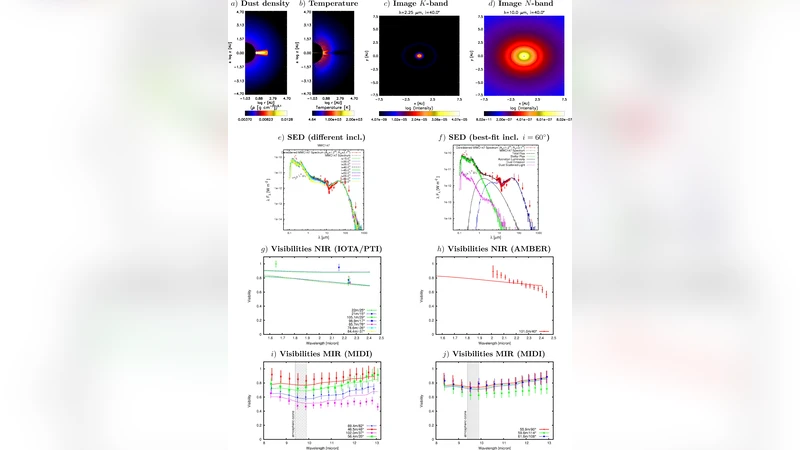
Long-baseline interferometry at infrared wavelengths allows the innermost regions around young stars to be observed. These observations directly probe the location of the dust and gas in the disks. The characteristic sizes of these regions found are larger than previously thought. These results have motivated in part a new class of models of the inner disk structure, but the precise understanding of the origin of these low visibilities is still in debate. Mid-infrared observations probe disk emission over a larger range of scales revealing mineralogy gradients in the disk. Recent spectrally resolved observations allow the dust and gas to be studied separately showing that the Brackett gamma emission can find its origin either in a wind or in a magnetosphere and that there is probably no correlation between the location of the Brackett gamma emission and accretion. In a certain number of cases, the very high spatial resolution reveals very close companions and can determine their masses. Overall, these results provide essential information on the structure and the physical properties of close regions surrounding young stars especially where planet formation is suspected to occur.
💡 Research Summary
The paper reviews the state‑of‑the‑art results obtained with long‑baseline infrared interferometry on young stellar objects (YSOs), focusing on how these observations have reshaped our understanding of the innermost regions of protoplanetary disks where planet formation is thought to occur. By combining high spatial resolution (down to ~1 mas, corresponding to sub‑AU scales at typical distances of a few hundred parsecs) with moderate to high spectral resolution, interferometers such as the VLTI (AMBER, MIDI, GRAVITY), the Keck Interferometer, and CHARA have been able to directly probe both dust and gas components in the disk.
Key findings in the near‑infrared (K‑band, ~2 µm).
Visibility measurements for a large sample of T Tauri and Herbig Ae/Be stars are systematically lower than predicted by classical thin‑disk models. The data imply characteristic emission radii that scale roughly with the square root of the stellar luminosity, consistent with a “puffed‑up inner rim” where the dust sublimation front is vertically inflated by direct stellar irradiation. However, the scatter among objects of similar luminosity indicates that additional parameters—disk inclination, inner gas opacity, and external radiation fields—play a significant role.
Mid‑infrared (N‑band, ~10 µm) constraints on mineralogy.
Spectrally dispersed interferometric data reveal a clear radial gradient in dust composition. The 10 µm silicate feature is broad and dominated by amorphous grains in the innermost few astronomical units, while at larger radii the feature becomes sharper, indicating a higher fraction of crystalline silicates (forsterite, enstatite) and the presence of high‑temperature minerals such as magnesite and phosphate. This gradient matches expectations from thermal annealing and radial mixing models, providing direct evidence that dust processing begins close to the star and propagates outward.
Spectrally resolved Brγ (2.166 µm) line studies.
High‑resolution interferometry of the Brγ hydrogen recombination line shows that the line‑emitting region can be located either at the magnetospheric accretion radius (a few stellar radii) or in an extended disk wind (up to several AU). Crucially, the size of the Brγ emitting region does not correlate with independently derived mass‑accretion rates, suggesting that Brγ is not a universal tracer of accretion but rather a composite diagnostic of both inflow and outflow processes. In several objects the line emission appears offset from the continuum centroid, reinforcing the wind interpretation.
Detection of close companions and dynamical mass estimates.
The extreme angular resolution of interferometers enables the direct detection of binary companions at separations of ≤10 AU. By monitoring the orbital motion over months to years, dynamical masses as low as ~0.1 M⊙ have been measured, providing crucial constraints on the initial mass function and on how multiplicity influences disk structure. In some cases the presence of a close companion explains anomalously large near‑infrared visibilities, as the companion’s own circumstellar material contributes to the measured flux.
Implications for disk modeling and future work.
The ensemble of interferometric results has motivated a new generation of disk models that incorporate a vertically inflated inner rim, a radially varying dust composition, and simultaneous treatment of gas dynamics (magnetospheric accretion, disk winds) and stellar multiplicity. Radiative‑transfer codes such as RADMC‑3D and TORUS are now routinely used to fit both the spectral energy distribution and the interferometric observables. The paper emphasizes that further progress will come from multi‑wavelength campaigns that combine infrared interferometry with (sub)millimeter imaging (e.g., ALMA) and from next‑generation instruments like VLTI/GRAVITY+ and CHARA‑MIRC‑X, which will push spatial resolution into the 10 µas regime. Time‑domain interferometry, monitoring visibility changes over months, is also highlighted as a promising avenue to track structural evolution of the inner disk and to follow the orbital motion of newly discovered companions.
In summary, long‑baseline infrared interferometry has revealed that the inner regions of YSO disks are larger, more complex, and chemically stratified than previously thought. The low visibilities, mineralogical gradients, diverse origins of Brγ emission, and frequent detection of close companions together paint a picture of a dynamic environment where dust growth, gas flows, and stellar multiplicity interact to set the initial conditions for planet formation. Continued advances in interferometric capabilities are expected to refine these insights and to directly observe the earliest stages of planet building.
Comments & Academic Discussion
Loading comments...
Leave a Comment