Cosmogenic Production as a Background in Searching for Rare Physics Processes
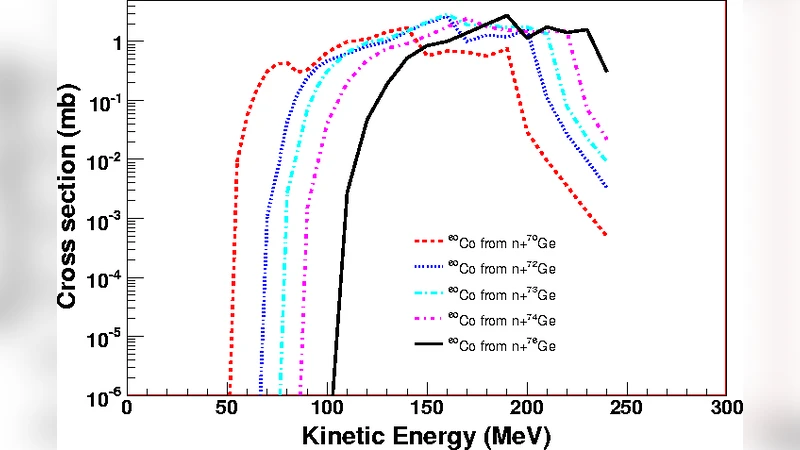
We revisit calculations of the cosmogenic production rates for several long-lived isotopes that are potential sources of background in searching for rare physics processes such as the detection of dark matter and neutrinoless double-beta decay. Using updated cosmic-ray neutron flux measurements, we use TALYS 1.0 to investigate the cosmogenic activation of stable isotopes of several detector targets and find that the cosmogenic isotopes produced inside the target materials and cryostat can result in large backgrounds for dark matter searches and neutrinoless double-beta decay. We use previously published low-background HPGe data to constrain the production of $^{3}H$ on the surface and the upper limit is consistent with our calculation. We note that cosmogenic production of several isotopes in various targets can generate potential backgrounds for dark matter detection and neutrinoless double-beta decay with a massive detector, thus great care should be taken to limit and/or deal with the cosmogenic activation of the targets.
💡 Research Summary
This paper provides a comprehensive reassessment of cosmogenic activation rates for long‑lived isotopes that can constitute significant backgrounds in rare‑event searches such as dark‑matter direct detection and neutrinoless double‑beta decay (0νββ). The authors begin by noting that earlier calculations relied on outdated cosmic‑ray neutron spectra and limited nuclear data, which introduced substantial uncertainties into background models for next‑generation experiments. To address this, they adopt the most recent measurements of the surface neutron flux, construct an energy‑dependent flux model, and feed it into the TALYS 1.0 nuclear reaction code. Using TALYS, they compute production cross‑sections for a suite of (n,γ), (n,p), (n,α), and spallation reactions on stable isotopes that are common detector materials: high‑purity germanium, liquid xenon, tellurium, silicon, sodium‑iodide and cesium‑iodide crystals, as well as argon and krypton used in cryogenic systems.
The calculated activation rates reveal several alarming trends. In germanium detectors, cosmogenic $^{68}$Ge and $^{60}$Co are produced at levels that generate continuous β‑γ spectra from tens of keV up to several MeV, directly overlapping the region of interest for $^{76}$Ge 0νββ searches. Liquid xenon experiments face the creation of $^{127}$Xe and $^{133}$Xe; $^{127}$Xe, in particular, decays via electron capture emitting a 33 keV X‑ray that mimics low‑energy nuclear recoils expected from weakly interacting massive particles (WIMPs). Sodium‑iodide and cesium‑iodide scintillators accumulate $^{125}$I, $^{126}$I, and $^{134}$Cs, producing distinct peaks in the 30–80 keV window, a region critical for many dark‑matter analyses. Surface exposure also leads to rapid buildup of tritium ($^{3}$H) and $^{22}$Na, both β‑emitters with endpoint energies below 200 keV, which can dominate the low‑energy background if not properly mitigated.
To validate their model, the authors compare the predicted $^{3}$H production on the surface with limits derived from low‑background high‑purity germanium (HPGe) data. The experimental upper bound aligns with the calculated rate, lending confidence to the overall methodology.
The paper proceeds to quantify the cumulative impact for tonne‑scale detectors. For a one‑ton liquid xenon target exposed for six months at sea level, the $^{127}$Xe activity would reach ~0.2 mBq kg⁻¹, sufficient to raise the background index above the design goal for next‑generation WIMP searches (cross‑section sensitivities below 10⁻⁴⁸ cm²). Similar calculations for germanium and tellurium show that even modest surface storage times can generate background levels that erode the projected half‑life sensitivities for 0νββ (10²⁶–10²⁸ yr).
In response, the authors outline a set of practical mitigation strategies: (1) store raw materials underground for extended periods before detector assembly; (2) employ neutron‑moderating and absorbing shields (e.g., polyethylene, lead) during surface transport and handling; (3) minimize the duration of exposure during machining, cleaning, and crystal growth; and (4) perform pre‑deployment assay of activated components to feed accurate cosmogenic background models into the data‑analysis pipeline. They stress that these measures become increasingly critical as experiments scale up in mass and push toward ever‑lower background thresholds.
Finally, the authors call for continued refinement of cosmic‑ray neutron measurements and nuclear reaction databases, noting that uncertainties in high‑energy neutron fluxes and in certain (n,x) cross‑sections remain the dominant systematic in cosmogenic background predictions. By integrating updated flux models, state‑of‑the‑art nuclear codes, and empirical validation, the community can better anticipate and control cosmogenic contributions, thereby preserving the discovery potential of forthcoming dark‑matter and neutrinoless double‑beta decay experiments.
Comments & Academic Discussion
Loading comments...
Leave a Comment