The Star Formation and Nuclear Accretion Histories of Normal Galaxies in the AGES Survey
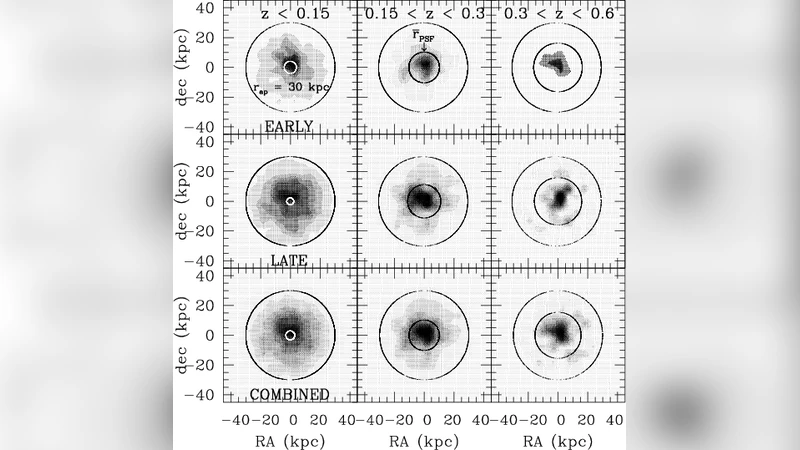
We combine IR, optical and X-ray data from the overlapping, 9.3 square degree NOAO Deep Wide-Field Survey (NDWFS), AGN and Galaxy Evolution Survey (AGES), and XBootes Survey to measure the X-ray evolution of 6146 normal galaxies as a function of absolute optical luminosity, redshift, and spectral type over the largely unexplored redshift range 0.1 < z < 0.5. Because only the closest or brightest of the galaxies are individually detected in X-rays, we use a stacking analysis to determine the mean properties of the sample. Our results suggest that X-ray emission from spectroscopically late-type galaxies is dominated by star formation, while that from early-type galaxies is dominated by a combination of hot gas and AGN emission. We find that the mean star formation and supermassive black hole accretion rate densities evolve like (1+z)^3, in agreement with the trends found for samples of bright, individually detectable starburst galaxies and AGN. Our work also corroborates the results of many previous stacking analyses of faint source populations, with improved statistics.
💡 Research Summary
The paper presents a comprehensive study of the X‑ray evolution of normal (non‑AGN‑dominated) galaxies in the redshift interval 0.1 < z < 0.5, using a combination of infrared, optical, and X‑ray data from three overlapping surveys: the NOAO Deep Wide‑Field Survey (NDWFS), the AGN and Galaxy Evolution Survey (AGES), and the XBootes Survey. The authors assemble a sample of 6,146 galaxies with spectroscopic redshifts from AGES, classify them into early‑type (absorption‑line dominated) and late‑type (emission‑line dominated) based on their optical spectra, and further subdivide them by absolute r‑band magnitude. Because only the brightest or nearest galaxies are individually detected in the shallow XBootes Chandra observations (typical detection limit ≈10⁴¹ erg s⁻¹), the authors employ a stacking technique to recover the average X‑ray signal for each subsample.
For each galaxy they extract a circular aperture corresponding to a physical radius of ~30 kpc in the 0.5–7 keV band, sum the counts over all galaxies in a given bin, and subtract a background estimated from randomly placed apertures of identical size. Uncertainties are derived using Poisson statistics and bootstrap resampling, providing robust error estimates even for the faintest bins. The stacked spectra are modeled with two components: a power‑law (photon index Γ≈1.8) representing high‑mass X‑ray binaries (HMXBs) and low‑luminosity active galactic nuclei (AGN), and a thermal plasma (kT≈0.3 keV) accounting for hot interstellar gas.
The analysis reveals distinct origins for the X‑ray emission in the two spectral classes. Late‑type galaxies show negligible power‑law contribution; their X‑ray output is dominated by the thermal component and a HMXB population that scales with the star‑formation rate (SFR). Early‑type galaxies, by contrast, exhibit a significant power‑law component, indicating the presence of low‑level AGN activity in addition to hot gas emission. By converting the X‑ray luminosities to star‑formation rates (using established L_X–SFR calibrations) and to black‑hole accretion rates (via L_X–Ṁ_BH relations), the authors find that both the cosmic star‑formation rate density (ρ_SFR) and the black‑hole accretion rate density (ρ_BH) evolve as (1 + z)³ over the studied redshift range. This evolutionary law matches that derived from samples of individually detected starburst galaxies and luminous AGN, suggesting a synchronized growth of stellar mass and supermassive black holes in typical galaxies.
The results are consistent with previous stacking studies (e.g., Lehmer et al. 2008, 2012; Xue et al. 2011) but improve upon them by virtue of a larger sample size, better control of optical classifications, and a more extensive multi‑wavelength overlap. The authors discuss several limitations: the stacked signal represents an average that may mask a broad intrinsic distribution; residual contamination by undetected luminous AGN could bias the power‑law component; and the modest spectral resolution of the stacked data hampers precise separation of thermal and non‑thermal contributions. They also note that environmental effects (cluster vs. field) and metallicity variations were not explicitly accounted for.
Future work is suggested to include deeper Chandra or XMM‑Newton observations that would allow direct spectral fitting of individual galaxies, as well as infrared spectroscopy (e.g., with JWST) to obtain independent SFR indicators (Hα, PAH features) for cross‑validation. Such data would enable a more refined decomposition of HMXB versus AGN contributions and test whether the (1 + z)³ scaling holds at higher redshifts or in different galaxy environments.
In summary, by integrating multi‑band data and applying a robust stacking methodology, the study quantifies the average X‑ray properties of normal galaxies at intermediate redshifts and demonstrates that both star formation and supermassive black‑hole accretion in these systems evolve in lockstep, following a (1 + z)³ law. This provides an important observational anchor for models of co‑evolution between galaxies and their central black holes.
Comments & Academic Discussion
Loading comments...
Leave a Comment