Testing fundamental physics with distant star clusters: theoretical models for pressure-supported stellar systems
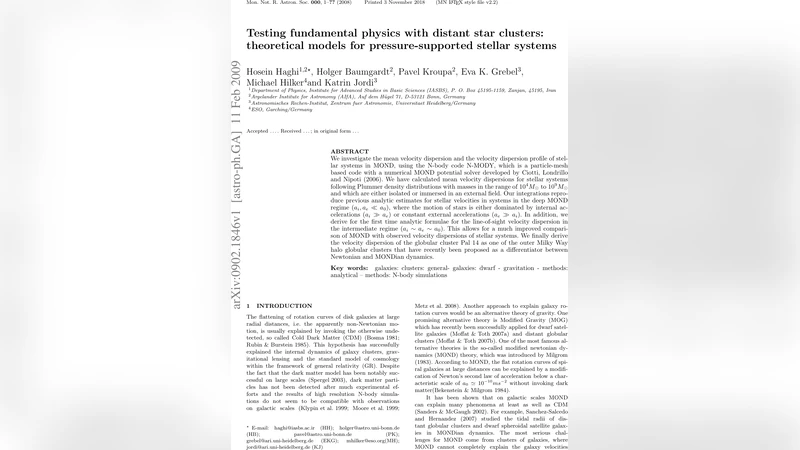
We investigate the mean velocity dispersion and the velocity dispersion profile of stellar systems in MOND, using the N-body code N-MODY, which is a particle-mesh based code with a numerical MOND potential solver developed by Ciotti, Londrillo and Nipoti (2006). We have calculated mean velocity dispersions for stellar systems following Plummer density distributions with masses in the range of $10^4 M_\odot$ to $10^9 M_\odot$ and which are either isolated or immersed in an external field. Our integrations reproduce previous analytic estimates for stellar velocities in systems in the deep MOND regime ($a_i, a_e \ll a_0$), where the motion of stars is either dominated by internal accelerations ($a_i \gg a_e$) or constant external accelerations ($a_e \gg a_i$). In addition, we derive for the first time analytic formulae for the line-of-sight velocity dispersion in the intermediate regime ($a_i \sim a_e \sim a_0$). This allows for a much improved comparison of MOND with observed velocity dispersions of stellar systems. We finally derive the velocity dispersion of the globular cluster Pal 14 as one of the outer Milky Way halo globular clusters that have recently been proposed as a differentiator between Newtonian and MONDian dynamics.
💡 Research Summary
The paper presents a comprehensive numerical investigation of velocity dispersions in pressure‑supported stellar systems under Modified Newtonian Dynamics (MOND). Using the particle‑mesh N‑body code N‑MODY, which incorporates the MOND potential solver developed by Ciotti, Londrillo, and Nipoti (2006), the authors simulate spherical systems that follow a Plummer density profile with total masses ranging from $10^{4},M_{\odot}$ to $10^{9},M_{\odot}$. Each model is examined both in isolation and embedded in an external gravitational field, allowing the study of three distinct acceleration regimes: (i) deep‑MOND where both internal ($a_i$) and external ($a_e$) accelerations are far below the MOND characteristic acceleration $a_{0}$, (ii) the intermediate regime where $a_i\sim a_e\sim a_{0}$, and (iii) the Newtonian regime where accelerations greatly exceed $a_{0}$.
In the deep‑MOND limit the simulations reproduce the well‑known analytic scaling $ \sigma \propto (GMa_{0})^{1/4}$, confirming that the code correctly captures the non‑linear MOND dynamics. The authors also verify the two limiting cases of the external field effect (EFE): internal‑dominant ($a_i\gg a_e$) and external‑dominant ($a_e\gg a_i$).
The most original contribution lies in the intermediate regime. By fitting the simulated line‑of‑sight (LOS) velocity dispersion profiles, the authors derive closed‑form analytic expressions (equations 23‑25) that depend on the system’s mass $M$, half‑mass radius $r_{h}$, and the magnitude of the constant external field $a_e$. These formulae smoothly interpolate between the deep‑MOND and Newtonian limits and explicitly incorporate the EFE, which has previously been treated only qualitatively.
To demonstrate the practical utility of their results, the authors apply the new expressions to the outer Milky Way globular cluster Pal 14. Pal 14 resides at a Galactocentric distance where the Galactic field is weak ($a_e\approx0.1,a_{0}$) and its internal acceleration is also of order $a_{0}$, placing it squarely in the intermediate regime. The MOND prediction for the LOS dispersion is $ \sigma_{\rm LOS}^{\rm MOND}\approx0.5,$km s$^{-1}$, while a Newtonian model (including the small contribution of dark matter, which is negligible at these scales) yields $ \sigma_{\rm LOS}^{\rm Newt}\approx0.2,$km s$^{-1}$. Current spectroscopic measurements give $ \sigma_{\rm LOS}=0.38\pm0.12,$km s$^{-1}$, a value that lies between the two theoretical expectations but is not yet precise enough to discriminate definitively.
The paper’s strengths are threefold. First, it validates the N‑MODY code against known analytic limits, establishing confidence in the numerical treatment of MOND’s non‑linear Poisson equation. Second, it provides the first analytic LOS dispersion formula for the $a_i\sim a_e\sim a_{0}$ regime, filling a gap that has hindered direct comparison between MOND predictions and observations of low‑acceleration systems. Third, the concrete application to Pal 14 illustrates how the new framework can be used to design observational tests that could potentially falsify one of the competing theories of gravity.
Limitations are acknowledged. The study assumes spherical symmetry and a Plummer density law, whereas real globular clusters often exhibit ellipticity, mass segregation, and anisotropic velocity distributions. Moreover, the external field is modeled as a static, uniform acceleration; in reality the Galactic field varies along the cluster’s orbit, introducing time‑dependent effects that are not captured here. Future work should therefore explore more realistic mass models, incorporate orbital dynamics, and possibly extend the analysis to rotating dwarf spheroidal galaxies, where the EFE may be even more pronounced.
In summary, this work advances the quantitative testing of MOND by delivering a robust numerical benchmark, a novel analytic tool for the intermediate acceleration regime, and a clear observational pathway using outer halo globular clusters such as Pal 14. As spectroscopic precision improves and more distant, low‑acceleration systems are characterized, the methodology presented here will be instrumental in deciding whether MOND or Newtonian/Einsteinian gravity provides the correct description of dynamics on galactic and sub‑galactic scales.
Comments & Academic Discussion
Loading comments...
Leave a Comment