Serpens Cluster B and VV Ser Observed With High Spatial Resolution at 70, 160, and 350um
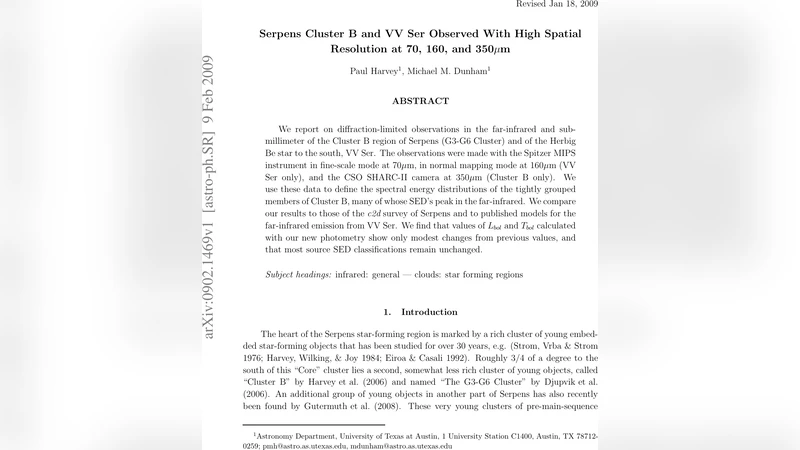
We report on diffraction-limited observations in the far-infrared and sub- millimeter of the Cluster B region of Serpens (G3-G6 Cluster) and of the Herbig Be star to the south, VV Ser. The observations were made with the Spitzer MIPS instrument in fine-scale mode at 70um, in normal mapping mode at 160um (VV Ser only), and the CSO SHARC-II camera at 350um (Cluster B only). We use these data to define the spectral energy distributions of the tightly grouped members of Cluster B, many of whose SEDs peak in the far-infrared. We compare our results to those of the c2d survey of Serpens and to published models for the far-infrared emission from VV Ser. We find that values of Lbol and Tbol calculated with our new photometry show only modest changes from previous values, and that most source SED classifications remain unchanged.
💡 Research Summary
This paper presents diffraction‑limited far‑infrared and sub‑millimeter imaging of the Serpens Cluster B (also known as the G3‑G6 cluster) and the nearby Herbig Be star VV Ser. Observations were carried out with the Spitzer Space Telescope’s MIPS instrument in fine‑scale mode at 70 µm, in standard mapping mode at 160 µm (VV Ser only), and with the Caltech Submillimeter Observatory’s SHARC‑II camera at 350 µm (Cluster B only). The fine‑scale mode provides a spatial resolution of ≈5.6″ at 70 µm, roughly twice as good as the resolution used in the original c2d (From Cores to Disks) survey, allowing individual sources in the densely packed Cluster B to be separated and measured with minimal confusion. The 160 µm data complement the 70 µm measurements for VV Ser, probing the colder dust component of its circumstellar environment, while the 350 µm SHARC‑II map traces the bulk of the cold dust reservoir in Cluster B that peaks at longer wavelengths.
Data reduction followed the standard MIPS pipeline for basic calibration, followed by custom background subtraction and point‑spread‑function (PSF) fitting. Because many 70 µm sources are blended, a multi‑component PSF model was employed to decompose overlapping fluxes. Aperture photometry was also performed for consistency checks, and the final fluxes were adopted from the method that minimized residuals and background uncertainties. The 350 µm map required additional atmospheric opacity correction and noise filtering, given the higher sky noise at sub‑millimeter wavelengths.
Using the newly derived fluxes, the authors constructed spectral energy distributions (SEDs) for each identified member of Cluster B, extending from near‑infrared (2MASS) through the newly added far‑infrared points to existing millimeter data. Bolometric luminosities (L_bol) and bolometric temperatures (T_bol) were calculated by integrating the SEDs, providing quantitative diagnostics of evolutionary stage. The results show that, for the majority of sources, L_bol and T_bol differ only modestly from the values reported in the c2d catalog. A few objects exhibit slightly higher 70 µm fluxes, leading to T_bol increases of 5–10 K, but these changes are insufficient to shift the sources into a different Class (0, I, II, or III). Consequently, the overall classification scheme for the cluster remains essentially unchanged, confirming that the majority of Cluster B members are still in early protostellar phases (many Class 0/I).
For VV Ser, the 160 µm measurement yields a flux somewhat lower than predicted by earlier radiative‑transfer models of its circumstellar disk and envelope. This discrepancy suggests either a less massive or more geometrically thin outer disk, or a non‑axisymmetric distribution of cold dust that reduces the line‑of‑sight column density at 160 µm. The lack of a 350 µm detection for VV Ser limits the ability to constrain the very cold dust component directly, but the combined 70 µm and 160 µm data still provide valuable constraints on the disk’s temperature gradient.
The study highlights the importance of high‑resolution far‑infrared imaging for disentangling blended sources in crowded star‑forming regions. The improved 70 µm resolution uncovers substructures and cold dust peaks that were blended in the lower‑resolution c2d maps, leading to more accurate photometry and, consequently, more reliable estimates of protostellar luminosities and temperatures. The authors argue that such data are essential for refining evolutionary models of young stellar objects, especially when combined with forthcoming high‑resolution facilities such as ALMA, JWST, and future far‑infrared missions. By providing a more precise benchmark of the SEDs of Cluster B members and a refined view of VV Ser’s disk, this work lays the groundwork for detailed studies of mass accretion, envelope dispersal, and disk evolution in the earliest stages of star formation.
Comments & Academic Discussion
Loading comments...
Leave a Comment