Stable ground states for the relativistic gravitational Vlasov-Poisson system
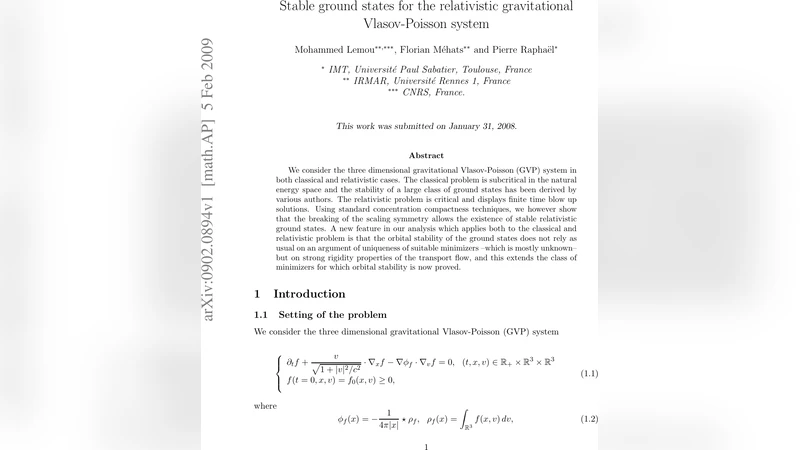
We consider the three dimensional gravitational Vlasov-Poisson (GVP) system in both classical and relativistic cases. The classical problem is subcritical in the natural energy space and the stability of a large class of ground states has been derived by various authors. The relativistic problem is critical and displays finite time blow up solutions. Using standard concentration compactness techniques, we however show that the breaking of the scaling symmetry allows the existence of stable relativistic ground states. A new feature in our analysis which applies both to the classical and relativistic problem is that the orbital stability of the ground states does not rely as usual on an argument of uniqueness of suitable minimizers –which is mostly unknown– but on strong rigidity properties of the transport flow, and this extends the class of minimizers for which orbital stability is now proved.
💡 Research Summary
The paper investigates the three‑dimensional gravitational Vlasov‑Poisson (GVP) system in both its classical (non‑relativistic) and relativistic formulations. In the classical case the system is subcritical with respect to the natural energy functional, and a large class of ground states (energy minimizers under a fixed mass constraint) has already been shown to be orbitally stable by a variety of authors. The relativistic version, however, is critical: the kinetic energy is given by the relativistic expression (\sqrt{1+|v|^{2}}-1), the scaling symmetry that underlies the subcritical structure is broken, and finite‑time blow‑up solutions are known to exist when the total mass exceeds a certain critical value.
The authors set up a constrained variational problem for the relativistic energy functional with a prescribed total mass (M). Because the scaling invariance is lost, the usual concentration‑compactness dichotomy (vanishing, dichotomy, compactness) must be handled carefully. By employing Lions’ concentration‑compactness principle together with a refined profile‑decomposition argument, they prove that for masses below a critical threshold (M_{c}) the minimizing sequences cannot vanish or split; instead they are pre‑compact up to translations. Consequently a minimizer exists, is radially symmetric, and satisfies the Euler–Lagrange equation which can be written as a decreasing function of the particle energy. The minimizer inherits sufficient regularity (belongs to (L^{p}) for some (p>1) and generates a smooth Poisson potential).
A central novelty of the work is the method used to establish orbital stability. Classical proofs rely on the uniqueness (or at least the classification) of minimizers, which is largely unknown in the relativistic setting. The authors bypass this requirement by exploiting a rigidity property of the transport flow generated by the Vlasov equation. They show that any two solutions sharing the same conserved quantities (mass, energy, momentum) must differ only by an element of the symmetry group (spatial translations and rotations). This rigidity, together with the conservation of the energy‑Casimir functional, yields a Lyapunov‑type control that guarantees that any solution starting sufficiently close to the set of minimizers remains close for all time, i.e., the set of minimizers is orbitally stable. Importantly, this argument does not need the minimizer to be unique; it works for the whole manifold of minimizers generated by the symmetry group.
The main results can be summarized as follows:
-
Existence of Relativistic Ground States – For any prescribed mass (M<M_{c}) the constrained minimization problem for the relativistic energy admits a minimizer.
-
Structure and Regularity – The minimizer is radially symmetric, decreasing in the particle energy, and belongs to the natural energy space; the associated gravitational potential solves the Poisson equation with the required decay.
-
Orbital Stability without Uniqueness – Using the transport‑flow rigidity, the authors prove that the whole orbit of minimizers under spatial translations and rotations is orbitally stable in the natural topology (e.g., (L^{1}\cap L^{p}) or suitable Sobolev spaces).
These findings demonstrate that even in a critical relativistic kinetic‑gravity model, the breaking of scaling symmetry can be leveraged to obtain stable ground states. Moreover, the rigidity‑based stability argument provides a new template that could be applied to other kinetic equations coupled with field equations (e.g., Vlasov‑Maxwell, Vlasov‑Poisson with different potentials) where uniqueness of minimizers is unavailable. The paper thus extends the classical stability theory of GVP to the relativistic regime and introduces a methodological advance that broadens the scope of orbital stability analysis in nonlinear kinetic‑field systems.
Comments & Academic Discussion
Loading comments...
Leave a Comment