The Space Density of Compton Thick AGN and the X-ray Background
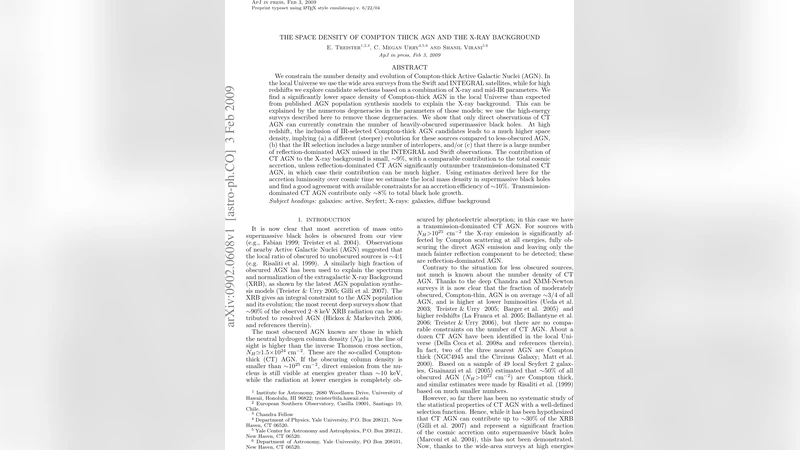
We constrain the number density and evolution of Compton-thick Active Galactic Nuclei (AGN). In the local Universe we use the wide area surveys from the Swift and INTEGRAL satellites, while for high redshifts we explore candidate selections based on a combination of X-ray and mid-IR parameters. We find a significantly lower space density of Compton-thick AGN in the local Universe than expected from published AGN population synthesis models to explain the X-ray background. This can be explained by the numerous degeneracies in the parameters of those models; we use the high-energy surveys described here to remove those degeneracies. We show that only direct observations of CT AGN can currently constrain the number of heavily-obscured supermassive black holes. At high redshift, the inclusion of IR-selected Compton-thick AGN candidates leads to a much higher space density, implying (a) a different (steeper) evolution for these sources compared to less-obscured AGN, (b) that the IR selection includes a large number of interlopers, and/or (c) that there is a large number of reflection-dominated AGN missed in the INTEGRAL and Swift observations. The contribution of CT AGN to the X-ray background is small, ~9%, with a comparable contribution to the total cosmic accretion, unless reflection-dominated CT AGN significantly outnumber transmission-dominated CT AGN, in which case their contribution can be much higher. Using estimates derived here for the accretion luminosity over cosmic time we estimate the local mass density in supermassive black holes and find a good agreement with available constraints for an accretion efficiency of ~10%. Transmission-dominated CT AGN contribute only ~8% to total black hole growth.
💡 Research Summary
The authors set out to determine how many heavily obscured, Compton‑thick active galactic nuclei (CT AGN) actually exist in the Universe and how they evolve, using the most direct observational constraints available. Their approach combines two complementary data sets. First, they exploit the all‑sky hard‑X‑ray surveys performed by Swift/BAT and INTEGRAL/IBIS, which operate above ~10 keV and are therefore capable of detecting the transmitted component of CT AGN that is otherwise invisible at lower energies. By constructing a well‑defined local (z ≈ 0) sample from these surveys, they measure the space density of transmission‑dominated CT AGN. The result is striking: the observed density is only a few percent of the total AGN population, far below the 20–30 % fraction required by most AGN population‑synthesis models that reproduce the cosmic X‑ray background (XRB). The authors argue that this discrepancy is not a failure of the models per se, but a manifestation of strong degeneracies among model parameters such as the reflection fraction, the distribution of column densities, and the assumed redshift evolution. Hard‑X‑ray detections break these degeneracies by providing a direct count of CT AGN, thereby tightening the allowed parameter space.
Second, the paper tackles the high‑redshift regime (1 < z < 3) where direct hard‑X‑ray detections become impractical. Here the authors adopt a hybrid selection technique that combines X‑ray flux limits with mid‑infrared (mid‑IR) colour criteria (e.g., high 24 µm/8 µm ratios) to isolate CT AGN candidates that are bright in the IR due to re‑processed nuclear radiation but faint or undetected in the X‑ray band. When these IR‑selected candidates are added to the hard‑X‑ray sample, the inferred space density of CT AGN rises dramatically. The authors discuss three possible interpretations: (a) CT AGN may evolve more steeply than less‑obscured AGN, with a density scaling roughly as (1 + z)^5–6, implying a strong increase in the obscured fraction at early cosmic times; (b) the IR colour selection may be heavily contaminated by star‑forming galaxies or low‑luminosity AGN, inflating the apparent CT AGN numbers; or (c) a substantial population of reflection‑dominated CT AGN (where the direct transmitted component is completely suppressed) could be missing from the Swift/INTEGRAL surveys, which are primarily sensitive to transmission‑dominated sources.
Quantitatively, the authors find that CT AGN contribute only about 9 % of the total X‑ray background intensity, a modest fraction compared with the ~30 % contribution often assumed in synthesis models. Transmission‑dominated CT AGN alone account for ~8 % of the total black‑hole growth, while reflection‑dominated objects could raise this contribution if they are as numerous as suggested. By integrating the observed AGN luminosity functions over cosmic time and assuming a standard radiative efficiency of ~10 %, the authors compute the local supermassive black‑hole mass density. Their estimate matches independent constraints from dynamical measurements, reinforcing the conclusion that the bulk of black‑hole growth occurs in less‑obscured phases.
In summary, the paper demonstrates that hard‑X‑ray surveys are essential for anchoring the CT AGN population in the local Universe, revealing that previous models over‑estimated their numbers due to parameter degeneracies. At higher redshifts, IR‑based selections hint at a potentially larger, rapidly evolving CT AGN population, but the reliability of these selections remains uncertain. The modest contribution of CT AGN to the XRB and to total black‑hole accretion implies that heavily obscured growth, while astrophysically interesting, does not dominate the cosmic history of supermassive black holes. Future missions with higher sensitivity in the >10 keV band (e.g., NuSTAR, Athena, XRISM) will be crucial for detecting the elusive reflection‑dominated CT AGN, thereby refining population‑synthesis models and improving our understanding of AGN evolution and the origin of the X‑ray background.
Comments & Academic Discussion
Loading comments...
Leave a Comment