Geomagnetic origin of the radio emission from cosmic ray induced air showers observed by CODALEMA
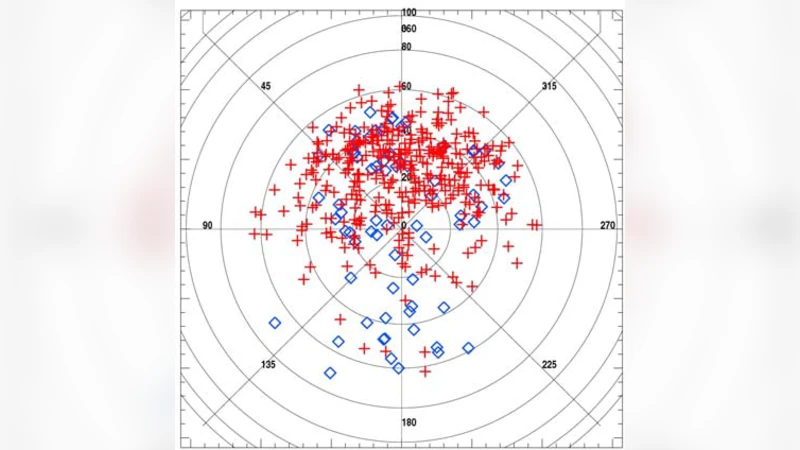
The new setup of the CODALEMA experiment installed at the Radio Observatory in Nancay, France, is described. It includes broadband active dipole antennas and an extended and upgraded particle detector array. The latter gives access to the air shower energy, allowing us to compute the efficiency of the radio array as a function of energy. We also observe a large asymmetry in counting rates between showers coming from the North and the South in spite of the symmetry of the detector. The observed asymmetry can be interpreted as a signature of the geomagnetic origin of the air shower radio emission. A simple linear dependence of the electric field with respect to vxB is used which reproduces the angular dependencies of the number of radio events and their electric polarity.
💡 Research Summary
The CODALEMA experiment, located at the Radio Observatory in Nançay, France, has been upgraded to provide a comprehensive study of radio emission from extensive air showers (EAS) induced by high‑energy cosmic rays. The new configuration comprises 24 broadband active dipole antennas covering the 20–200 MHz band and an expanded particle detector array of 13 scintillator stations. Each antenna incorporates a low‑noise pre‑amplifier and is digitized at 500 MS/s, allowing precise reconstruction of the electric field vector (amplitude, polarity, and polarization) for each triggered event. The particle detectors deliver independent measurements of the shower core position, arrival direction, and primary energy (10¹⁶–10¹⁸ eV) through standard lateral‑distribution and timing analyses.
Data acquisition is synchronized to the particle detector trigger; upon a trigger the radio system records a ±2 µs window around the trigger time. Signal extraction uses a 5σ voltage threshold combined with a narrow time window to isolate the transient radio pulse. Calibration procedures correct for antenna directivity, cable attenuation, and amplifier response, yielding a calibrated electric field at ground level. Crucially, the polarity of the field (sign of the measured voltage) and its polarization are retained, enabling a direct test of emission models.
A striking result of the campaign is a pronounced north–south asymmetry in the rate of radio‑detected showers. The detector layout is geometrically symmetric, and extensive checks rule out instrumental biases, anthropogenic radio interference, or atmospheric effects as the cause. The authors interpret the asymmetry as evidence for a geomagnetic emission mechanism, wherein the radiated electric field is proportional to the vector product v × B, with v the velocity of the shower front and B the local geomagnetic field (≈48 µT, inclined ≈63° toward the north at Nançay). When the shower axis points northward, v × B points largely upward, producing a strong radio signal with a consistent polarity. Conversely, for southward‑going showers v × B is near zero, leading to weak or undetectable radio pulses.
Quantitative analysis confirms a linear relationship |E| ∝ |v × B| across the dataset. Northern showers exhibit average field amplitudes of ~5 µV m⁻¹ and a uniform positive polarity, while southern showers typically fall below 1 µV m⁻¹ and are rarely recorded. This correlation reproduces both the angular dependence of the event count and the observed polarity reversal, providing a robust validation of the geomagnetic model.
The upgraded particle array also permits an efficiency study as a function of primary energy. By cross‑matching the independently reconstructed energy with the presence or absence of a radio signal, the authors derive an efficiency curve that rises steeply above 10¹⁷ eV, reaching >50 % at 10¹⁸ eV. The curve follows an approximate power law ε ∝ Eⁿ with n ≈ 1.5, consistent with expectations that the radio emission scales with the number of charged particles and their transverse current induced by the geomagnetic field.
These findings have several implications for the future of radio detection of cosmic rays. First, the demonstrated geomagnetic dependence confirms that radio antennas can serve as a directional, polarization‑sensitive probe of shower physics, complementing traditional particle detectors. Second, the high efficiency at ultra‑high energies suggests that large‑scale, low‑cost radio arrays could significantly increase the aperture for cosmic‑ray observatories, especially in remote or harsh environments where conventional detectors are impractical. Third, the necessity of accounting for the local magnetic field vector underscores the importance of precise geomagnetic modeling in any global radio‑based network.
The authors conclude by outlining next steps: deployment of additional antennas to improve sampling density, implementation of multi‑band receivers to study frequency‑dependent effects, and integration with other radio experiments (e.g., AERA, LOFAR) to build a worldwide radio detection infrastructure. Their work solidifies the geomagnetic origin of EAS radio emission and establishes CODALEMA as a leading platform for advancing the technique toward next‑generation ultra‑high‑energy cosmic‑ray astronomy.