Al-26 and the formation of the Solar System from a molecular cloud contaminated by Wolf-Rayet winds
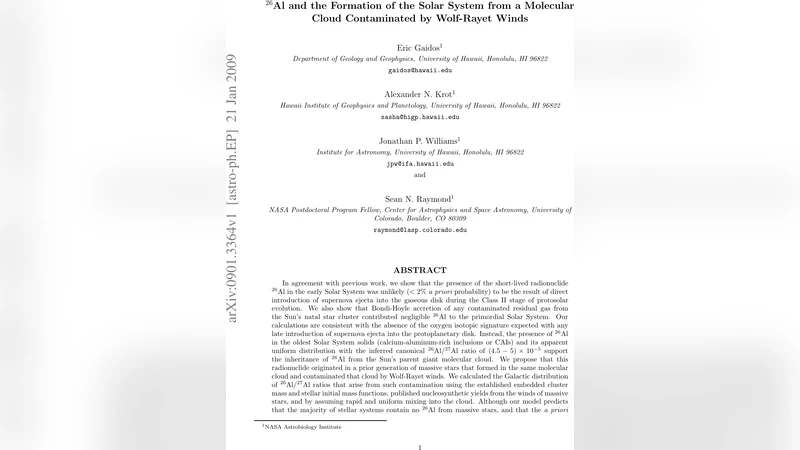
In agreement with previous work, we show that the presence of the short-lived radionuclide Al-26 in the early Solar System was unlikely (<2% a priori probability) to be the result of direct introduction of supernova ejecta into the gaseous disk during the Class II stage of protosolar evolution. We also show that any Bondi-Hoyle accretion of contaminated residual gas from the natal star cluster made a negligible contribution to the primordial Al-26 inventory of the Solar System. These results are consistent with the absence of the oxygen isotopic signature expected with any late introduction of supernova ejecta into the protoplanetary disk. Instead, the presence of Al-26 in the oldest Solar System solids (calcium-aluminum-rich inclusions or CAIs) and its apparent uniform distribution with the inferred canonical Al-26/Al-27 ratio of (4.5-5)E-5 support the inheritance of Al-26 from the parent giant molecular cloud. We propose that this radionuclide originated in a prior generation of massive stars that formed in the same host molecular cloud as the Sun and contaminated that cloud by Wolf-Rayet winds. We calculated the Galactic distribution of Al-26/Al-27 ratios that arise from such contamination using the established embedded cluster mass and stellar initial mass functions, published nucleosynthetic yields from the winds of massive stars, and by assuming rapid and uniform mixing into the cloud. Although our model predicts that the majority of stellar systems contain no Al-26 from massive stars, and that the a priori probability that the Al-26/Al-27 ratio will reach or exceed the canonical Solar System value is only ~6%, the maximum in the distribution of non-zero values is close to the canonical ratio.
💡 Research Summary
The paper tackles the long‑standing problem of the origin of the short‑lived radionuclide ^26Al in the early Solar System. Calcium‑aluminum‑rich inclusions (CAIs) record a canonical ^26Al/^27Al ratio of (4.5–5) × 10⁻⁵, implying that ^26Al was present uniformly at the time of the first solid formation. Historically, two external‑delivery mechanisms have been invoked: (i) direct injection of supernova (SN) ejecta into the protoplanetary disk during the Class II stage, and (ii) later accretion of contaminated residual gas from the natal star cluster via Bondi‑Hoyle accretion. The authors quantitatively assess both scenarios using the embedded‑cluster mass function (CMF), the stellar initial mass function (IMF), and realistic dynamical parameters for young clusters.
For the SN‑injection hypothesis, they calculate the a‑priori probability that a massive (>8 M☉) star explodes close enough to a still‑gas‑rich disk to deliver sufficient ^26Al. The combined CMF‑IMF analysis yields a probability below 2 %. Moreover, SN ejecta would imprint a distinctive oxygen‑isotope signature (e.g., anomalous ^16O/^18O ratios) in the disk material, yet such signatures are absent in CAIs and bulk meteorites. Consequently, the SN‑direct‑injection model is inconsistent with both statistical expectations and isotopic observations.
The Bondi‑Hoyle accretion route is examined by estimating the mass‑capture rate of residual cluster gas onto a protostellar disk, given typical gas densities (∼10⁻²⁰ kg m⁻³) and relative velocities (∼1 km s⁻¹). The resulting ^26Al flux is found to be less than 1 % of the amount required to explain the canonical ratio, rendering this mechanism negligible.
Having ruled out these external sources, the authors propose that the Solar System inherited its ^26Al from the giant molecular cloud (GMC) in which it formed. They argue that a prior generation of massive stars within the same GMC entered the Wolf‑Rayet (WR) phase, shedding copious amounts of ^26Al‑rich wind material. To test this idea, they construct a Monte‑Carlo model that (1) draws cluster masses from the observed CMF, (2) populates each cluster with stars drawn from a Salpeter IMF, (3) assigns ^26Al yields to WR stars using published nucleosynthetic wind yields, and (4) assumes rapid, homogeneous mixing of wind material throughout the cloud.
The simulation produces a probability distribution of ^26Al/^27Al ratios for newly forming stellar systems. The majority of systems receive essentially zero ^26Al, reflecting the rarity of nearby WR contamination. However, the distribution of non‑zero values peaks near 4.5–5 × 10⁻⁵, precisely the canonical Solar System ratio. The model predicts that only about 6 % of all planetary systems will achieve a ratio equal to or exceeding the Solar value, indicating that the Sun belongs to a statistically uncommon but not impossible subset of systems enriched by WR winds.
The authors discuss several implications. First, the uniformity of ^26Al in CAIs is naturally explained by inheritance from a well‑mixed GMC, eliminating the need for a late, heterogeneous injection event. Second, the lack of an oxygen‑isotope anomaly aligns with the WR‑wind scenario, as WR ejecta are not expected to carry the same O‑isotope signature as SN material. Third, the framework can be extended to other short‑lived radionuclides such as ^60Fe, which are predominantly produced in supernovae; a combined model could account for the observed ^60Fe/^56Fe ratios if a modest SN contribution occurred after WR enrichment.
In conclusion, the paper provides a robust statistical and isotopic argument that the Solar System’s ^26Al most plausibly originated from Wolf‑Rayet wind contamination of its parent molecular cloud, rather than from direct supernova injection or later gas accretion. This paradigm shift emphasizes the importance of pre‑stellar environmental processing in setting the initial radionuclide inventory of planetary systems and suggests that future high‑resolution simulations of GMC dynamics, coupled with refined wind yield calculations, will be essential to fully validate the WR‑contamination hypothesis.
Comments & Academic Discussion
Loading comments...
Leave a Comment