Stochastic self-enrichment, pre-enrichment, and the formation of globular clusters
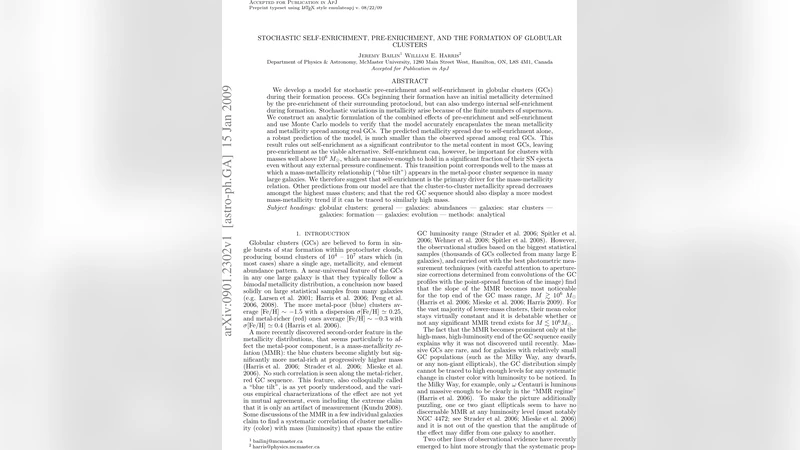
We develop a model for stochastic pre-enrichment and self-enrichment in globular clusters (GCs) during their formation process. GCs beginning their formation have an initial metallicity determined by the pre-enrichment of their surrounding protocloud, but can also undergo internal self-enrichment during formation. Stochastic variations in metallicity arise because of the finite numbers of supernova. We construct an analytic formulation of the combined effects of pre-enrichment and self-enrichment and use Monte Carlo models to verify that the model accurately encapsulates the mean metallicity and metallicity spread among real GCs. The predicted metallicity spread due to self-enrichment alone, a robust prediction of the model, is much smaller than the observed spread among real GCs. This result rules out self-enrichment as a significant contributor to the metal content in most GCs, leaving pre-enrichment as the viable alternative. Self-enrichment can, however, be important for clusters with masses well above 10^6 Msun, which are massive enough to hold in a significant fraction of their SN ejecta even without any external pressure confinement. This transition point corresponds well to the mass at which a mass-metallicity relationship (“blue tilt”) appears in the metal-poor cluster sequence in many large galaxies. We therefore suggest that self-enrichment is the primary driver for the mass-metallicity relation. Other predictions from our model are that the cluster-to-cluster metallicity spread decreases amongst the highest mass clusters; and that the red GC sequence should also display a more modest mass-metallicity trend if it can be traced to similarly high mass.
💡 Research Summary
The paper presents a comprehensive stochastic framework for understanding how globular clusters (GCs) acquire their metallicities during formation. Two distinct enrichment channels are considered: (1) pre‑enrichment, the metallicity inherited from the protocloud’s ambient environment before the cluster begins to collapse, and (2) self‑enrichment, the addition of metals produced by supernovae (SNe) that explode within the forming cluster. The authors argue that because the number of SNe is finite—especially in low‑mass clusters—metallicity variations are intrinsically stochastic.
To capture this, they model the number of SNe as a Poisson process and assign each SN a metal yield drawn from a distribution with a well‑defined mean and variance. By summing the contributions of all SNe, they derive analytic expressions for the expected mean metallicity ⟨Z⟩ and its variance Var(Z) as functions of the initial metallicity Z₀, the cluster mass M_GC, the average SN yield y_SN, and the statistical properties of the SN count. The key result is that the variance scales inversely with the square of the cluster mass, implying that low‑mass clusters should display large metallicity spreads purely from stochastic self‑enrichment.
The analytic model is then tested against extensive Monte‑Carlo simulations that span a wide range of initial conditions (different Z₀, M_GC, external pressure confinement, etc.). The simulations confirm that the analytic formulas accurately reproduce both the mean metallicity and its dispersion for any chosen parameter set. Crucially, when only self‑enrichment is allowed, the predicted metallicity spread is far smaller than the spread observed among real Milky Way and extragalactic GCs. This discrepancy leads the authors to conclude that self‑enrichment cannot be the dominant source of metals for the bulk of the GC population.
However, the model predicts a sharp transition at a cluster mass of roughly 10⁶ M_⊙. Above this threshold, the gravitational potential is deep enough to retain a substantial fraction of SN ejecta even without external pressure confinement. In this regime, self‑enrichment becomes efficient, producing a measurable increase of metallicity with mass. This naturally explains the “blue tilt” – the observed mass‑metallicity relation among metal‑poor (blue) GCs in massive galaxies. The authors further predict that the metallicity dispersion should decline among the most massive clusters because the large number of SNe averages out stochastic fluctuations.
The paper also extends the discussion to the metal‑rich (red) GC sub‑population. If red clusters can reach comparable masses, a weaker but analogous mass‑metallicity trend should emerge, reflecting the same self‑enrichment physics operating on a higher baseline metallicity.
Overall, the study makes three major contributions: (1) it provides a unified stochastic analytic description of pre‑ and self‑enrichment, (2) it demonstrates that pre‑enrichment is the primary driver of the observed metallicities for the majority of GCs, and (3) it identifies self‑enrichment as the physical mechanism behind the blue tilt, operative only in the most massive clusters. The work offers clear, testable predictions—such as reduced metallicity scatter at the high‑mass end and a modest tilt in the red GC sequence—that can be probed with high‑resolution spectroscopy of extragalactic GC systems. By bridging theoretical modeling with observational constraints, the paper advances our understanding of GC formation and the chemical evolution of early galactic environments.
Comments & Academic Discussion
Loading comments...
Leave a Comment