Exploring the formation of spheroidal galaxies out to z~1.5 in GOODS
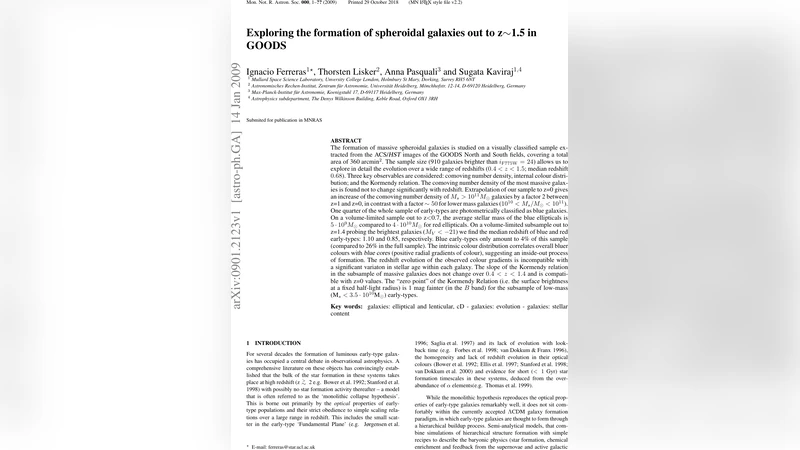
(Abridged) The formation of massive spheroidal galaxies is studied on a visually classified sample of 910 galaxies extracted from the ACS/HST images of the GOODS North and South fields (0.4<z<.5). Three key observables are considered: comoving number density, internal colour distribution; and the Kormendy relation. The comoving number density of the most massive galaxies is found not to change significantly with redshift. One quarter of the whole sample of early-types are photometrically classified as blue galaxies. On a volume-limited subset out to z<0.7, the average stellar mass of the blue ellipticals is 5E9Msun compared to 4E10Msun for red ellipticals. On a volume-limited subsample of bright galaxies (Mv<-21) out to z=1.4 we find only 4% are blue early-types, in contrast with 26% for the full sample. The intrinsic colour distribution correlates overall bluer colours with blue cores (positive radial gradients of colour), suggesting an inside-out process of formation. The redshift evolution of the observed colour gradients is incompatible with a significant variaton in stellar age within each galaxy. The slope of the Kormendy relation in the subsample of massive galaxies does not change between z=0 and z=1.4.
💡 Research Summary
The authors present a comprehensive observational study of early‑type (spheroidal) galaxies in the GOODS North and South fields, exploiting the high‑resolution ACS/HST imaging together with extensive multi‑wavelength photometry. From an initial catalog of galaxies with reliable spectroscopic or high‑quality photometric redshifts in the interval 0.4 < z < 1.5, they visually classify 910 objects as ellipticals or lenticulars. Stellar masses are derived by fitting spectral energy distributions (SEDs) across the UBVRIzJHK bands, while rest‑frame colours are obtained from k‑corrected photometry.
Three principal diagnostics are examined: (1) the comoving number density of early‑type galaxies as a function of stellar mass and redshift, (2) the internal colour distribution, including radial colour gradients, and (3) the Kormendy relation (the correlation between effective radius and mean surface brightness).
Number‑density results. When the sample is split into three mass bins (10⁹–10¹⁰ M⊙, 10¹⁰–10¹¹ M⊙, and >10¹¹ M⊙), the most massive bin shows virtually no evolution in comoving number density from z ≈ 1.5 to the present. This implies that the bulk of the stellar mass in the most massive spheroids was assembled early, consistent with a “downsizing” scenario in which massive systems form first and then evolve passively. In contrast, lower‑mass early‑type galaxies display a modest increase in number density toward lower redshift, indicating ongoing formation or transformation processes at later epochs.
Colour classification and gradients. Using the (U–V) versus (V–J) colour‑colour diagram, the authors separate “blue” from “red” early‑type galaxies. Approximately 25 % of the full sample are classified as blue. In a volume‑limited subsample limited to z < 0.7, blue ellipticals have a median stellar mass of ~5 × 10⁹ M⊙, whereas red ellipticals are an order of magnitude more massive (~4 × 10¹⁰ M⊙). When the analysis is restricted to bright galaxies (M_V < –21) out to z = 1.4, the blue fraction drops to only 4 %, underscoring that the most luminous spheroids are overwhelmingly red.
Radial colour profiles are measured by extracting (U–V) colour in concentric annuli spaced by 0.1 R_e. The majority of blue early‑type galaxies exhibit positive colour gradients (bluer cores), with an average slope of +0.05 mag per dex in radius. Red early‑type galaxies show flat or slightly negative gradients. The authors interpret the prevalence of blue cores as evidence for an “inside‑out” growth mode: star formation or rejuvenation episodes are concentrated in the central kiloparsec, while the outer regions are already dominated by older stellar populations.
Age versus metallicity gradients. By comparing the observed evolution of colour gradients with simple stellar‑population models, the authors argue that the gradients are dominated by metallicity variations rather than age differences. The lack of a strong redshift dependence in the gradient amplitude suggests that the internal age spread within individual spheroids does not evolve dramatically over the examined epoch.
Kormendy relation. For the massive subsample (>10¹¹ M⊙), the slope of the Kormendy relation (log R_e versus mean surface brightness ⟨μ⟩_e) remains unchanged from the local Universe (z ≈ 0) to z ≈ 1.4. The zero‑point shifts brighter by ~0.3 mag, consistent with passive fading of an old stellar population. The constancy of the slope indicates that the structural scaling between size and surface brightness was already established at high redshift and has not been significantly altered by subsequent mergers or secular processes.
Overall synthesis. The study paints a coherent picture in which the most massive spheroidal galaxies are largely assembled by z ≈ 1.5 and then evolve passively, preserving both their structural scaling relations and internal colour gradients. Lower‑mass early‑type galaxies continue to experience star formation, as reflected by their higher blue fractions and lower median masses. The observed positive colour gradients in blue spheroids support an inside‑out formation scenario, while the dominance of metallicity gradients over age gradients suggests that chemical enrichment proceeds more rapidly than stellar‑age diversification within these systems.
These findings provide stringent empirical constraints for semi‑analytic models and hydrodynamic simulations of galaxy formation, particularly regarding the timing of mass assembly, the role of minor mergers versus in‑situ star formation, and the mechanisms that maintain the tight Kormendy relation over several gigayears.
Comments & Academic Discussion
Loading comments...
Leave a Comment