A quantitative explanation of the observed population of Milky Way satellite galaxies
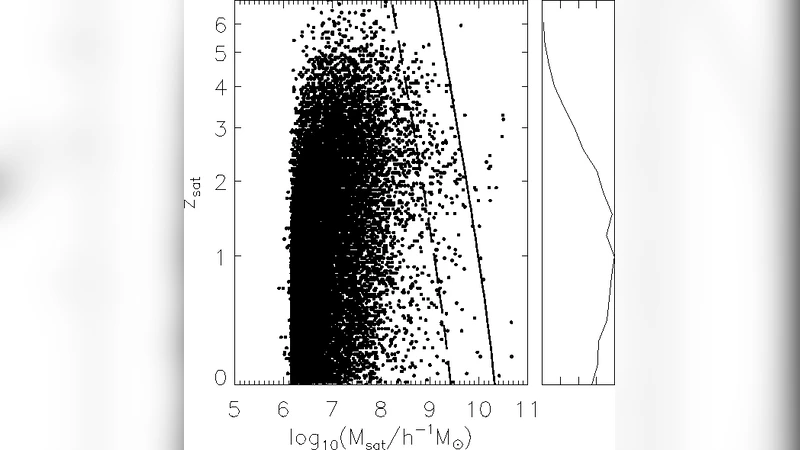
We revisit the well known discrepancy between the observed number of Milky Way (MW) dwarf satellite companions and the predicted population of cold dark matter (CDM) sub-halos, in light of the dozen new low luminosity satellites found in SDSS imaging data and our recent calibration of the SDSS satellite detection efficiency, which implies a total population far larger than these dozen discoveries. We combine a dynamical model for the CDM sub-halo population with simple, physically motivated prescriptions for assigning stellar content to each sub-halo, then apply observational selection effects and compare to the current observational census. As expected, models in which the stellar mass is a constant fraction F(Omega_b/Omega_m) of the sub-halo mass M_sat at the time it becomes a satellite fail for any choice of F. However, previously advocated models that invoke suppression of gas accretion after reionization in halos with circular velocity v_c <~ 35 km/s can reproduce the observed satellite counts for -15 < M_V < 0, with F ~ 10^{-3}. Successful models also require strong suppression of star formation BEFORE reionization in halos with v_c <~ 10 km/s; models without pre-reionization suppression predict far too many satellites with -5 < M_V < 0. Our models also reproduce the observed stellar velocity dispersions ~ 5-10 km/s of the SDSS dwarfs given the observed sizes of their stellar distributions, and model satellites have M(<300 pc) ~ 10^7 M_sun as observed even though their present day total halo masses span more than two orders of magnitude. Our modeling shows that natural physical mechanisms acting within the CDM framework can quantitatively explain the properties of the MW satellite population as it is presently known, thus providing a convincing solution to the `missing satellite’ problem.
💡 Research Summary
The paper addresses the long‑standing “missing satellite” problem – the apparent discrepancy between the large number of low‑mass dark‑matter sub‑halos predicted by cold dark matter (CDM) simulations and the far fewer dwarf satellite galaxies observed around the Milky Way. The authors begin by incorporating the dozen ultra‑faint dwarfs discovered in the Sloan Digital Sky Survey (SDSS) and, crucially, a calibrated detection‑efficiency model that quantifies how many satellites of a given luminosity, size, and distance would be missed by the survey. Applying this correction reveals that the true Milky Way satellite population is likely many times larger than the current census.
Next, they generate a realistic CDM sub‑halo population using a dynamical model that provides each sub‑halo’s mass at infall (M_sat) and its circular velocity (v_c). A naïve prescription that assigns a fixed fraction F of the cosmic baryon fraction (Ω_b/Ω_m) of the sub‑halo mass to stars fails for any choice of F, because it vastly over‑produces bright satellites while under‑producing the ultra‑faint ones.
To resolve this, the authors introduce two physically motivated suppression mechanisms. The first is post‑reionization suppression: after the universe is re‑ionized, photo‑heating prevents gas accretion onto halos with v_c ≲ 35 km s⁻¹, effectively shutting down further star formation in these systems. The second is pre‑reionization suppression: even before re‑ionization, halos with v_c ≲ 10 km s⁻¹ are unable to retain or cool gas efficiently, so they form very few stars. When both thresholds are imposed and the stellar mass is set to be about 10⁻³ of the sub‑halo mass at infall (F ≈ 10⁻³), the model reproduces the observed satellite luminosity function over the range –15 ≲ M_V ≲ 0. In particular, the pre‑reionization cut is essential to avoid an excess of satellites with –5 ≲ M_V ≲ 0, which would otherwise be predicted.
The authors then test the dynamical consistency of their model. Using the observed half‑light radii of the SDSS dwarfs and the measured line‑of‑sight velocity dispersions (≈ 5–10 km s⁻¹), they compute the expected mass within 300 pc for each model satellite, assuming an NFW dark‑matter profile. The result is a remarkably uniform M(<300 pc) ≈ 10⁷ M_⊙, matching the “common mass scale” reported for real dwarf spheroidals. Although the present‑day total halo masses of the model satellites span more than two orders of magnitude (10⁸–10¹⁰ M_⊙), tidal stripping and the imposed suppression mechanisms ensure that the inner mass remains essentially unchanged.
Overall, the study demonstrates that a CDM framework, supplemented with simple, physically justified prescriptions for when gas accretion and star formation are halted, can quantitatively account for the number, luminosities, sizes, velocity dispersions, and inner mass profiles of the Milky Way’s satellite system. This provides a compelling resolution to the missing satellite problem, showing that the discrepancy arises not from a failure of CDM itself but from the complex baryonic physics governing star formation in low‑mass halos and from observational selection effects.
Comments & Academic Discussion
Loading comments...
Leave a Comment