Spitzer View of Young Massive Stars in the LMC HII Complex N44
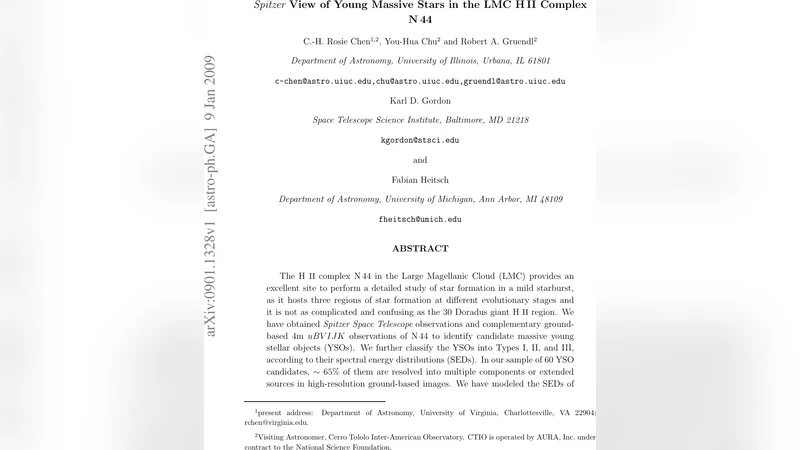
The HII complex N44 in the Large Magellanic Cloud (LMC) provides an excellent site to perform a detailed study of star formation in a mild starburst, as it hosts three regions of star formation at different evolutionary stages and it is not as complicated and confusing as the 30 Doradus giant HII region. We have obtained Spitzer Space Telescope observations and complementary ground-based 4m uBVIJK observations of N44 to identify candidate massive young stellar objects (YSOs). We further classify the YSOs into Types I, II, and III, according to their spectral energy distributions (SEDs). In our sample of 60 YSO candidates, ~65% of them are resolved into multiple components or extended sources in high-resolution ground-based images. We have modeled the SEDs of 36 YSOs that appear single or dominant within a group. We find good fits for Types I and I/II YSOs,but Types II and II/III YSOs show deviations between their observed SEDs and models that do not include PAH emission. We have also found that some Type III YSOs have central holes in their disk components. YSO counterparts are found in four ultracompact HII regions and their stellar masses determined from SED model fits agree well with those estimated from the ionization requirements of the HII regions. The distribution of YSOs is compared with those of the underlying stellar population and interstellar gas conditions to illustrate a correlation between the current formation of O-type stars and previous formation of massive stars. Evidence of triggered star formation is also presented.
💡 Research Summary
The paper presents a comprehensive study of massive young stellar objects (YSOs) in the Large Magellanic Cloud (LMC) H II complex N44, using a combination of Spitzer Space Telescope infrared imaging (IRAC 3.6–8 µm, MIPS 24 µm) and ground‑based 4 m telescope optical–near‑infrared photometry (u, B, V, I, J, K). The authors first identified 60 YSO candidates by applying color–color and magnitude criteria that isolate objects with infrared excesses indicative of circumstellar dust. High‑resolution ground‑based images revealed that roughly two‑thirds of these candidates are resolved into multiple components or extended structures, underscoring the clustered nature of massive star formation.
The candidates were then classified into three evolutionary types based on the shape of their spectral energy distributions (SEDs): Type I (deeply embedded, envelope‑dominated), Type II (disk‑dominated, still embedded), and Type III (disk‑only, approaching the main‑sequence stage). For the subset of 36 objects that appear single or dominate their local group, the authors performed SED fitting using the radiative‑transfer models of Robitaille et al. (2006). The fits for Type I and hybrid I/II objects are generally good, yielding stellar masses in the range 10–30 M⊙, envelope accretion rates, and disk parameters consistent with early massive‑star evolution. However, Type II and II/III objects display systematic discrepancies at 8 µm, where the observed fluxes exceed model predictions. The authors attribute this to polycyclic aromatic hydrocarbon (PAH) emission, which is not included in the standard model grid, highlighting the need for PAH‑inclusive models when interpreting mid‑IR data of massive YSOs.
A notable result is the detection of central “holes” in the disks of several Type III sources, inferred from a dip in the near‑IR flux combined with excess emission at 24 µm. This suggests inner disk clearing, possibly due to photoevaporation, planet formation, or rapid accretion onto the central star. Four ultracompact H II (UC H II) regions within N44 have identified YSO counterparts; the stellar masses derived from SED fitting (≈15–30 M⊙) agree well with independent estimates based on the ionizing photon budget required to sustain the UC H II regions, providing an external validation of the SED methodology.
The spatial distribution of YSOs was compared with the underlying stellar population (OB associations) and interstellar medium tracers (CO, H I, Hα, X‑ray). The analysis reveals a clear correlation: current O‑type star formation is concentrated near the peripheries of older massive‑star clusters and along the edges of the large N44 superbubble. This pattern is consistent with a feedback‑driven, triggered star‑formation scenario, where winds, supernovae, and ionizing radiation from earlier generations compress surrounding molecular gas, inducing the collapse of new massive cores. The authors present several specific cases where YSO clustering aligns with bright CO clumps and the rims of expanding shells, strengthening the argument for sequential star formation in N44.
In summary, the study demonstrates that N44 serves as an ideal laboratory for probing massive star formation in a modest starburst environment. It provides robust YSO classifications, highlights the importance of PAH emission in mid‑IR SED modeling, uncovers evidence for inner‑disk clearing in later‑stage massive YSOs, and offers compelling observational support for triggered star formation driven by stellar feedback. The work sets the stage for future high‑resolution (e.g., ALMA) observations and for the development of more sophisticated SED models that incorporate PAH and complex disk geometries.
Comments & Academic Discussion
Loading comments...
Leave a Comment