An "archaeological" quest for galactic supernova neutrinos
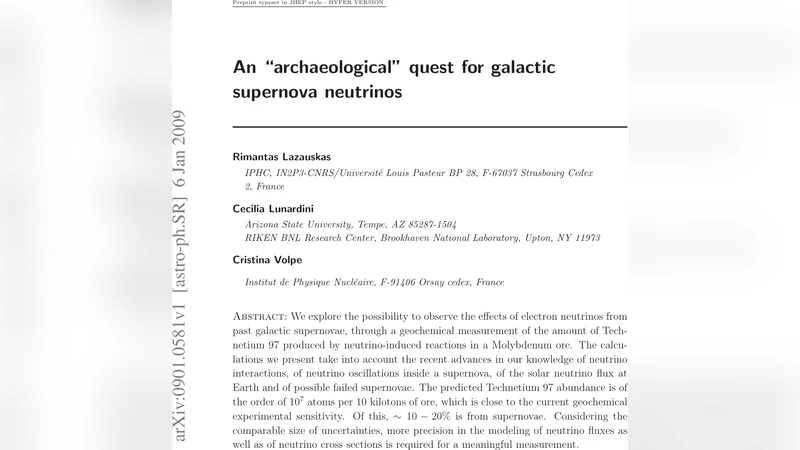
We explore the possibility to observe the effects of electron neutrinos from past galactic supernovae, through a geochemical measurement of the amount of Technetium 97 produced by neutrino-induced reactions in a Molybdenum ore. The calculations we present take into account the recent advances in our knowledge of neutrino interactions, of neutrino oscillations inside a supernova, of the solar neutrino flux at Earth and of possible failed supernovae. The predicted Technetium 97 abundance is of the order of 10^7 atoms per 10 kilotons of ore, which is close to the current geochemical experimental sensitivity. Of this, 10-20% is from supernovae. Considering the comparable size of uncertainties, more precision in the modeling of neutrino fluxes as well as of neutrino cross sections is required for a meaningful measurement.
💡 Research Summary
The authors propose a novel “archaeological” method to detect the cumulative imprint of electron‑type neutrinos emitted by past Galactic core‑collapse supernovae. The idea rests on the fact that νₑ can induce the reaction ⁹⁷Mo(νₑ,e⁻)⁹⁷Tc in molybdenum‑rich ores; the daughter nucleus ⁹⁷Tc has a half‑life of 2.6 Myr, long enough to accumulate over geological timescales. By measuring the number of ⁹⁷Tc atoms in a large (∼10 kiloton) molybdenum deposit, one could infer the integrated flux of supernova νₑ that have traversed the Earth since the formation of the deposit.
To evaluate the feasibility, the paper builds a comprehensive model of the Galactic supernova neutrino background. The authors adopt a Galactic core‑collapse rate of 2–3 per century and assume a quasi‑thermal νₑ spectrum characterized by an average energy of ≈12 MeV and a power‑law tail (α≈3). They incorporate modern understanding of flavor conversion inside the exploding star, including both matter‑enhanced (MSW) resonances and collective neutrino oscillations, which redistribute the original νₑ and ν̄ₑ spectra. In addition, they consider the contribution of “failed” supernovae—events that collapse directly to a black hole and emit a truncated neutrino burst—by assigning a plausible fraction (∼10 %) to the overall rate.
The nuclear physics input is equally detailed. The νₑ capture cross‑section on ⁹⁷Mo is calculated using state‑of‑the‑art quasiparticle random‑phase approximation (QRPA) and shell‑model techniques, explicitly including Gamow‑Teller and first‑forbidden transitions. The resulting energy‑dependent cross‑section peaks at ≈10⁻⁴² cm² for neutrino energies around 15 MeV. By folding this cross‑section with the modeled νₑ flux, the authors obtain a production rate of roughly 10⁻⁴ ⁹⁷Tc atoms per kilogram of molybdenum per year.
Integrating this rate over a 10 kiloton ore body and a geological timescale of 10⁶ years yields an expected total of ≈1 × 10⁷ ⁹⁷Tc atoms. Of these, about 10–20 % (i.e., 1–2 × 10⁶ atoms) are attributable to supernova neutrinos; the remainder is dominated by solar νₑ interactions, atmospheric neutrinos, and a small radioactive background. The authors note that current geochemical extraction techniques can reach sensitivities of order 10⁷ atoms per 10 kt, placing the predicted signal within striking distance of experimental reach.
However, the paper emphasizes that the uncertainties are comparable in magnitude to the signal itself. The dominant sources of error are (i) the assumed supernova νₑ spectrum and its variation with progenitor mass and equation of state, (ii) the theoretical uncertainty in the ν‑Mo cross‑section (≈30 %), and (iii) the efficiency and systematic errors of the chemical separation and counting of ⁹⁷Tc. Consequently, while the concept is theoretically sound and experimentally tantalizing, a meaningful measurement will require substantial improvements in supernova neutrino modeling, dedicated nuclear‑physics experiments to pin down the ν‑Mo cross‑section, and refined geochemical assay methods.
In summary, the study demonstrates that a high‑precision geochemical search for ⁹⁷Tc in molybdenum ores could, in principle, provide a unique integrated record of Galactic core‑collapse supernova neutrinos. The predicted abundance lies just below current detection thresholds, and the authors argue that coordinated advances in astrophysical modeling, nuclear theory, and analytical chemistry could turn this “neutrino archaeology” into a viable probe of the Milky Way’s supernova history.
Comments & Academic Discussion
Loading comments...
Leave a Comment