Nonadditive entropy: the concept and its use
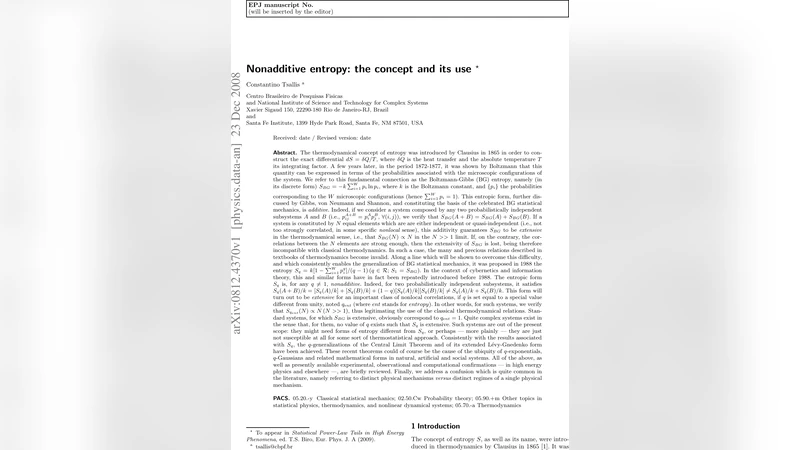
The entropic form $S_q$ is, for any $q \neq 1$, {\it nonadditive}. Indeed, for two probabilistically independent subsystems, it satisfies $S_q(A+B)/k=[S_q(A)/k]+[S_q(B)/k]+(1-q)[S_q(A)/k][S_q(B)/k] \ne S_q(A)/k+S_q(B)/k$. This form will turn out to be {\it extensive} for an important class of nonlocal correlations, if $q$ is set equal to a special value different from unity, noted $q_{ent}$ (where $ent$ stands for $entropy$). In other words, for such systems, we verify that $S_{q_{ent}}(N) \propto N (N»1)$, thus legitimating the use of the classical thermodynamical relations. Standard systems, for which $S_{BG}$ is extensive, obviously correspond to $q_{ent}=1$. Quite complex systems exist in the sense that, for them, no value of $q$ exists such that $S_q$ is extensive. Such systems are out of the present scope: they might need forms of entropy different from $S_q$, or perhaps – more plainly – they are just not susceptible at all for some sort of thermostatistical approach. Consistently with the results associated with $S_q$, the $q$-generalizations of the Central Limit Theorem and of its extended L'evy-Gnedenko form have been achieved. These recent theorems could of course be the cause of the ubiquity of $q$-exponentials, $q$-Gaussians and related mathematical forms in natural, artificial and social systems. All of the above, as well as presently available experimental, observational and computational confirmations – in high energy physics and elsewhere –, are briefly reviewed. Finally, we address a confusion which is quite common in the literature, namely referring to distinct physical mechanisms {\it versus} distinct regimes of a single physical mechanism.
💡 Research Summary
The paper presents a comprehensive study of the nonadditive entropy (S_q), a one‑parameter generalization of the Boltzmann–Gibbs entropy (S_{BG}). The authors begin by recalling that (S_{BG}) is additive for two statistically independent subsystems, i.e. (S_{BG}(A+B)=S_{BG}(A)+S_{BG}(B)). By contrast, (S_q) obeys the composition rule
\
Comments & Academic Discussion
Loading comments...
Leave a Comment