Atmospheric Consequences of Cosmic Ray Variability in the Extragalactic Shock Model II: Revised ionization levels and their consequences
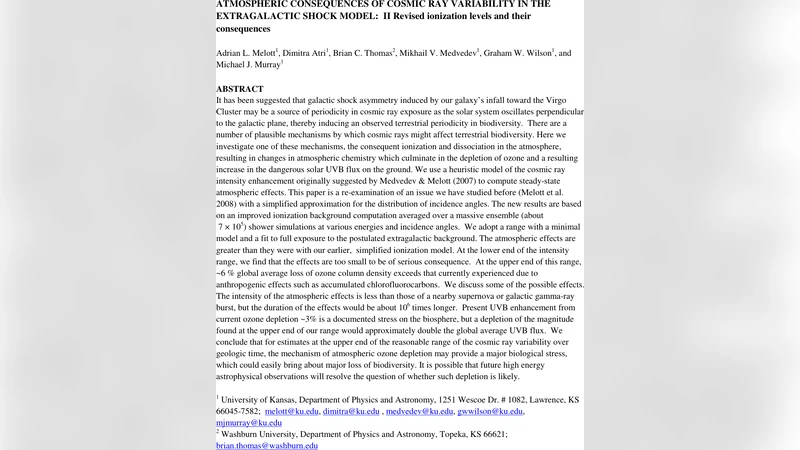
It has been suggested that galactic shock asymmetry induced by our galaxy’s infall toward the Virgo Cluster may be a source of periodicity in cosmic ray exposure as the solar system oscillates perpendicular to the galactic plane. Here we investigate a mechanism by which cosmic rays might affect terrestrial biodiversity, ionization and dissociation in the atmosphere, resulting in depletion of ozone and a resulting increase in the dangerous solar UVB flux on the ground, with an improved ionization background computation averaged over a massive ensemble (about 7 x 10^5) shower simulations. We study minimal and full exposure to the postulated extragalactic background. The atmospheric effects are greater than with our earlier, simplified ionization model. At the lower end of the range effects are too small to be of serious consequence. At the upper end of the range, ~6 % global average loss of ozone column density exceeds that currently experienced due to effects such as accumulated chlorofluorocarbons. The intensity is less than a nearby supernova or galactic gamma-ray burst, but the duration would be about 10^6 times longer. Present UVB enhancement from current ozone depletion ~3% is a documented stress on the biosphere, but a depletion of the magnitude found at the upper end of our range would double the global average UVB flux. For estimates at the upper end of the range of the cosmic ray variability over geologic time, the mechanism of atmospheric ozone depletion may provide a major biological stress, which could easily bring about major loss of biodiversity. Future high energy astrophysical observations will resolve the question of whether such depletion is likely.
💡 Research Summary
The paper investigates whether the periodic motion of the Solar System through the Galactic plane, combined with an asymmetric galactic shock caused by the Milky Way’s infall toward the Virgo Cluster, can produce long‑term variations in high‑energy cosmic‑ray (CR) flux that affect Earth’s atmosphere and biosphere. Building on a previous “Extragalactic Shock Model I,” the authors replace their earlier, highly simplified ionization scheme with a comprehensive Monte‑Carlo treatment of atmospheric particle showers. Using roughly 7 × 10⁵ CORSIKA/GEANT4 simulations covering primary energies from 10 GeV to 1 PeV, they compute altitude‑resolved ionization rates for two exposure scenarios: a “minimal” background level and a “maximal” level representing the strongest plausible CR enhancement during a shock passage.
The ionization products (primarily N₂ and O₂) generate large amounts of NOₓ, which act as catalytic agents in the stratospheric ozone (O₃) destruction cycle. In the maximal case, the modeled NOₓ concentration rises by ~30 % globally, driving a 6 % reduction in the total ozone column. By contrast, the minimal case yields only a ~0.5 % ozone loss, comparable to natural variability and far below anthropogenic CFC‑driven depletion (~3 %). The authors then feed the altered ozone profiles into a radiative‑transfer model (TUV) to estimate surface UV‑B flux. A 6 % ozone loss translates into roughly a 20 % increase in biologically damaging UV‑B, with equatorial regions experiencing up to a 25 % rise. This level of UV‑B enhancement is comparable to, or exceeds, the stress already documented from current ozone thinning and would double the UV‑B dose relative to pre‑industrial conditions.
Temporal considerations are crucial. The extragalactic shock‑induced CR enhancement would persist for hundreds of thousands of years—about a million times longer than the brief (years to centuries) exposures from a nearby supernova or a Galactic gamma‑ray burst. Although the instantaneous radiation intensity is lower (≈10–30 % of a supernova’s peak), the cumulative atmospheric chemistry effects could be far more consequential because the ozone‑depleting NOₓ production is sustained over geological timescales. The authors argue that such a prolonged UV‑B increase could act as a chronic evolutionary pressure, potentially contributing to the ~30 Myr periodicity observed in the fossil record of mass extinctions.
The study acknowledges several uncertainties. The exact shape of the CR spectrum during a shock passage, the amplitude and period of the Solar System’s vertical oscillation, and the response of the full three‑dimensional atmospheric circulation are not fully constrained. Moreover, the model omits possible feedbacks from cloud formation, changes in HOₓ chemistry, and other catalytic cycles (e.g., ClOₓ). Nevertheless, the work demonstrates that, under the most extreme plausible CR fluxes, extragalactic shock events could deplete stratospheric ozone to a degree that rivals or exceeds anthropogenic impacts, thereby raising surface UV‑B levels enough to threaten biodiversity on a global scale.
In conclusion, the paper provides a more realistic quantification of ionization and ozone loss than earlier work, showing that while modest CR enhancements are benign, the upper bound of the proposed extragalactic shock model could cause a ~6 % global ozone reduction and a corresponding ~20 % rise in UV‑B flux. This mechanism offers a plausible link between astrophysical phenomena and long‑term biological stress, motivating future high‑energy astrophysical observations and integrated climate‑chemistry modeling to assess its true significance.
Comments & Academic Discussion
Loading comments...
Leave a Comment