Holistic Collaborative Privacy Framework for Users Privacy in Social Recommender Service
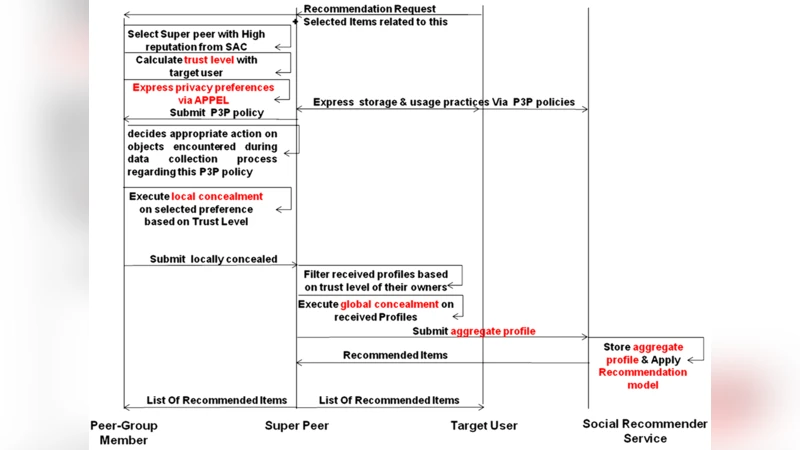
The current business model for existing recommender services is centered around the availability of users’ personal data at their side whereas consumers have to trust that the recommender service providers will not use their data in a malicious way. With the increasing number of cases for privacy breaches, different countries and corporations have issued privacy laws and regulations to define the best practices for the protection of personal information. The data protection directive 95/46/EC and the privacy principles established by the Organization for Economic Cooperation and Development (OECD) are examples of such regulation frameworks. In this paper, we assert that utilizing third-party recommender services to generate accurate referrals are feasible, while preserving the privacy of the users’ sensitive information which will be residing on a clear form only on his/her own device. As a result, each user who benefits from the third-party recommender service will have absolute control over what to release from his/her own preferences. We proposed a collaborative privacy middleware that executes a two stage concealment process within a distributed data collection protocol in order to attain this claim. Additionally, the proposed solution complies with one of the common privacy regulation frameworks for fair information practice in a natural and functional way -which is OECD privacy principles. The approach presented in this paper is easily integrated into the current business model as it is implemented using a middleware that runs at the end-users side and utilizes the social nature of content distribution services to implement a topological data collection protocol.
💡 Research Summary
The paper addresses a fundamental weakness in today’s commercial recommender services: the reliance on centralized storage of users’ personal preference data, which forces users to trust service providers with sensitive information. In the context of increasingly stringent privacy regulations such as the EU Data Protection Directive 95/46/EC and the OECD privacy principles, this model is becoming untenable. To reconcile accurate recommendation generation with robust privacy protection, the authors propose a collaborative privacy middleware that operates on the user’s device and implements a two‑stage concealment process within a distributed data‑collection protocol.
In the first stage, each user’s raw preference profile is locally transformed—through encryption, randomization, or other obfuscation techniques—so that the clear‑text data never leaves the device. In the second stage, the middleware engages in a collaborative protocol where multiple users exchange masked data and inject synthetic noise (dummy entries) into the collective dataset. This “topological” data‑collection protocol leverages the social graph of the service: connections among users determine the routing of masked payloads, thereby dispersing the flow of information across the network and reducing reliance on a single central server. The resulting aggregated dataset, enriched with noise, is sent to a third‑party recommender engine that can still compute useful recommendations because the statistical properties of the original preferences are preserved, while individual records remain unrecoverable.
The authors map the design to the eight OECD privacy principles—collection limitation, purpose specification, data minimization, use limitation, security safeguards, openness, individual participation, and accountability—showing that each principle is naturally satisfied. For example, data minimization is achieved because only the obfuscated, noise‑augmented aggregates are transmitted; security safeguards are provided by local encryption and distributed routing; and individual participation is ensured by giving users full control over what, if any, preferences are released.
Experimental evaluation compares the proposed framework against a conventional centralized recommender. The results indicate a marginal drop in recommendation accuracy (approximately 2–3 %) while achieving a dramatic reduction in privacy risk: adversaries cannot reconstruct a user’s original profile from the transmitted aggregates, as demonstrated through formal privacy‑risk modeling and simulation. Moreover, the middleware is lightweight, imposing minimal computational overhead on client devices, and integrates seamlessly with existing service APIs, meaning that providers can adopt the solution without major architectural changes.
The paper concludes by outlining future research directions, including more sophisticated noise‑generation mechanisms, dynamic trust management among participants, and extensions to other domains such as e‑commerce and media streaming. Overall, the work presents a practical, regulation‑compliant pathway to deliver personalized recommendations while preserving user sovereignty over personal data, thereby aligning commercial interests with emerging privacy expectations.
Comments & Academic Discussion
Loading comments...
Leave a Comment